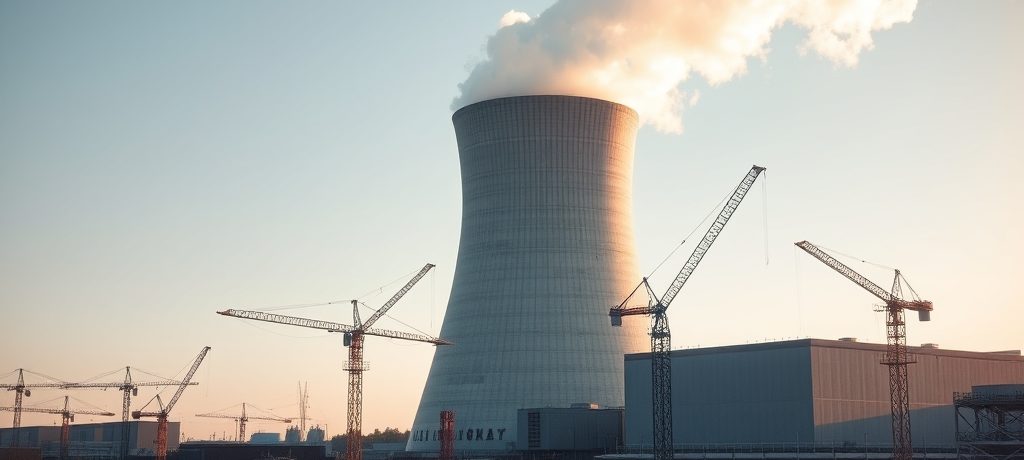
WASHINGTON – The Trump administration has committed $17.5 billion in federal financing to expedite the construction of 10 new large nuclear reactors, a strategic move aimed at addressing the rapidly escalating power demands from massive data centers across the United States. Energy Secretary Chris Wright confirmed the initiative, highlighting significant interest from data center developers, utilities, and energy companies poised to utilize the generated power.
These new nuclear facilities are projected to commence construction by 2030 and become operational in the mid-2030s. Secretary Wright emphasized the long-term vision, stating, ‘This is the start. We’re going to move with the players that are ready to stand up and move quickly. Once that supply chain is up and running, do we think there will be dozens of these built going forward? I’d be very surprised if there were not.’
Addressing Surging Energy Demand
The impetus for this substantial investment stems directly from the exponential growth in energy consumption by data centers. Government estimates indicate that data centers consumed between 4% and 5% of the nation’s total electricity in 2024, a share that could nearly triple by 2028. Furthermore, analysts predict a potential 20% rise in nationwide electricity use over the next decade, with data centers identified as a primary driver of this increase.
The Energy Department asserts that the federal loans could accelerate the development of these 10 reactors by up to three years and contribute to lowering construction costs. The overarching goal is to have all 10 reactors under construction by 2030, ensuring they begin supplying power in the mid-2030s.
Learning from Past Challenges and Scaling Up
Most of the existing U.S. nuclear power plants were constructed between 1970 and 1990. In recent decades, only two new large reactors have been built from scratch in the United States: Georgia Power Co.’s Plant Vogtle units. These projects faced significant hurdles, completing years behind schedule and billions of dollars over budget.
The 10 new reactors will utilize the same design, Westinghouse’s AP1000, which was employed at Plant Vogtle. Secretary Wright acknowledged the challenges at Vogtle, attributing them to ‘bad planning, supply chain problems and the COVID-19 pandemic.’ However, he affirmed the reactor design as ‘robust and sound.’
Wright articulated a strategy to mitigate past issues by leveraging economies of scale and geographic diversification. ‘By building in volume and at multiple locations, we think we will create and stand up a large supply chain and build a lot of construction expertise,’ he explained. ‘We expect the timing and cost of these plants to well outperform what was done on Vogtle.’
Financial Structure and Risk Assessment
The Department of Energy has received letters of intent from seven utilities and energy companies that have identified potential sites for the new reactors. The agency plans to select five of these, with each site hosting two reactors. The federal financing, totaling up to $17.5 billion, is specifically designated for the purchase of nuclear components with long lead times, rather than serving as general construction loans.
Utilities and Westinghouse are expected to contribute up to $5 billion in equity across the five two-reactor projects. Secretary Wright detailed the federal contribution as up to $3.5 billion in loans per project, designed to pair with the equity investment. He characterized this financial arrangement as ‘very, very low risk to the American taxpayers.’
The department has not yet disclosed the names of the involved utilities or their locations, deeming it premature until the selections are finalized, and has not provided a timeline for these decisions.
Strategic Imperatives and Industry Perspective
President Donald Trump has set an ambitious objective to quadruple domestic nuclear power production within the next 25 years, reinforcing this goal through executive orders aimed at accelerating development. Beyond large-scale reactors, the administration is also actively promoting new nuclear technologies, including small modular nuclear reactors.
Dan Sumner, President and CEO of Westinghouse, underscored the strategic importance of this initiative. He stated that ‘industrialized nuclear power needs to be built at fleet scale, in order for the United States to lead in artificial intelligence, advanced manufacturing and the industries that will define the next century.’
Despite the administration’s enthusiasm, critics continue to voice concerns regarding the high costs and perceived risks associated with building more nuclear reactors, often arguing that other low-carbon energy sources present more viable alternatives.
This significant federal investment signals a renewed commitment to nuclear power as a critical component of the nation’s energy future, particularly in light of the escalating demands from the digital economy. The success of this program hinges on the ability to overcome historical challenges in nuclear plant construction and to effectively scale up a domestic supply chain and expertise, potentially laying the groundwork for a broader nuclear renaissance in the United States.