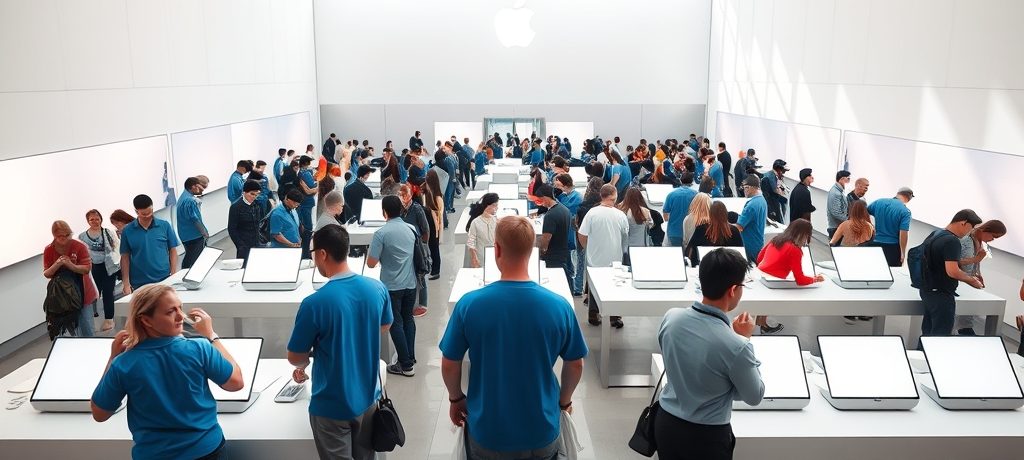
In the spring of 2001, as Apple prepared to launch its ambitious retail strategy, a wave of skepticism swept through the business world. Publications like BusinessWeek, in an article titled “Sorry, Steve: Here’s Why Apple Stores Won’t Work,” joined a chorus of naysayers who predicted the venture’s swift demise. The prevailing sentiment was that Apple, a technology company, was overstepping its bounds by venturing into brick-and-mortar retail, especially at a time when established consumer electronics chains were struggling.
A Skeptical Market Confronts Innovation
The narrative of impending failure was fueled by a palpable trend: the decline of physical retail. Companies like Gateway, which would shutter its stores in 2004, and CompUSA, which followed suit in 2007, served as stark warnings. Retail consultants, such as David Goldstein, were quoted with dire predictions. “I give [Apple] two years before they’re turning out the lights on a very painful and expensive mistake,” Goldstein reportedly stated. This widespread pessimism highlights a recurring pitfall for investors: the tendency to extrapolate current trends into the future without accounting for disruptive innovation.
The author of the original BusinessWeek piece, Cliff Edwards, along with numerous “armchair pontificators,” seemingly overlooked a critical element: the potential for revolutionary products and services to fundamentally alter market dynamics. The article, referenced in a recent excerpt from the book “How NOT to Invest,” serves as a potent reminder of how easily expert opinions can be wrong when faced with true innovation.
The Unforeseen Success of Apple Retail
The reality of Apple’s retail footprint stands in stark contrast to the early predictions. By 2020, Apple had established over 500 stores across 25 countries, transforming itself into a top-tier retailer. The speed at which these stores achieved financial milestones was unprecedented. They became the fastest retailers to reach $1 billion in annual sales. Furthermore, Apple Stores consistently outperformed competitors in terms of sales per square foot.
Data from 2012 indicated that Apple Stores generated more sales per square foot than any other retailer in the U.S. By 2017, this figure had climbed to $5,546 per square foot, more than double that of Tiffany’s, its closest competitor at the time. While Apple no longer breaks down store-specific revenue in its quarterly reports, current estimates suggest monthly store revenues hover around $2.4 billion.
Lessons in Metacognition and Investment
The trajectory of the Apple Store offers a powerful case study in the limitations of forecasting and the importance of metacognition – the awareness of one’s own knowledge and limitations. The original article’s author, who famously predicted the failure of Apple’s retail strategy, serves as an unwitting example of how a lack of awareness regarding the limits of one’s expertise can lead to flawed predictions. Finance, in particular, can foster such overconfidence, encouraging individuals to forecast futures they do not fully understand.
The success of the Apple Store, much like other transformative innovations such as the iPod, iPhone, Tesla Model S, Netflix streaming, Amazon Prime, AI, and even Bitcoin, demonstrates that truly radical products and services defy conventional expectations. Their impact is often difficult to foresee until they have already reshaped the world. The challenge for investors and analysts alike is to recognize the potential for such paradigm shifts, rather than relying on extrapolations of past trends or the pronouncements of those who fail to grasp the essence of genuine innovation. The story of the Apple Store’s predicted failure and subsequent triumph underscores the enduring difficulty of predicting the impact of game-changing technologies and business models.