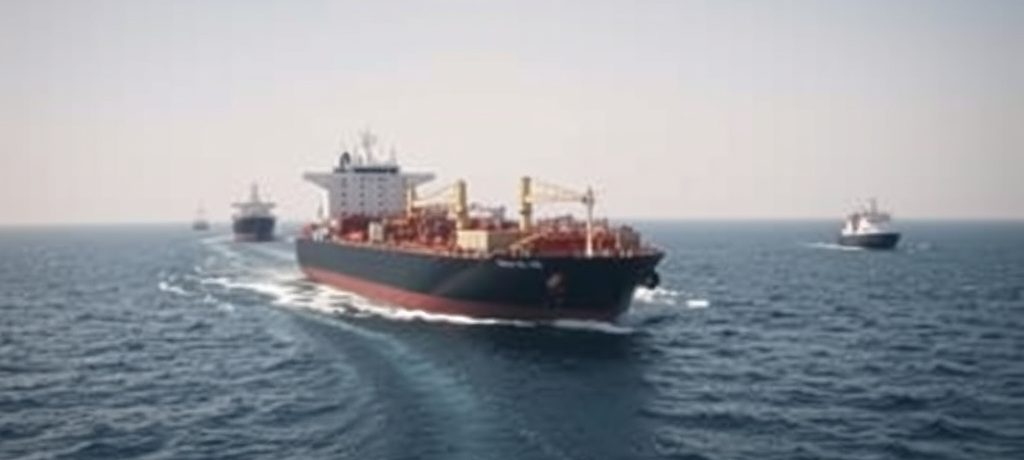
Global benchmark Brent crude has fallen to levels not observed since before the Iran war, driven primarily by the gradual resumption of shipping traffic through the strategically vital Strait of Hormuz. The price movement follows a period of significant volatility in energy markets triggered by geopolitical tensions, with a recent diplomatic breakthrough now easing supply concerns.
Geopolitical De-escalation Drives Market Reversal
On 25 June 2026, Brent crude briefly dipped below $72.48 (£55) a barrel, marking a return to the price point recorded on 28 February, the day prior to the US and Israel launching attacks on Iran. The benchmark subsequently edged up to $73.23. This significant price correction comes after energy costs experienced a ‘wild ride’ following Iran’s response to the initial strikes, which included effectively closing the Strait of Hormuz, a critical waterway for global oil and gas shipments.
A key turning point was the signing of a Memorandum of Understanding (MOU) between the US and Iran on 17 June. This agreement established a 60-day negotiation period aimed at addressing Tehran’s nuclear programme and other measures to conclude the conflict. Further diplomatic progress was made last weekend in Switzerland, where representatives from both sides met for talks that resulted in the US partially lifting sanctions on Iranian oil exports.
Despite the recent price retreat, Pratibha Thaker, regional director of Middle East and Africa at the Economist Intelligence Unit, cautioned against complacency. ‘Markets are still watching the region closely, and any renewed tensions could quickly send oil higher again,’ she stated, highlighting the persistent underlying risks.
Strait of Hormuz Traffic Gradually Resumes
The easing of geopolitical tensions has directly translated into increased maritime activity in the Strait of Hormuz. According to maritime intelligence firm Kpler, the number of vessels transiting the strait has risen ‘significantly’ since the MOU was signed. Kpler’s latest data indicates that 284 vessels made the transit from 18 June, the day after the deal, although this figure remains ‘well below the pre-conflict average of some 138 crossings each day.’ The ships observed in recent days have included those carrying crude oil, liquefied natural gas (LNG), fertiliser, and other goods.
To facilitate safer passage, mediators Qatar and Pakistan announced on Monday that the US and Iran had established a ‘communication line’ to prevent misunderstandings, with the explicit aim of ensuring ‘safe passage for commercial vessels through the Strait of Hormuz.’ Dimitris Maniatis, chief executive of Marisks, a maritime risk advisory firm, confirmed a ‘tremendous shift’ with more ships utilising the strait. He noted that a limited number of ships are now permitted to use a northern passageway with the authorisation of Iranian authorities, while the US Navy has provided guidance for vessels to navigate a southern route, deemed safe from mines and other obstacles laid since the war’s commencement.
However, Maniatis also pointed out that despite the increase, the number of ships crossing the strait is still below pre-war levels, when more than 100 ships used the waterway daily. Hundreds of vessels reportedly remain anchored and waiting in the Gulf, underscoring the ongoing challenges in fully restoring pre-conflict shipping volumes.
Consumer Fuel Prices Face Lagged Adjustment
The fall in crude oil prices has now shifted focus to how quickly these reductions will translate into lower costs at the fuel pump for consumers. Fuel prices saw sharp increases when the Iran war began. In the UK, Simon Williams, head of policy at motoring group the RAC, projected that ‘on the back of the lowest oil price since before the Iran war started, drivers should see the average price of petrol fall below 150p [a litre] in the next week or so.’ He further added that the price of diesel ‘ought to go back under 160p.’ This follows petrol peaking at 159.53p a litre on 28 May and diesel reaching a high of 191.54p on 15 April.
Across the Atlantic, the average price of regular gasoline in the US has dropped to approximately $3.93 a gallon, down from its April peak of $4 a gallon, which was the highest since 2022. Despite this decrease, US pump prices are still ‘well above pre-war levels.’
Accusations of Price Gouging Emerge
The disparity between falling crude prices and slower reductions at the pump has led to accusations of price gouging against major energy companies. US President Donald Trump, on Wednesday, ordered an investigation into firms such including Shell and ExxonMobil. Accusing them of ‘gouging’ drivers, Trump stated in the Oval Office, ‘Oil prices have come down so much and we are not seeing anything at the pump by comparison the way they should be.’
In response, the American Petroleum Institute, representing the US oil and gas industry, countered that fuel prices ‘don’t move in lockstep with crude oil.’ Similar allegations of unfairly hiking petrol prices were directed at British energy firms following the Iran war. However, the UK competition watchdog concluded last month that there was ‘no widespread evidence of this,’ noting that average profit margins remained ‘broadly unchanged’ between February and March.
The return of oil prices to pre-conflict levels, alongside the partial reopening of the Strait of Hormuz, signals a significant de-escalation in a region critical to global energy supply. While diplomatic efforts have yielded tangible results in stabilising shipping routes and reducing immediate price pressures, the underlying geopolitical fragility, as highlighted by analysts, suggests continued vigilance will be necessary to maintain market equilibrium and ensure the sustained flow of vital energy resources.