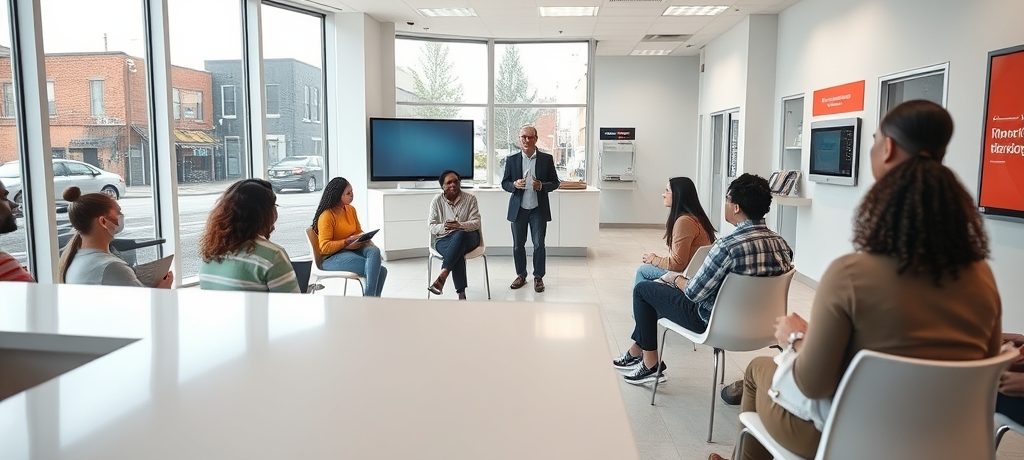
NEW YORK – JPMorgan Chase is set to substantially expand its national ‘Community Center’ program, with the banking giant announcing plans to double the number of these specialized branches operating in low-income neighborhoods. This strategic expansion underscores the bank’s commitment to enhancing financial access and education in underserved communities, a move that will also see the creation of 150 new roles for community managers.
Strategic Expansion and Staffing Boost
The expansion will specifically target low- and moderate-income communities, areas often characterized by a significant population of underbanked or unbanked residents. Beyond merely increasing physical presence, JPMorgan Chase intends to bolster the program by hiring an additional 150 employees, designated as community managers, and by providing a wider array of programming at these locations. Diedra Porché, head of Chase’s community and business development division, articulated the bank’s intent, stating, “We are doubling down on our efforts to expand access.”
The Community Center concept originated as an experiment in Harlem in 2019. Following its initial success, the program grew to encompass 19 locations across the country. The bank’s CEO, Jamie Dimon, has historically demonstrated a personal commitment to the initiative, attending the grand opening of nearly all Community Centers, events often graced by local government officials and other dignitaries.
A Model for Financial Education and Community Engagement
While these locations function as Chase branches, their design and operational philosophy diverge significantly from traditional banking outlets. They feature open areas specifically designated for financial educators, local nonprofit organizations, and other community groups to conduct free financial workshops for neighborhood residents. A core tenet of the program is that the locally-hired community managers are explicitly directed not to sell products, and attendance at workshops does not require individuals to be Chase customers or express interest in the bank’s offerings.
The curriculum of these workshops is broad, focusing on fundamental financial literacy. Topics range from practical skills like building a household budget to more specialized guidance for small business owners. Since the inception of the first Community Center, JPMorgan Chase estimates it has hosted approximately 14,000 workshops, reaching more than 1 million attendees. The bank has now set an ambitious goal to further scale this impact, aiming to increase programming to reach 5 million attendees.
Meeting Regulatory Mandates and Business Objectives
The expansion aligns with regulatory requirements under the Community Reinvestment Act, which mandates banks to provide services to low-income communities. However, JPMorgan Chase’s approach extends beyond mere compliance. CEO Jamie Dimon has previously articulated a belief that the bank can achieve a more profound impact in low-income communities through direct branch presence, job creation, and the provision of financing in underserved areas, rather than relying solely on charitable giving via the JPMorgan Chase Foundation.
Porché further elaborated on this philosophy, noting, “We try to meet people where they are, and then give them the tools and resources they might need to take their next step successfully.” This direct engagement model seeks to empower residents with the knowledge and resources necessary for financial advancement.
Beyond its social impact, the Community Center program also demonstrates a compelling business case for JPMorgan Chase. Despite the non-sales directive for workshop facilitators, the establishment of a Community Center branch in an underserved neighborhood typically correlates with an increase in new account openings and customer acquisition for the bank. Past reports issued by Chase indicate that these community centers often lead to a higher volume of account openings compared to other branches in the same geographical areas, suggesting a synergistic relationship between community investment and business growth.
The expansion represents a significant investment by JPMorgan Chase in both its community outreach and its long-term market strategy. By embedding financial education and support directly into the fabric of low-income neighborhoods, the bank aims to foster greater financial inclusion while simultaneously cultivating new customer relationships in previously underserved markets, reinforcing a model where social responsibility and commercial viability converge.