WINDSOR, Ontario – Canada is poised to inaugurate the Gordie Howe International Bridge this Friday, a significant infrastructure project intended to bolster cross-border trade with the United States. However, the celebratory mood has been tempered by recent economic friction, specifically President Donald Trump’s sudden announcement of 50% tariffs on Canadian goods entering the U.S.
Officials are gathering in Windsor, Ontario, for a ceremony ahead of the bridge’s opening to traffic on Monday. Originally envisioned as a joint celebration on the bridge deck with representatives from both nations, Canada opted against a shared gathering following the tariff imposition. This decision underscores the current strain in the bilateral trade relationship. Windsor Mayor Drew Dilkens expressed the prevailing sentiment, stating, “It’s regretful that we’re at this point in time with our trade relationship. We’re hopeful for better days ahead.”
Economic Implications and Trade Dynamics
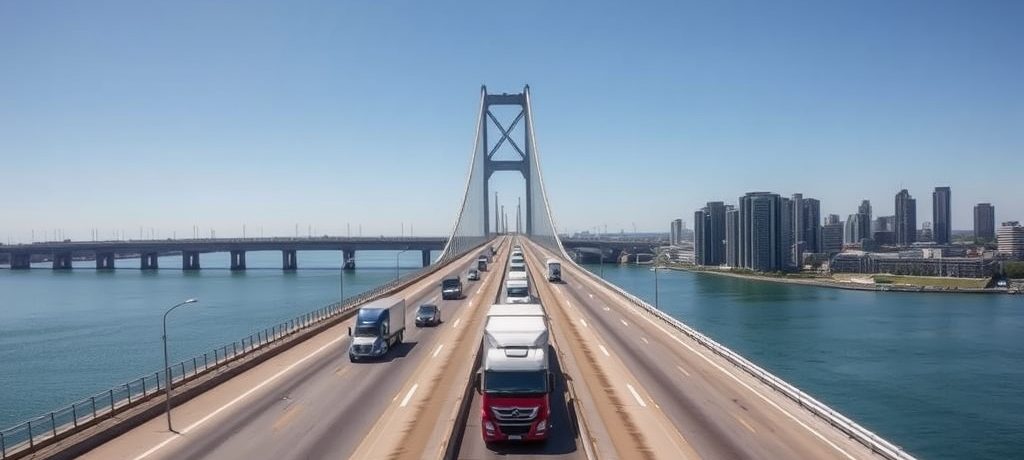
The new six-lane span over the Detroit River is expected to significantly enhance trade flows between the two countries, which share one of the world’s largest bilateral trading relationships. The U.S. Department of Transportation highlights that more than 70% of Canada’s exports are destined for the U.S., making America its largest trade partner. Furthermore, Detroit stands as the No. 1 port for truck traffic along the U.S.-Canada border, emphasizing the critical role this specific crossing plays in North American commerce.
For nearly a century, the privately owned Ambassador Bridge has served as the sole conduit for large commercial trucks traversing the U.S.-Canada border at Detroit. The introduction of the Gordie Howe International Bridge will create immediate and vital competition, offering an alternative route and potentially streamlining logistics for the substantial volume of goods exchanged daily. This new capacity is crucial for improving efficiency and resilience in the supply chain. Detroit Mayor Mary Sheffield underscored its economic importance, asserting, “It will be vital for our economy,” while carefully sidestepping questions regarding its potential to become a “political football” in the often-complex bilateral relationship.
Bridge Specifications and Funding Structure
Named in honor of Gordie Howe, the renowned Canadian hockey player who famously played for the NHL’s Detroit Red Wings until his passing in 2016, the bridge represents a substantial investment in cross-border connectivity. Construction commenced in 2018, experiencing delays partly due to the global slowdown caused by the COVID-19 pandemic, a factor that impacted large-scale infrastructure projects worldwide. The structure itself is an impressive feat of engineering, measuring 1.5 miles (2.4 kilometers) long and reaching a height of 151 feet (46 meters) above the Detroit River at its highest point. Beyond commercial traffic, the bridge will also accommodate pedestrians and bicyclists, who, carrying proper identification, will be permitted to cross for free in a few weeks.
Canada bore the entirety of the estimated $6.4 billion construction cost for the bridge, a testament to its commitment to facilitating trade and strengthening economic ties. A recent agreement outlines that Canada will share a portion of the toll revenue generated by the bridge with the U.S. government for a period of 15 years. The state of Michigan is also slated to receive a share, though this distribution will only commence after Canada has fully recovered its initial construction and operational costs, a process anticipated to take several decades given the scale of the investment.
The inauguration of the Gordie Howe International Bridge thus unfolds against a backdrop of complex economic realities. While it stands as a tangible testament to enduring cross-border infrastructure cooperation and promises substantial economic benefits through enhanced trade capacity and efficiency, its opening is undeniably shadowed by the current strain in U.S.-Canada trade relations, particularly the new tariff regime announced by President Trump. This dual narrative highlights the intricate interplay between economic necessity and political friction in international commerce.