TEHRAN, Iran — While Iran’s strategic control over the Strait of Hormuz continues to disrupt global energy supplies and inflict economic pain worldwide, the Islamic Republic’s own internal economic struggles are profoundly testing its resilience against ongoing conflict and Washington’s demands. Ordinary Iranians are grappling with a severe cost-of-living crisis, marked by spiraling prices for essential goods, widespread job losses, and business closures exacerbated by industrial strikes and a monthslong government-imposed internet shutdown.
Hadi Kahalzadeh, an Iranian economist and research fellow at Brandeis University, described the economic toll of the war and the U.S. naval blockade as ‘very substantial and unprecedented for Iran.’ While Kahalzadeh believes Iran can likely ‘avoid a complete economic collapse or total shortage of essential goods,’ he warns this comes ‘at a very high cost,’ primarily borne by its citizens through ‘higher inflation, more poverty, weaker services and a much harder daily life.’
Macroeconomic Indicators Signal Deepening Crisis
Recent data underscores the severity of the downturn. The International Monetary Fund has projected Iran’s economy to contract by approximately 6 percentage points in the coming year. Iran’s official statistics center reported in mid-April that annual inflation stood at a staggering 53.7%, with food inflation breaching 115% compared to the same period last year. Concurrently, Iran’s rial currency has depreciated sharply, losing over half its value in the past year to reach a record low of 1.9 million to the dollar by the end of last month. These deepening economic woes were a significant factor fueling the massive anti-government protests that swept across the country in January.
Daily Hardship for Ordinary Iranians
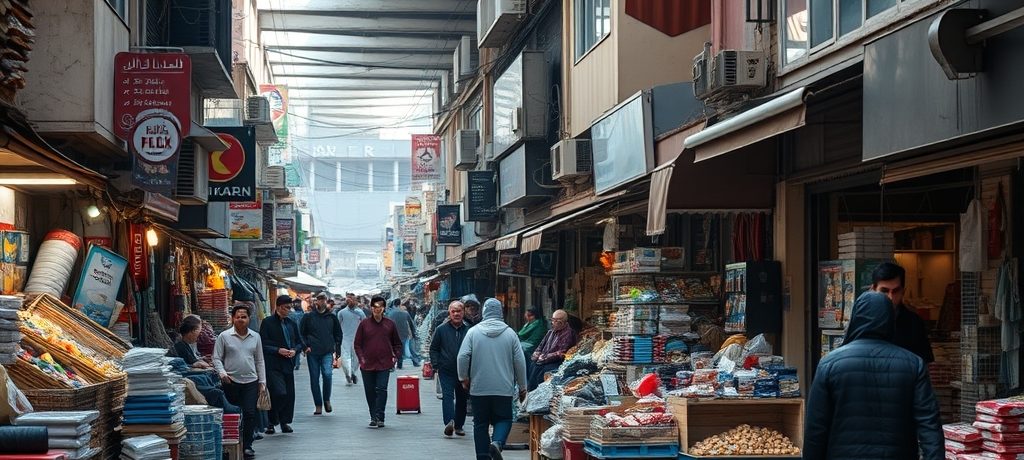
The impact is palpable on the streets of Tehran. Hossein Farmani, a 56-year-old taxi driver, reflected on the dramatic price increases, noting that the price of tea alone had risen over 50% since the war began. ‘If things keep heading in this direction, we’re going to suffer a lot more,’ Farmani stated. An Associated Press survey of Tehran grocery stores revealed significant price jumps since February, prior to the war’s commencement: chicken and lamb were up 45%, rice 31%, and eggs 60%.
Government initiatives aimed at alleviating the burden, such as a 60% hike in the minimum wage and coupon programs for essential goods, are paradoxically contributing to inflationary pressures, according to Taymur Rahmani, an economist at the University of Tehran, writing in the business newspaper Dunya-ye Eqtesad. For taxi drivers like Mohammad Deljoo, 73, who supports a family of two children on a daily income of just $4, even basic necessities are becoming luxuries. ‘We only buy what’s absolutely necessary, things like bread and potatoes. Even eggs have become too expensive for us,’ Deljoo lamented, blaming ‘price gouging’ for the instability. He cited a fivefold increase in the price of tires and other car parts in less than a year, asking, ‘One price today, another tomorrow. How is that possible?’
Job losses are pushing many into precarious work. Ali Asghar Nahardani, 32, resorted to street vending after his ride-hailing app employer failed to pay him for over a month. ‘We’re just living day by day, trying to get through this situation while the war conditions continue,’ he said.
Societal Fallout and Government Appeals
Beyond immediate financial strain, the economic crisis is eroding Iran’s social fabric. Mohammad Farzanegan, a professor of Middle Eastern economics at the University of Marburg, noted that Iran’s middle class had already shrunk to around 55% of the population by 2019, a figure further diminished by new sanctions, conflicts, corruption, and economic mismanagement. A report by the U.N.’s development agency in late March predicted the war would likely push several million more Iranians below the poverty line.
A physical trainer in downtown Tehran, speaking anonymously due to security concerns, described the economic crisis as a ‘mental health crisis’ for society. She reported clients discussing signs of depression and her own severe cutbacks, including not buying meat for two months and foregoing therapy. ‘The system is just collapsing. The layoffs are in factories, in companies, in startups, in whatever your work is,’ she stated.
A Karaj resident, who participated in the January protests and also spoke anonymously, attributed the yearslong decline to ‘severe systemic corruption’ and the Islamic Republic’s costly support for militant groups in Lebanon, Yemen, and Iraq. ‘Most people blame the government and its ambitions,’ he conveyed via WhatsApp.
In response, Iran’s leadership is attempting to rally public support. The new supreme leader, Mojtaba Khamenei, described the current phase as an ‘economic battlefield’ in messages on his official Telegram channel, urging employers to ‘avoid layoffs as much as possible.’ Parliament speaker Mohammad Bagher Qalibaf echoed this sentiment, calling on Iranians to ‘be frugal’ in their spending and emphasizing a collective duty to ease economic effects.
The U.S. blockade continues to restrict Iran’s vital Gulf trade, with Farzanegan estimating that over 90% of Iranian trade, including billions of dollars in oil exports, flows through its southern ports. Despite the immense pressure, some, like taxi driver Farmani, express defiance against external demands. ‘A country that has sacrificed so many martyrs and has so many people willing to give their lives cannot simply let others from across the world dictate terms to us,’ he asserted.
The confluence of soaring inflation, a plummeting currency, and widespread economic hardship presents an unprecedented test for Iran’s ability to maintain internal stability and project external strength amidst ongoing geopolitical tensions and international isolation. The burden of this struggle, as economists and citizens attest, falls disproportionately on the shoulders of ordinary Iranians, whose daily lives are increasingly defined by scarcity and uncertainty.