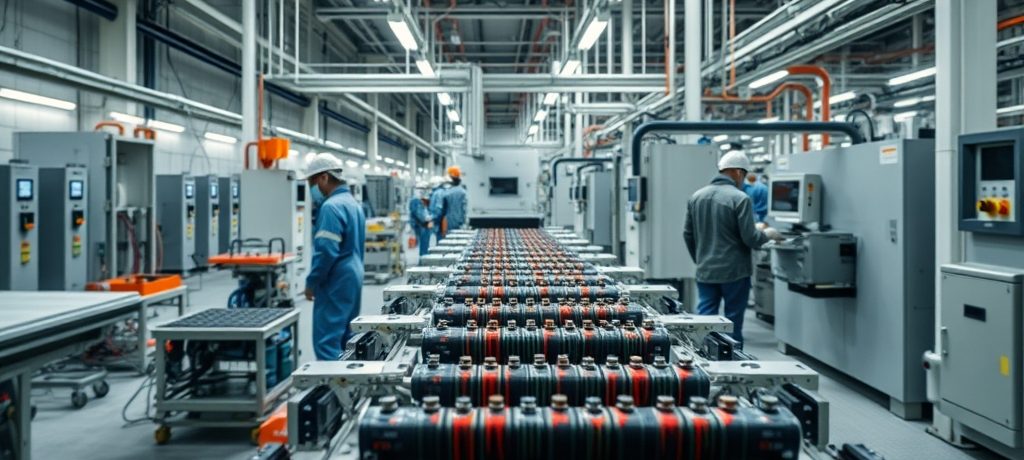
The narrative surrounding batteries has dramatically shifted from consumer electronics and electric vehicles (EVs) to a critical component of national security, particularly within defense applications. This reclassification, driven by heightened geopolitical tensions, is compelling policymakers to prioritize domestic battery output, aiming to bolster industrial resilience across North America and Europe.
According to an August 10, 2026 article by Georgia Williams for Investing News Network, this strategic pivot is creating a new demand driver for battery materials and accelerating investment across the value chain. Cormac O’Laoire, managing director of Electrios Consultants, highlighted this transformation, stating that batteries have been officially classified as “munitions” over the past year. “So batteries are right there next to bullets and missiles. And what does the army need? Munitions. They need a lot of it, but you usually can’t buy off your adversary,” O’Laoire explained to the Investing News Network.
Defense Demands Drive Policy Shift
The strategic importance of batteries for military operations is underscored by the sheer volume required. A 2023 report cited in the source indicates that a US soldier on a 72-hour mission carries 15 to 20 pounds of batteries for equipment such as radios, rifle scopes, night-vision goggles, and GPS. With approximately 1.32 million active duty US members, this theoretically translates to 19.8 million pounds of batteries, excluding those used in drones and other advanced military applications.
This operational necessity has led the US Department of War to introduce programs under the National Defense Authorization Act, explicitly banning the procurement of battery cells or systems from China between now and 2031. This direct prohibition contrasts with the EV industry’s use of broader terms like “foreign entity of concern.”
Significant Investment and Performance Priorities
The policy shift is backed by substantial financial commitments. The Department of War’s Drone Dominance Program, a US$1.1 billion initiative, aims to deploy over 300,000 domestically produced attack drones by 2028, entirely free of Chinese components. O’Laoire characterized this as a much-needed “cash infusion” for the battery sector.
The cost disparity between commercial and defense-grade batteries further illustrates the priority placed on mission success over price. While EV battery packs average around US$120 per kilowatt-hour, comparable aerospace and defense-grade cells can fetch approximately US$11,000 per kilowatt-hour. “Cost is secondary to mission success,” O’Laoire affirmed. Military applications, including drones and unmanned vehicles, predominantly utilize nickel-manganese-cobalt (NMC) chemistry, which offers higher energy density in a lighter package, unlike the lighter, cheaper lithium-iron-phosphate (LFP) cells common in EVs. However, the inherently erratic nature of defense demand means stockpiling batteries is not a viable strategy.
Navigating China’s Supply Chain Dominance
Despite the growing emphasis on domestic manufacturing, Western governments face significant challenges in reducing their reliance on China, which, according to the International Energy Agency and Fastmarkets, dominates global processing capacity for battery materials and cell manufacturing. Building alternative supply chains, particularly in the battery midstream—where raw materials are processed into cathode and anode materials—is a major hurdle.
O’Laoire noted the lack of experience in this segment, making private investment risky. “You’re taking a chance investing in companies that … might have modeled their project wrong … they’ve never done it before,” he explained. Even seasoned Asian manufacturers have struggled to establish processing facilities outside China due to workforce shortages and competitive raw material sourcing.
Graphite: The Unseen Vulnerability
Among critical battery materials, graphite presents a particularly acute vulnerability for defense planners. As the anode material in nearly every lithium-ion battery, China controls roughly 90 percent of global graphite processing, while the US currently operates no natural graphite mines. Washington has responded by launching the National Defense Stockpile, allocating US$2 billion to graphite in 2025, marking it as the first dedicated “critical mineral reserve.” This move is timely, as China’s graphite export curbs, currently paused, are set to expire in late November 2026.
Amy Bennett, principal consultant at Fastmarkets, highlighted during a presentation at the Fastmarkets Global Lithium, Battery & Critical Materials conference that graphite can constitute 30 to 50 percent of a battery’s total weight, yet accounts for only about 7 percent of the cell’s cost, compared to cathodes at 60 percent. This cost dynamic has historically diverted investment away from anode materials. Bennett warned that China’s control of “at least 95 percent of the anode market” poses a severe risk, as a halt in supply could collapse the entire Western supply chain. Mitigating this requires urgent collaboration between government and private investors, potentially through initiatives like Project Vault, despite the weak business case for independent investment at current low prices. O’Laoire believes government procurement policies prioritizing domestic sourcing over cost could create opportunities for emerging North American graphite projects.
While policy support is strengthening, O’Laoire cautioned that long-term success hinges on building commercially viable businesses rather than solely relying on government incentives. He remains optimistic about established lithium-ion chemistries, predicting that LFP and NMC will underpin the market for decades. This evolving policy landscape signals a new phase for battery investments, reinforcing demand across the critical minerals value chain and creating new opportunities for companies involved in mining, processing, and manufacturing as North America and Europe strive to build domestic alternatives to China’s entrenched supply network.