As artificial intelligence tools become increasingly accessible, a growing number of individuals are turning to AI for investment insights. These advanced systems can process vast quantities of data and simplify complex financial topics. However, it is crucial to acknowledge their limitations, including the potential for ‘hallucinations’ and the regurgitation of existing information without rigorous accuracy checks. When leading AI assistants—OpenAI’s ChatGPT, xAI’s Grok, and Gemini from Alphabet’s Google—were queried about cryptocurrency recommendations, they offered remarkably similar responses, echoing common market sentiments.
AI’s Role in Investment Guidance
The utility of AI in financial decision-making is a double-edged sword. While AI can make complex topics more digestible, it primarily processes and reiterates information already available, often without discerning the accuracy of its sources. This means that while AI can serve as a starting point for research, its recommendations should not be taken as definitive investment advice. The source article highlights a significant caution: AI can give confident, yet inaccurate, answers. Investors are advised to treat AI assistants as an initial step in their due diligence, rather than a substitute for comprehensive personal research.
Bitcoin: The Cornerstone of Digital Assets
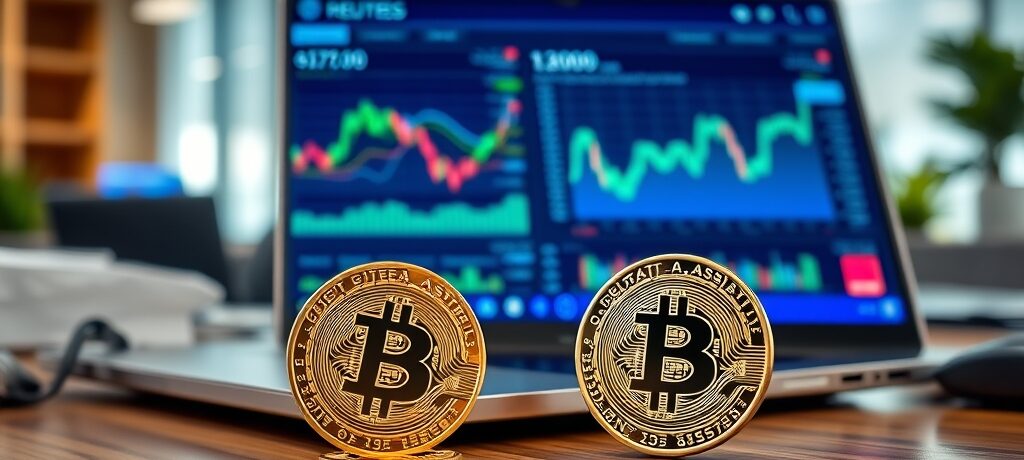
Bitcoin (CRYPTO: BTC) consistently emerged as a primary recommendation from the AI assistants, often alongside Ethereum (CRYPTO: ETH). Together, these two cryptocurrencies account for nearly 70% of the total cryptocurrency market capitalization. Despite the inherent risks in crypto investing, Bitcoin’s established size and reputation position it as a relatively safer asset within the volatile digital market. ChatGPT and Grok, for instance, suggested that Bitcoin and Ethereum should comprise between 50% and 70% of a crypto portfolio. The AI chatbots emphasized Bitcoin’s high level of institutional adoption and its function as a store of value as key long-term strengths. Two of the tools specifically highlighted Bitcoin’s potential as a form of ‘digital gold,’ citing its scarcity—with only 21 million units ever to be mined—and its decentralized nature. While this ‘digital gold’ narrative is prevalent, it warrants close scrutiny, as gold has demonstrably outperformed Bitcoin in the past year, indicating Bitcoin has not yet fully established itself as a hedge against inflation or a safer asset.
Ethereum: Powering Decentralized Finance Innovation
Ethereum (CRYPTO: ETH) was another unanimous recommendation from the AI assistants, primarily due to its pivotal role in decentralized finance (DeFi). Ethereum’s ecosystem currently holds almost 60% of all funds locked in DeFi protocols. It pioneered the introduction of smart contracts, which are foundational code snippets that enable decentralized applications, other cryptocurrencies, stablecoins, and tokenization. Both ChatGPT and Grok underscored Ethereum’s robust developer community, a critical factor for its continued growth and adaptability. Gemini specifically mentioned an upcoming ‘Glamsterdam’ upgrade, which is set to deliver two simultaneous upgrades, Gloas and Amsterdam, later this year. Ethereum’s developers state that these enhancements are part of a broader roadmap aimed at improving the network’s scalability, security, and overall usability, with Gemini noting a specific benefit of reduced gas fees.
Solana: A High-Growth, Higher-Risk Proposition
Each AI assistant identified Solana (CRYPTO: SOL) as a growth-oriented cryptocurrency, acknowledging its higher risk profile compared to Bitcoin and Ethereum. Solana’s appeal stems from its high transaction speeds and low costs, attributes that have attracted a significant DeFi community. Grok and ChatGPT did reference Solana’s past technical difficulties, which impacted confidence in its early stages. However, it is important to note that Solana has not experienced an outage since February 2024, and recent upgrades are designed to bolster its reliability. Despite these improvements, any future technical issues could severely damage investor confidence.
The Transformative Potential of Tokenization
A significant underlying factor mentioned by the AI tools, though not fully elaborated upon, is the potential for Solana and Ethereum to benefit from an explosion in tokenized assets and stablecoins. Tokenization, which involves recording ownership on a blockchain, could profoundly integrate cryptocurrencies into mainstream finance, potentially rivaling the impact of the shift from landlines to mobile phones. Optimistic estimates suggest the value of tokenized assets could surge from approximately $30 billion today to as much as $4 trillion by 2030.
While AI assistants can provide a convenient starting point for exploring investment opportunities, their advice is generalized and lacks the personalized context of a human financial advisor. The source article cautions against sharing sensitive personal and financial information with free AI tools, highlighting privacy risks and the potential for data collection and sharing. Ultimately, investors should approach AI recommendations with skepticism, conducting thorough independent research and considering their individual risk tolerance before making any investment decisions. For instance, the author suggests that cryptocurrency investments should constitute no more than 5% of an investor’s wider portfolio, with the majority allocated to more established projects like Bitcoin and Ethereum to mitigate risk.