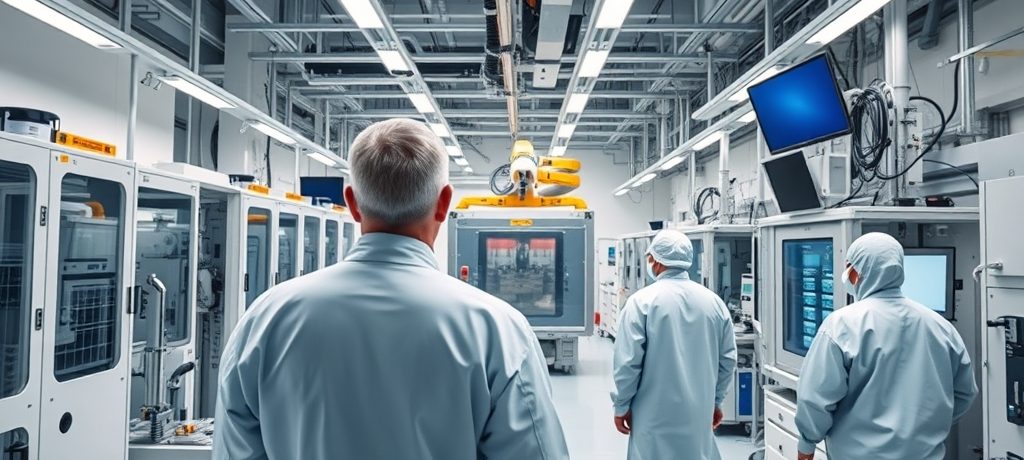
U.S. stock indexes settled mixed on Thursday, with a significant sell-off in chipmakers weighing heavily on the technology-laden Nasdaq 100, which closed down -1.61%. In contrast, the Dow Jones Industrial Average surged +1.14% to hit a new all-time high, and the S&P 500 Index closed unchanged, having earlier posted a 2-week high. The divergent performance underscored a market grappling with sector-specific concerns, particularly around the artificial intelligence (AI) buildout, even as broader economic data offered some support.
Chipmakers Retreat Amid AI Capacity Concerns
The primary drag on the market, especially the Nasdaq 100, came from chipmakers, which experienced a second consecutive day of declines. This retreat was sparked by renewed doubts regarding the sustainability of the AI buildout boom. The sector opened lower following a more than -7% plunge in South Korea’s Kospi Index to a 3-week low, led by significant drops in SK Hynix and Samsung Electronics. Adding to the negative sentiment was carryover from Wednesday, when Meta Platforms announced plans to sell computing power, raising “questions about excess AI capacity,” according to the source.
The iShares Semiconductor ETF (SOXX) fell more than -5% on Thursday. Individual chip stocks saw substantial losses, with SanDisk (SNDK) leading the decline in the S&P 500 and Nasdaq 100, closing down more than -14%. KLA Corp (KLAC) fell over -12%, Marvell Technology (MRVL) dropped more than -11%, and both Lam Research (LRCX) and Seagate Technology Holdings Plc (STX) closed down more than -10%. Other notable declines included Western Digital (WDC) by more than -9%, Applied Materials (AMAT) by more than -8%, ARM Holdings Plc (ARM) by more than -6%, and Micron Technology (MU) and Intel (INTC) by more than -5%. Advanced Micro Devices (AMD), Microchip Technology (MCHP), and ASML Holding NV (ASML) each closed down more than -4%.
Economic Data Bolsters Fed Rate Pause Speculation
Despite the chip sector’s woes, stocks initially opened higher on Thursday, finding support from a series of U.S. economic reports that bolstered speculation the Federal Reserve might delay interest rate hikes. US nonfarm payrolls in June rose by a weaker-than-expected +57,000, falling short of expectations for +113,000. Furthermore, May nonfarm payrolls were revised lower to +129,000 from an originally reported +172,000.
Conversely, the June unemployment rate unexpectedly fell -0.1 to a 1-year low of 4.2%, signaling a stronger labor market than expectations of no change at 4.3%. US January average hourly earnings rose +0.3% month-over-month and +3.5% year-over-year, aligning with expectations. US weekly initial unemployment claims also unexpectedly fell -1,000 to 215,000, indicating a stronger labor market than anticipated. Additionally, the US May factory orders report showed a smaller-than-expected decline of -1.3% month-over-month, against expectations of -2.0%. Factory orders excluding transportation rose +1.9% month-over-month, exceeding expectations of +1.0% and marking the biggest increase in over four years.
Broader Market Dynamics and Sectoral Performance
While chipmakers struggled, other sectors demonstrated resilience. Software stocks, for instance, rose for a second consecutive day. Adobe (ADBE) closed up more than +4% after HSBC upgraded the stock to buy from hold with a price target of $308. Autodesk (ADSK), Intuit (INTU), and Workday (WDAY) all closed up more than +3%, while Palantir Technologies (PLTR) gained over +2% following a DA Davidson upgrade to buy with a price target of $175. Microsoft (MSFT) and Salesforce (CRM) also saw gains of more than +1%.
Mining stocks rallied significantly, driven by a surge in gold and silver prices. Coeur Mining (CDE), Hecla Mining (HL), Anglogold Ashanti (AU), Barrick Mining (B), and Newmont Corp (NEM) all closed up more than +4%, with Freeport McMoran (FCX) gaining +0.71%. Among other notable movers, Genuine Parts (GPC) led S&P 500 gainers, closing up more than +12% on reports of a bid from O’Reilly Automotive. AeroVironment (AVAV) climbed over +10% after securing a US Army contract valued at up to $500 million. Apple (AAPL) led gainers in the Dow Jones Industrials, closing up more than +4% after Nikkei reported the company plans to produce 10 million foldable iPhones this year, an increase from earlier forecasts. Tesla (TSLA), however, closed down more than -7% despite Q2 deliveries beating expectations, failing to impress investors.
Global Outlook and Commodity Movements
Overseas stock markets generally settled higher on Thursday, with the Euro Stoxx 50 rallying to a new record high, closing up +1.24%. China’s Shanghai Composite climbed to a 1-week high, up +0.4%, and Japan’s Nikkei-225 Stock Average closed up +0.59%. In the commodities market, WTI crude oil (CLQ26) fell to a fresh 4.25-month low, influenced by increasing global supplies, including a 30% ramp-up in shipments from the United Arab Emirates in June and surging commercial shipping through the Strait of Hormuz. This decline in crude oil prices also contributed to lower inflation expectations, providing some support to T-notes, with the September 10-year T-note yield falling -0.2 bp to 4.477%.
The mixed market performance on Thursday highlights a complex interplay of factors, where robust economic data and strong Q2 earnings forecasts (Bloomberg Intelligence suggests a 23% increase, with AI infrastructure stocks contributing nearly 60% of S&P 500 EPS growth) are counterbalanced by specific sector vulnerabilities. The ongoing concerns about AI capacity and the resulting retreat in chipmakers underscore a cautious sentiment within a key growth segment, even as the broader market finds support from a potentially less hawkish Federal Reserve and solid corporate earnings outlooks.