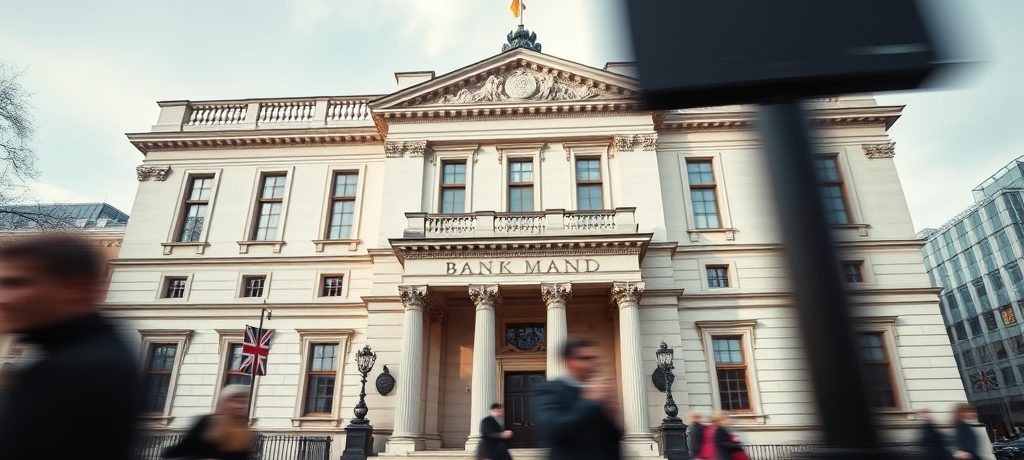
The Bank of England’s Monetary Policy Committee (MPC) is widely anticipated to maintain interest rates at their current level of 3.75% for a fourth consecutive meeting, as policymakers closely monitor geopolitical developments in the Middle East. This decision comes despite UK inflation remaining above target, with recent data suggesting a more tempered rise than initially feared, partly due to a significant peace deal in the region.
MPC Holds Steady Amidst Shifting Global Dynamics
Analysts across the financial sector are in broad agreement that the MPC will opt to hold its benchmark rate at 3.75%, which serves as the primary instrument for controlling inflation. This stability follows a period of heightened concern, particularly after the Bank’s last rate cut in December. While the UK’s inflation rate, reported at 2.8% in the year to May, still exceeds the Bank’s target, it has not escalated to the levels many had projected in the wake of global economic disruptions stemming from the US-Israel war with Iran.
Official figures released on Wednesday provided further reassurance, indicating that the pace of food price rises had slowed to a 17-month low. Although transport costs registered the fastest increase over the year to May, according to the Office for National Statistics (ONS), the rate of price increases for essential items such as meat, dairy, and vegetables eased. This lower-than-expected inflation figure has solidified expectations that the MPC will not need to implement further interest rate hikes at its upcoming announcement scheduled for 12:00 BST on Thursday.
Geopolitical Easing and Energy Market Impact
A crucial factor influencing the MPC’s current stance is the de-escalation of tensions in the Middle East. Earlier this year, at its April meeting, the MPC had signalled the possibility of interest rate increases, citing a “significant energy price shock” resulting from the Iran conflict as a key driver for curbing inflation. However, these fears have been considerably assuaged by the recent announcement of a US-Iran peace deal.
US President Donald Trump confirmed on Wednesday that a peace agreement with Iran had been signed, a development expected to facilitate the reopening of the vital Strait of Hormuz. This waterway is critical, typically handling a fifth of the world’s oil and gas supplies. In response to this news, oil prices have fallen to nearly their lowest levels since the conflict began, as traders anticipate the unimpeded flow of ships through the strait. Analysts now project that this deal could significantly slow the rise in energy and fuel prices, thereby making the most severe inflation scenarios less probable.
Domestic Inflationary Headwinds Persist
Despite the positive shifts in global energy markets, the UK economy still faces domestic inflationary pressures that are expected to accelerate. Analysts highlight the delayed impact of higher wholesale energy prices on household gas and electricity bills. Millions of UK households are subject to regulator Ofgem’s price cap, which is set to increase by 13% in July, directly translating to higher energy costs for consumers.
Victoria Scholar, head of investment for Interactive Investor, articulated this nuanced outlook, stating, “UK inflation is expected to increase over the summer after the next Ofgem price cap in July, when we will likely arrive at peak inflation, so for now [inflation] data looks like the calm before the storm.” This perspective underscores the temporary nature of the current inflation reprieve and points towards a potential resurgence in price rises later in the year.
Global Divergence and Future Uncertainty
The Bank of England’s anticipated hold contrasts with actions taken by other major central banks. Last week, the European Central Bank (ECB) opted to increase its interest rate for the first time in nearly three years, explicitly noting that the conflict was “generating inflation pressures.” This divergence highlights the differing economic conditions and policy responses across regions.
While some analysts are now predicting no further increases in the BoE’s benchmark rate for the remainder of the year, the overall situation is described as “highly uncertain.” The MPC’s decisions will continue to be influenced by evolving geopolitical events, domestic economic data, and the trajectory of energy prices.
Impact on Borrowers and Savers
The Bank of England’s base rate is what it charges other banks and building societies to borrow money, which directly influences the rates at which commercial banks and building societies lend money to their customers, affecting everything from mortgages to personal loans, as well as the interest rates paid on savings. Fluctuations in the base rate therefore have a tangible impact on household finances.
Recent data from the financial information service Moneyfacts illustrates this impact. As of 17 June, the average rate for a new two-year fixed mortgage deal stood at 5.60%, marking an increase from 4.83% at the beginning of March, when the Iran conflict commenced. Similarly, for those seeking a five-year fixed deal, the average rate climbed to 5.57% from 4.95% over the same period. These figures underscore the sensitivity of borrowing costs to global events and the Bank’s monetary policy decisions.
The MPC’s anticipated decision to hold interest rates reflects a careful balancing act, weighing the immediate relief from easing geopolitical tensions and a slightly better-than-expected inflation print against the looming domestic energy price increases. The coming months will reveal whether this period of calm truly precedes a storm or if the global and domestic economic currents will allow for sustained stability.