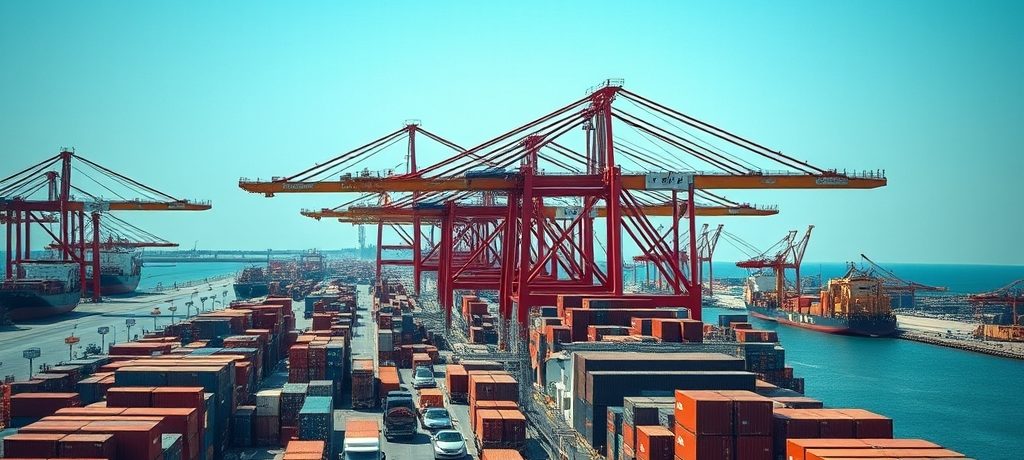
A decade after the UK’s decision to leave the European Union, and four years since its formal departure, the economic consequences predicted by many economists are increasingly evident, though their full manifestation has been gradual. Early hopes for a frictionless new trade era have been tempered by persistent challenges, as highlighted by the experience of Bristol-based firm Eskimo.
Trade in Goods Faces Headwinds
Eskimo, a manufacturer of high-fashion, energy-efficient electric radiators, saw its exports to the EU plummet from 40% in 2020 to just 5% by 2025. Despite a zero-tariff deal, “red tape and paperwork” created delays, costs, and “the expectation of hassle” for customers, according to boss Phil Ward. The company stopped selling directly to European consumers and a planned expansion to Germany “floundered.” This micro-level experience reflects broader trends: the UK Trade Policy Observatory at Sussex University calculated a 26% reduction in the types of UK exports by 2023, while a new study from Aston University Business School found a 53.8% loss of export types and 31.5% for imports over five years. These figures represent falls in the number of products sent to different EU countries.
Official figures show UK exports to the EU in 2025 were 14% down compared to 2019, with imports down 10%. Last year, 2025, marked the worst year for UK goods export volumes to the EU this century, excluding one year during the financial crisis. Think tanks like Niesr calculate exports were 16.9% lower and imports 16.1% less than expected based on positive pre-2016 trends. The Centre for European Reform, using a different method, reported a 16% goods export hit and 14% import hit. While some analysts point to a 4% rise in cash terms for UK goods exports to the EU since 2019, this figure does not account for significant inflationary spikes.
Economists Affirm Longer-Term Damage
The period since Brexit has been marked by significant global flux, including the 2020 pandemic, the 2022 war in Ukraine, and recent energy price shocks. However, the clear consensus of economists making the calculations say they have factored in this global turmoil. Nick Bloom, a British Stanford University professor, states, “Among economists there is not much debate… The experts were right. It was, if anything, worse than we thought, but it’s taken longer to get there.” His work is among dozens of academic papers analysing vast data to assess Brexit’s economic effect. While some of the most negative 2016 predictions, such as a “Great Depression-style hit,” proved unduly pessimistic, the longer-term damage is considered profound.
Services Sector Shows Resilience
One area that has demonstrated stronger performance since 2016 is the services sector, which constitutes over 80% of total UK economic output. Services sector exports from the UK to the EU have risen 57% over the last decade, driven by categories including accountancy, legal services, and consultancy. Non-EU services exports are up 49%, while imports from the EU are up 35% and from outside the EU up 60%. This growth aligns with a broader service boom across the advanced world, and some argue Britain might have performed even better without Brexit. Nevertheless, financial services have remained in healthier shape than the worst projections made during the referendum.
Business Investment Lags Expectations
Investment by businesses has significantly underperformed what might have continued after Brexit, according to two studies. Jonathan Haskel, a former Bank of England independent economist, calculates a £29bn, or 1.3%, reduction in the size of the economy due to lower investment than would have been expected since 2016. Business investment flattened in real terms immediately after 2016, showing a shortfall of 13% against the pre-referendum trend from 1997-2016. The National Institute of Economic and Social Research (NIESR) and the NBER, a top US economic research body, both find UK business investment to be down 12-13% compared to a representative basket of advanced economies. Much of this hit, attributed to uncertainty in the initial years after Brexit, predates the 2022 energy shock. Latest analyses show the UK still behind most of the G7 but having overtaken Germany after the hit to its economy from the 2022 energy crisis.
Sterling’s Volatility and Impact
The most immediate and visible economic shock was the sharp fall in the value of the pound following the referendum. Pre-referendum, sterling had reached new highs against major currencies, but it then traded lower, particularly against the dollar and the euro. Further declines occurred during periods of post-Brexit uncertainty and the 2022 mini-budget. Since then, sterling has broadly strengthened, taking advantage of a weaker dollar, and is currently near the top of its post-Brexit range. An overall weaker pound has increased prices for imported goods, from fresh foods to manufactured products, but it has also offered a cushion for exporters by making their goods cheaper in international markets. In turn, some food prices have been helped a little by lower tariffs on international imports not produced in the UK.
New Trade Deals Offer Modest Boost
A theoretical benefit of Brexit was the UK’s ability to forge its own trade agreements outside the EU. The UK-India deal is cited as an example of breaking new ground. However, the government itself calculates that the trade deals Britain has signed will only “slightly boost economic growth, by fractions of a percentage point over decades.” Even former Prime Minister Tony Blair, a staunch Remainer, recently suggested the UK had benefited from its own AI regulations, potentially complicating any future attempts to rejoin the EU or single market. Conversely, the EU has also signed significant agreements, such as the Mercosur deal, which provides access for EU car exporters.
The economic picture emerging a decade after the Brexit vote is complex, marked by a clear divergence in goods trade and investment from pre-referendum trends, alongside resilience in the services sector. While the most dire short-term predictions did not materialize, the cumulative effect of reduced trade varieties, lower business investment, and persistent non-tariff barriers suggests a significant, albeit gradual, economic reorientation that continues to unfold amidst global economic shifts.