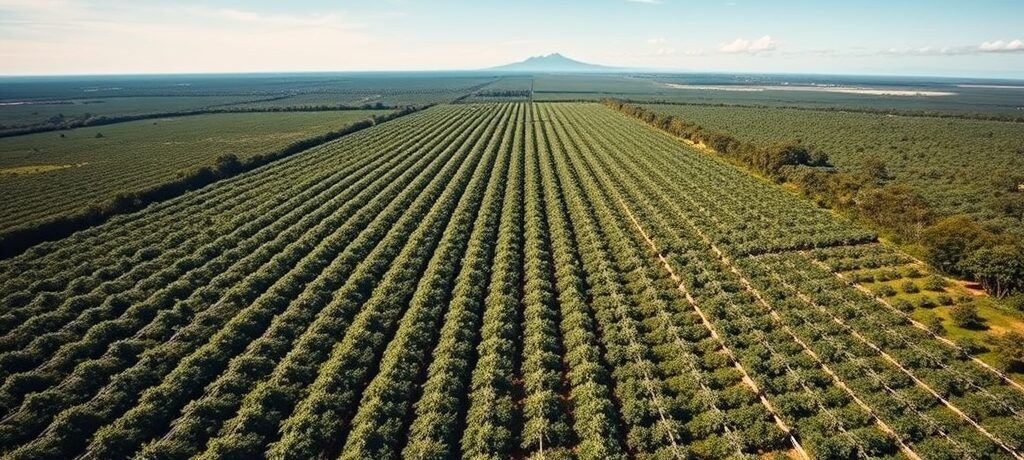
Arabica coffee prices are experiencing significant downward pressure, with May arabica coffee (KCK26) today declining by -1.40 points, or -0.47%, reaching a 1.5-week low. This downturn is primarily driven by mounting expectations for a bumper coffee crop in Brazil, the world’s largest producer. In contrast, May ICE robusta coffee (RMK26) has seen an increase of +37 points, or +1.06%, reflecting a mixed performance across the coffee futures market.
Brazil’s Record Crop Projections Drive Arabica Decline
The outlook for a record Brazilian coffee crop is the dominant factor influencing arabica prices. Recent projections from leading commodity analysts underscore this expectation. Last Thursday, Marex Group Plc forecasted a record 2026/27 Brazil coffee crop of 75.9 million bags, representing a substantial increase of +15.5% year-over-year. This estimate surpasses Sucafina’s forecast of 75.4 million bags.
Earlier this month, StoneX also revised its Brazil 2026/27 coffee production estimate upwards to a record 75.3 million bags, a significant jump from its November estimate of 70.7 million bags. These figures collectively paint a picture of abundant supply emerging from Brazil, which typically exerts bearish pressure on arabica prices.
Further reinforcing this outlook, Brazil’s crop forecasting agency, Conab, reported on February 5 that the nation’s 2026 coffee production is projected to climb by +17.2% year-over-year to a record 66.2 million bags. Within this, arabica production is expected to rise by +23.2% year-over-year to 44.1 million bags, while robusta production is anticipated to increase by +6.3% year-over-year to 22.1 million bags. This comprehensive increase across both varieties contributes to the overall bearish sentiment for arabica.
Countervailing Factors and Regional Nuances
Despite the overarching pressure from Brazil’s crop forecasts, several factors are providing some limitation to arabica’s losses. The strength of the Brazilian real (^USDBRL) is one such element, as the currency rallied to a 3-week high against the dollar today. A stronger real discourages export sales from Brazil’s coffee producers, as it makes their coffee more expensive for international buyers, potentially limiting the immediate influx of supply onto the global market.
Localized weather conditions also present a nuanced picture. Somar Meteorologia reported that Brazil’s largest arabica coffee-growing area, Minas Gerais, received only 11.7 mm of rain last week, amounting to just 47% of the historical average. Such below-normal rainfall in key growing regions can be supportive of coffee prices, even amid broader expectations for a large national crop, by raising concerns about specific regional yields or quality.
Moreover, recent data on Brazil’s coffee exports indicates a temporary slowdown. According to Cecafe, Brazil’s February green coffee exports fell by -27% year-over-year to 2.3 million bags. Concurrently, Brazil’s Trade Ministry reported on March 19 that the nation’s February coffee exports declined by -17.4% year-over-year to 142,000 metric tons. These short-term export reductions could offer some temporary relief to prices, despite the long-term production forecasts.
Robusta’s Divergent Path Amid Supply Tightness
While arabica faces headwinds, the robusta market is moving higher, primarily due to tightness in robusta supplies. ICE robusta inventories today fell to a 3.5-month low of 4,093 lots, signaling constrained availability. This scarcity is providing crucial support for robusta prices, allowing them to buck the downward trend seen in arabica.
However, the global robusta market also presents a complex dynamic, with soaring exports from Vietnam, the world’s largest robusta producer, acting as a bearish factor for robusta prices. Vietnam’s National Statistics Office reported on March 6 that the country’s 2026 coffee exports for January-February rose by 14% year-over-year to 366,000 metric tons. Furthermore, Vietnam’s 2025 coffee exports jumped by +17.5% year-over-year to 1.58 million metric tons, and its 2025/26 coffee production is projected to climb +6% year-over-year to a 4-year high of 1.76 million metric tons (equivalent to 29.4 million bags).
Global Supply Outlook and Market Disruptions
Broader global supply projections also contribute to the market’s current state. Rabobank, on March 4, projected global coffee production to reach a record 180 million bags in the 2026/27 season, an increase of approximately 8 million bags from the previous year. This overall increase in global supply, driven by major producers, reinforces the bearish sentiment for prices.
The USDA’s Foreign Agriculture Service (FAS) bi-annual report on December 18 projected that world coffee production in 2025/26 will increase by +2.0% year-over-year to a record 178.848 million bags. This includes a forecasted -4.7% decrease in arabica production to 95.515 million bags, but a significant +10.9% increase in robusta production to 83.333 million bags. FAS also forecasted that Brazil’s 2025/26 coffee production would decline by -3.1% year-over-year to 63 million bags, while Vietnam’s 2025/26 coffee output would rise by 6.2% year-over-year to a 4-year high of 30.8 million bags. Despite these production figures, FAS forecasts that 2025/26 ending stocks will fall by -5.4% to 20.148 million bags from 21.307 million bags in 2024/25.
Adding to market complexities, the closure of the Strait of Hormuz has disrupted global shipping, leading to tightened global coffee supplies. This waterway closure has resulted in increased global shipping rates, insurance, and fuel costs, consequently raising costs for coffee importers and roasters, which could indirectly support prices by increasing the cost of delivery.
In summary, while the robusta market finds support from tight inventories and shipping disruptions, arabica coffee prices remain firmly under pressure. The overwhelming expectation of a record-breaking coffee harvest in Brazil, as indicated by multiple analytical forecasts, is the primary driver pushing arabica to multi-week lows, despite some mitigating factors like a stronger Brazilian real and localized rainfall deficits.