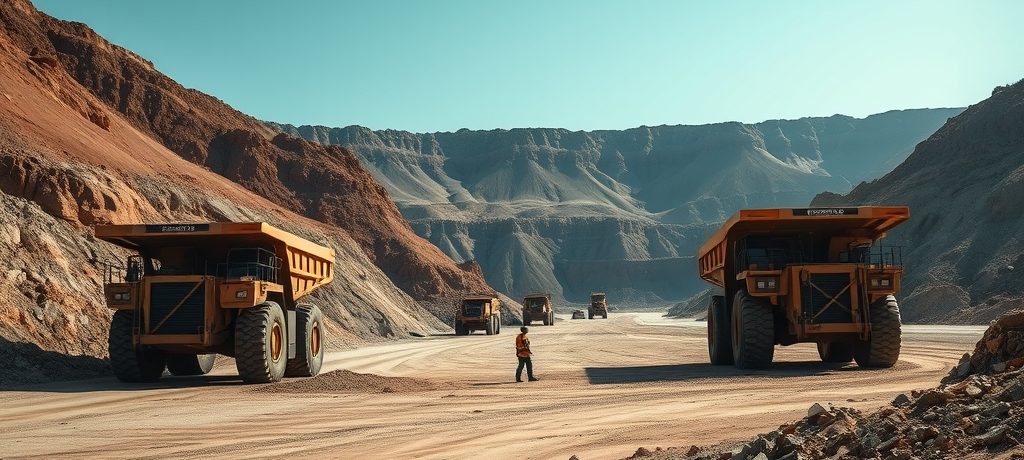
Despite copper futures reaching historic highs, a critical analysis by Mining Visuals reveals a growing vulnerability within the global supply chain: major mining companies are increasingly masking their true operational expenses through reliance on by-product credits and one-off production expansions. This financial divergence, marked by a widening two-dollar spread between the industry’s cheapest and most expensive producers, suggests an underlying fragility in profitability that belies the metal’s record market performance. As copper remains pivotal for grid expansions, AI data centers, and the electric vehicle transition, this deceptive cost structure poses significant long-term risks.
Deceptive Profitability Amidst Record Highs
The current copper rally is undeniable. On May 13, 2026, COMEX futures broke records at US$6.71 per pound, while the London Metal Exchange saw prices peak at US$14,527.50 per metric ton earlier this year. This surge is driven by a massive supply and demand mismatch, recently exacerbated by the closing of the Strait of Hormuz, which triggered a global shortage of sulfuric acid—a critical refining chemical. With the International Energy Agency (IEA) projecting a 30 percent supply shortfall by 2035, copper’s strategic importance is paramount. Yet, a newly compiled cost-curve analysis challenges the perception of robust industry health, indicating that apparent profitability is, in fact, deceptive.
The By-Product Credit Strategy
The core of this deception lies in the strategic use of by-product credits. Southern Copper (NYSE:SCCO) reported the industry’s lowest net cash cost in 2025 at just US$0.58 per pound, a 34 percent drop from its 2019 baseline. However, its underlying operating expenses actually rose to US$2.17 per pound. This low net figure was entirely sustained by massive by-product credits, which expanded by US$0.34 per pound year-over-year, primarily from higher zinc and silver output at its Buenavista concentrator. Similarly, Antofagasta (LSE:ANTO,OTCPL:ANFGF) saw its net cash costs fall 27 percent to US$1.19 per pound, purely because gold prices surged and its molybdenum output jumped 48 percent. These examples highlight reliance on external market factors rather than internal cost containment.
Volume Dilution as a Temporary Tactic
Beyond by-product credits, other major producers have temporarily diluted fixed overheads through sheer production volume. Rio Tinto (ASX:RIO,NYSE:RIO,LSE:RIO) slashed its 2025 net unit costs by 53 percent to US$0.67 per pound—a 27.96 percent drop against its 2019 baseline. This reduction was heavily reliant on a substantial 61 percent production spike at its massive Oyu Tolgoi underground development in Mongolia. BHP (ASX:BHP,NYSE:BHP,LSE:BHP) followed a similar strategy at its Escondida mine, lowering unit cash costs by 18 percent year-over-year to US$1.19 per pound by strategically mining its highest-grade ore bodies in 17 years. While effective in the short term, these tactics do not address fundamental cost structures.
Unmasked Core Costs Reveal Inflationary Pressures
Where these windfalls were absent, cost lines immediately bloated against historical baselines, exposing inflationary pressures. Chilean state giant Codelco watched its C1 cash costs climb to US$2.08 per pound, a significant 46.89 percent increase since 2019. This escalation was attributed to high equipment rental fees, unexpected maintenance, a seismic event at El Teniente, and a stronger Chilean peso. First Quantum Minerals’ (TSX:FM,OTCPL:FQVLF) C1 cost also hit US$2.02 per pound, driven by lower grades at its Sentinel mine, alongside higher employee, maintenance, and contractor costs. At the top of the cost curve, Teck Resources (TSX:TECK.A,TECK.B,NYSE:TECK) averaged US$2.03 per pound across its portfolio, with its newly opened Quebrada Blanca mine operating at a steep US$2.67 per pound. These figures underscore the pervasive challenge of containing core extraction expenses.
Cyclical Risks and Structural Industry Challenges
The reliance on by-product credits introduces significant cyclical risk. Should prices for gold, zinc, or molybdenum pull back, the net cash costs for these ‘insulated’ miners will instantly snap back to their true, higher baselines, eroding apparent profitability. Compounding this vulnerability is the industry’s inability to easily mine its way out of the dilemma. New copper discoveries have become increasingly rare over the last decade, and many major existing mines face steadily depleting high-grade resources. S&P Global reports that global copper supply is expected to peak by 2030 without massive structural expansions. Given that moving a project from initial greenfield discovery to commercial production routinely takes 10 to 20 years, the market is structurally locked into its current infrastructure, limiting rapid responses to demand shifts or cost pressures.
Looking ahead into late 2026, preliminary corporate guidance indicates that local currency appreciation will continue to drive extraction costs higher, suggesting the current floor under copper prices is likely to persist. This structural reality, combined with the deceptive accounting practices highlighted by Mining Visuals, paints a picture of an industry grappling with fundamental cost challenges beneath a veneer of market-driven profitability. Investors and policymakers alike must look beyond headline figures to understand the true, and increasingly vulnerable, cost landscape of global copper production.