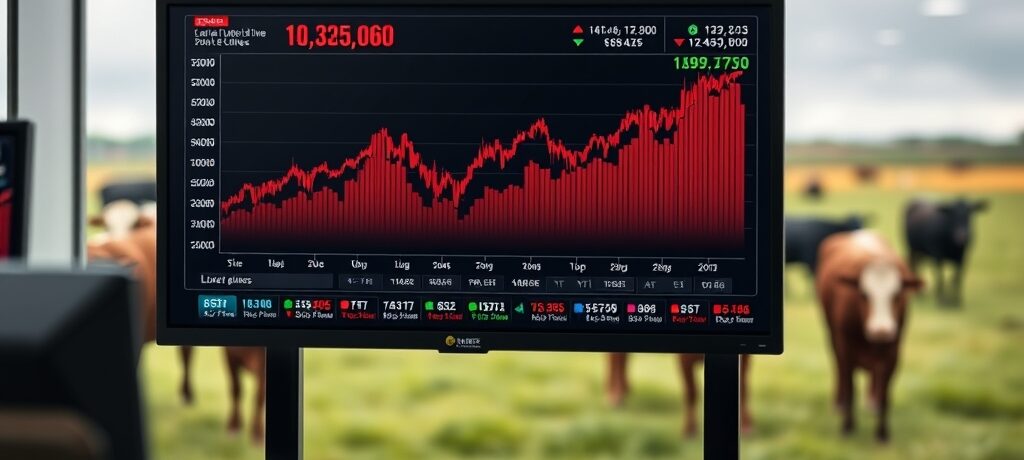
Live cattle futures demonstrated notable strength on Thursday, extending higher at midday despite a complex tapestry of underlying market signals. The gains in futures contracts unfolded as cash trade for the week had yet to firmly establish itself, and wholesale boxed beef prices experienced a decline. This upward movement in futures positions the cattle market with a degree of resilience as it approaches the Good Friday holiday closure.
Futures Market Performance Shows Upward Momentum
The live cattle futures market saw significant advances across key contracts. At midday, live cattle futures were up between 67 cents and $1.05. Specifically, the April 2026 Live Cattle contract climbed $1.050 to settle at $245.100. The June 2026 contract also rose, gaining $0.800 to reach $245.150, while the August 2026 contract increased by $0.675 to $241.350.
Feeder cattle futures mirrored this upward trend, with front-month contracts trading higher by 70 cents to $1.25. The April 2026 Feeder Cattle contract saw an increase of $0.700, reaching $371.450. The May 2026 contract posted a more substantial gain of $1.250, closing at $369.250, and the August 2026 contract was up $1.175 at $368.025. This positive sentiment in feeder cattle futures was further supported by the CME Feeder Cattle Index, which had risen by 89 cents to $366.82 as of March 31.
Cash Trade Stalls, Fed Cattle Exchange Sees No Sales
In contrast to the futures market’s upward trajectory, the cash trade for cattle remained largely dormant through Thursday midday. Bids were reported in the range of $238-242, indicating a cautious approach from buyers and sellers. Further illustrating this hesitancy, the Thursday morning Fed Cattle Exchange, which offered 1,016 head, recorded no sales. Limited bids were observed between $238 and $239.50, suggesting a disconnect between seller expectations and buyer willingness in the spot market.
This lack of definitive cash trade initiation for the week underscores a prevailing wait-and-see attitude among market participants, potentially influenced by the upcoming holiday and broader economic uncertainties. The absence of sales on the exchange, despite offerings, highlights a standoff that could impact price discovery in the immediate term.
Mixed Signals from Beef Exports and Wholesale Prices
The broader beef market presented a mixed picture, with some indicators suggesting robust demand while others pointed to underlying weaknesses. Beef export sales for the week ending March 26 reached 11,886 metric tons (MT), marking a three-week high. This surge in sales suggests a healthy international appetite for U.S. beef. However, shipments in the same week were 13,630 MT, a figure that was down from the previous week, indicating potential logistical or fulfillment challenges.
Adding a layer of complexity, Census data, converted to a carcass basis, revealed that beef exports in February stood at 183.6 million pounds. This figure represents a 10-year low for the month and a 6% decline compared to January’s export volume. Such a significant drop in monthly exports could signal a softening in global demand or increased competition, despite the recent weekly sales uptick.
Domestically, wholesale boxed beef prices reported lower figures on Thursday morning. The Choice/Select spread was noted at $2.75. Choice boxes experienced a decline of $3.99, settling at $390.43, while Select boxes fell by $4.91 to $387.68. These decreases in wholesale prices suggest that despite the strength in futures, downstream demand for beef might be facing headwinds, potentially impacting packer margins and, eventually, live cattle prices.
Slaughter Rates and Market Outlook
USDA’s estimated federally inspected cattle slaughter for Wednesday was reported at 107,000 head. The weekly total reached 324,000 head, an increase of 9,000 head from the previous week. However, this weekly total remains significantly below the same week last year, by 45,169 head. The year-over-year reduction in slaughter rates could be interpreted as a tightening of supply, which typically supports higher prices, aligning with the upward movement seen in futures.
As the markets prepare for the Good Friday closure, with Thursday being the last trading day of the week, the cattle complex presents a nuanced scenario. The robust performance of live and feeder cattle futures indicates strong speculative interest and perhaps an anticipation of future demand or tighter supplies. Yet, the stalled cash trade, declining wholesale beef prices, and a 10-year low in February beef exports introduce elements of caution. Market participants will be closely monitoring the resumption of cash trade and the evolution of demand indicators following the holiday weekend to gauge the sustainability of Thursday’s futures rally.