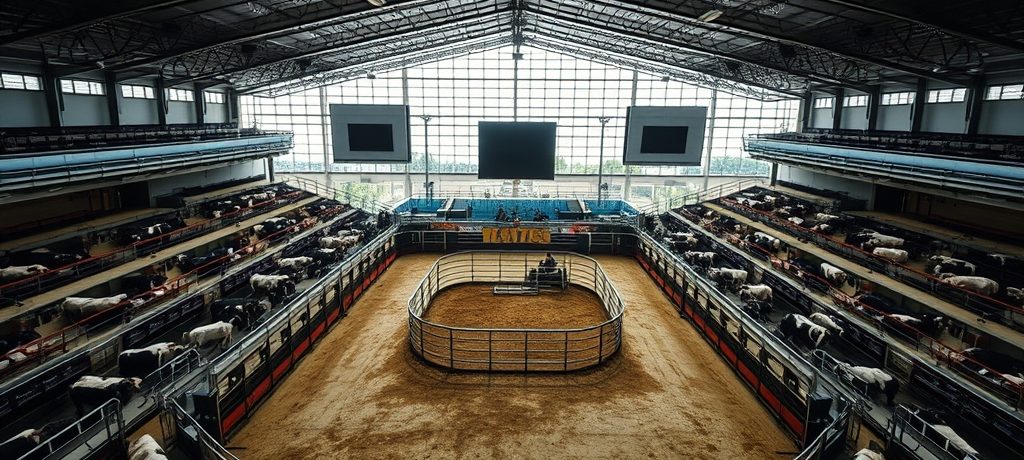
The cattle market concluded the trading week on Friday, July 19, 2026, with a pronounced downturn across live cattle and feeder cattle futures, alongside weaker cash trade and declining wholesale beef prices. This comprehensive slide underscores a challenging period for the sector, as investor confidence waned, leading to significant position adjustments. The August live cattle contract, a key benchmark, registered a substantial weekly loss of $10.77, signaling a broader bearish sentiment that permeated the entire complex.
Live Cattle Futures Experience Broad Declines
Live cattle futures contracts posted widespread losses on Friday, ranging from 97 cents to $2.67 across most active contracts. The August 2026 Live Cattle contract closed at $224.425, down $2.650 for the day, contributing to its notable weekly decline. Similarly, the October 2026 Live Cattle contract settled at $220.700, down $2.575, while the December 2026 Live Cattle contract saw a $2.675 reduction, closing at $220.525. These daily losses compounded a challenging week, with the August contract’s $10.77 drop highlighting the severity of the market’s retreat.
Cash Trade Reflects Market Weakness
The cash cattle market mirrored the futures’ downward trajectory, settling at lower price points across key regions. Northern cash trade concluded the week in the range of $238 to $240. In the Southern markets, prices were marginally lower, with trade settling between $237 and $238. This consistent weakness in cash prices across both major trading zones further validated the bearish sentiment observed in the futures arena, indicating a lack of robust demand at higher price levels.
Feeder Cattle Futures Also Retreat
Feeder cattle futures contracts did not escape the market’s negative momentum, recording losses between 65 cents and $2.20 on Friday. The August 2026 Feeder Cattle contract closed at $345.950, down $0.650 for the day, extending its weekly decline to $8.65. Other feeder cattle contracts also saw reductions, with the September 2026 contract closing at $339.350, down $1.000, and the October 2026 contract settling at $332.825, a decrease of $1.625. The CME Feeder Cattle Index, a crucial indicator for the sector, further underscored the weakness, falling another $1.49 on July 16 to $364.03, reflecting the broader pressure on feeder cattle prices.
Investor Sentiment Shifts: Managed Money Reduces Long Positions
A significant factor contributing to the market’s slide was the notable reduction in net long positions by managed money and speculative funds, as detailed in the Friday Commitment of Traders report. Managed money entities cut back a substantial 16,997 contracts from their net long in live cattle futures and options, bringing their total to 96,324 contracts as of Tuesday. This aggressive trimming of long positions suggests a decrease in bullish conviction among institutional investors. Similarly, in feeder cattle futures and options, spec funds were active in slashing their net long positions, reducing them by 3,810 contracts to 9,880 contracts as of July 14. These movements indicate a strategic withdrawal from bullish bets, adding downward pressure to prices.
Wholesale Boxed Beef Prices Decline Amidst Reduced Slaughter
The downstream segment of the beef supply chain also experienced a downturn, with wholesale boxed beef prices quoted lower in the Friday PM report. Choice boxes saw a reduction of $1.57, settling at $366.81, while Select boxes were down 40 cents to $355.29. This decline in wholesale prices suggests a softening in demand or an increase in available supply relative to demand at the wholesale level. Concurrently, USDA data revealed a decrease in federally inspected cattle slaughter for the week, totaling 525,000 head through Saturday. This figure represents a decrease of 4,000 head from the previous week and a more significant reduction of 42,470 head compared to the same week last year. While lower slaughter numbers might typically support prices, the simultaneous decline in wholesale beef prices indicates that other market forces, such as overall demand weakness or ample existing inventories, are currently exerting greater influence.
The cumulative data from futures, cash markets, investor positioning, and wholesale prices paints a clear picture of a cattle market under considerable pressure as it headed into the weekend. The consistent declines across various segments, from live and feeder cattle contracts to the physical cash trade and boxed beef, suggest a broad-based recalibration of expectations. As market participants look ahead, the interplay of supply, demand, and investor sentiment will continue to shape the trajectory of cattle prices in the coming weeks, with the current trend indicating a prevailing bearish outlook.