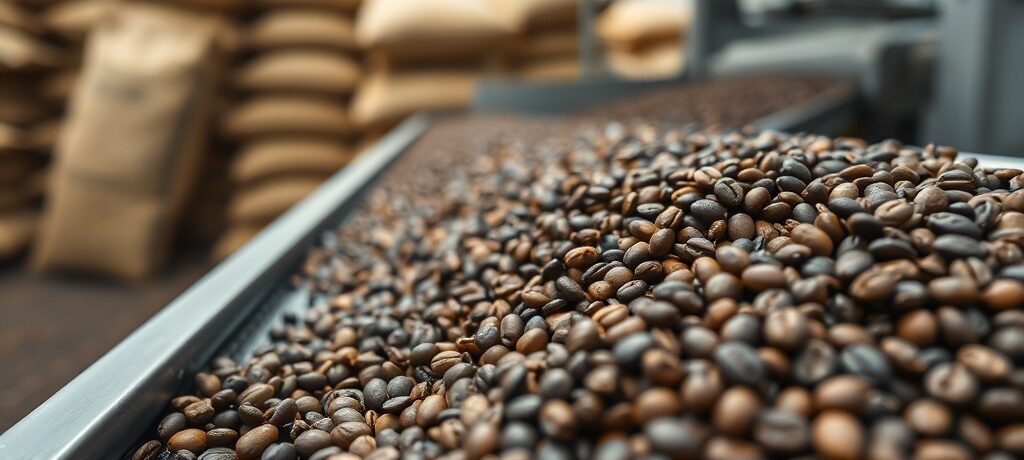
Coffee prices are experiencing a significant downturn today, with both arabica and robusta varieties plunging amidst expectations of a substantial increase in global supplies. May arabica coffee futures (KCK26) registered a sharp decline of -11.80 points, or -3.96%, while May ICE robusta coffee futures (RMK26) fell by -115 points, a -3.34% drop. This sell-off has pushed arabica to a 3-week low and robusta to an 8-month nearest-futures low, extending a retreat observed over the past two weeks.
Brazil’s Bumper Harvest Fuels Global Glut
The primary catalyst for the current price erosion appears to be the robust outlook for Brazil’s upcoming coffee harvest, signaling a significant expansion in global supply. Recent projections from leading agricultural analysts point to a record-setting crop for the 2026/27 season. On March 19, Marex Group Plc forecasted Brazil’s 2026/27 coffee crop at an unprecedented 75.9 million bags, representing a substantial 15.5% year-over-year increase. This figure surpasses even Sucafina’s forecast of 75.4 million bags. Further reinforcing this bullish supply narrative, StoneX, on March 12, raised its Brazil 2026/27 coffee production estimate to a record 75.3 million bags, a considerable increase from its November estimate of 70.7 million bags.
These projections contribute to a broader expectation of a burgeoning global coffee surplus. StoneX notably projected that the 2026 global coffee surplus would expand dramatically to 10 million bags, up from 1.8 million bags in 2025, marking the largest surplus seen in six years. Earlier in the year, on February 5, Brazil’s crop forecasting agency Conab had also indicated a significant rise, stating that Brazil’s 2026 coffee production will climb by 17.2% year-over-year to a record 66.2 million bags. This included a 23.2% increase in arabica production to 44.1 million bags and a 6.3% rise in robusta production to 22.1 million bags. Adding to this outlook, Rabobank, on March 4, projected global coffee production to reach a record 180 million bags in the 2026/27 season, an increase of approximately 8 million bags from the previous year.
Vietnam’s Export Surge Adds Pressure
Beyond Brazil, soaring coffee exports from Vietnam, the world’s largest robusta producer, are exerting additional bearish pressure on robusta prices. Data released by Vietnam’s National Statistics Office last Friday revealed that the country’s coffee exports for the first quarter of 2026 (January-March) surged by 14% year-over-year to 585,000 metric tons (MT). This follows a strong performance in 2025, where Vietnam’s coffee exports jumped by 17.5% year-over-year to 1.58 million MT.
Looking ahead, Vietnam’s 2025/26 coffee production is projected to climb by 6% year-over-year, reaching a 4-year high of 1.76 million MT, equivalent to 29.4 million bags. The USDA’s Foreign Agriculture Service (FAS) bi-annual report, published on December 18, also forecasted Vietnam’s 2025/26 coffee output to rise by 6.2% year-over-year to a 4-year high of 30.8 million bags, further solidifying expectations of ample robusta supply. The FAS report also projected world coffee production in 2025/26 to increase by 2.0% year-over-year to a record 178.848 million bags, with robusta production specifically seeing a 10.9% increase to 83.333 million bags.
Inventory Dynamics and Mixed Signals
While the overarching narrative is one of increasing supply, the market has also seen some mixed signals from inventory levels and other factors. ICE-monitored arabica inventories, for instance, rose to a 6.25-month high of 585,621 bags on March 18, contributing to the downward pressure on arabica prices. Conversely, ICE robusta inventories fell to a 3.75-month low of 4,051 lots today, a factor that could theoretically offer some support for robusta prices, though it appears to be currently outweighed by the broader supply outlook.
Other factors that have provided intermittent support to coffee prices include disruptions to global shipping. The closure of the Strait of Hormuz has reportedly tightened global coffee supplies by increasing shipping rates, insurance, and fuel costs, thereby raising costs for coffee importers and roasters. Below-normal rainfall in Brazil’s largest arabica coffee-growing area, Minas Gerais, also presented a supportive element, with Somar Meteorologia reporting last Monday that the region received only 11.7 mm of rain last week, or 47% of the historical average.
Furthermore, recent export data from Brazil showed some declines. According to Cecafe, Brazil’s February green coffee exports fell by 27% year-over-year to 2.3 million bags. The Brazilian Trade Ministry also reported on March 19 that Brazil’s February coffee exports decreased by 17.4% year-over-year to 142,000 MT. However, these short-term export dips appear to be overshadowed by the overwhelming long-term production forecasts. The International Coffee Organization (ICO), on November 7, reported that global coffee exports for the current marketing year (October-September) fell by 0.3% year-over-year to 138.658 million bags, another data point suggesting a potential tightening, but again, not enough to counter the dominant supply expansion narrative.
Despite these minor supportive factors and short-term export fluctuations, the dominant force in the coffee market remains the expectation of abundant global supplies, particularly from Brazil and Vietnam. The consistent upward revisions in crop forecasts and projections for a significant global surplus are driving the current bearish sentiment, pushing futures prices for both arabica and robusta to multi-week and multi-month lows. As the market digests these supply-side developments, the trajectory for coffee prices appears to be firmly set by the prospect of a well-supplied global market in the coming seasons.