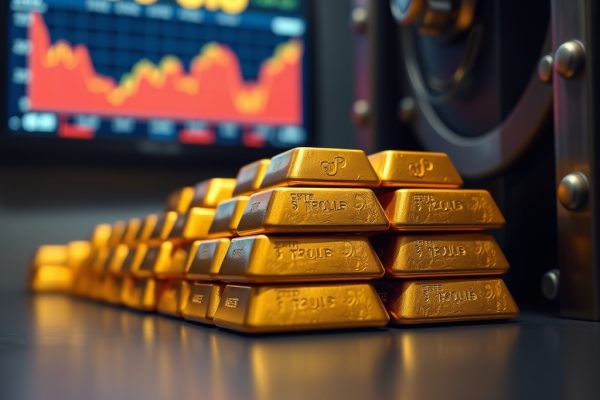
Gold prices experienced a notable rebound on Thursday, breaking a three-day losing streak to settle above the critical $4,100 an ounce threshold. The precious metal’s ascent was primarily fueled by renewed geopolitical tensions in the Middle East, following a second consecutive day of U.S. military strikes against Iranian targets, alongside a dip in the U.S. dollar from its recent highs.
Gold’s Performance Amidst Market Volatility
Spot gold registered a 0.7 percent increase, reaching $4,105.77 an ounce. Concurrently, U.S. gold futures also saw a significant uptick, rising 0.9 percent to trade at $4,117.20. This upward movement marks a reversal for gold, which had been under pressure for the preceding three trading sessions. The precious metal often serves as a safe-haven asset during periods of economic uncertainty or geopolitical instability, attracting investors seeking to mitigate risk.
The dollar’s retreat from its recent peak provided additional tailwinds for gold. A weaker dollar typically makes dollar-denominated commodities, including gold, more attractive to holders of other currencies. Treasury yields, however, remained steady. This stability in yields followed the release of the FOMC minutes from the June 16-17 meeting, which, according to the source, reinforced the central bank’s cautious stance on monetary policy.
Escalating Geopolitical Tensions in the Middle East
The primary catalyst for gold’s rally appears to be the intensifying military confrontation between the United States and Iran. U.S. airstrikes have targeted approximately 90 locations across Iran over the past two days, in response to Tehran’s alleged targeting of Gulf states. The U.S. Central Command (CENTCOM) confirmed these additional strikes were launched with the explicit aim to ‘further degrade their ability to threaten freedom of navigation in the Strait of Hormuz.’
In an earlier statement, CENTCOM also disclosed that more than 20 U.S. Navy warships are currently patrolling waters across the Middle East, underscoring the heightened military presence in the region. The Strait of Hormuz is a vital chokepoint for global oil shipments, and any disruption there has significant implications for international trade and energy markets.
President Trump’s Stance on the Conflict
Despite the escalating military actions, President Donald Trump expressed confidence that any renewed fighting with Iran would be short-lived. In a social media post, he asserted that the U.S. is not seeking a protracted conflict. Trump stated, ‘I don’t think it’s going to start again. If they hit, we hit ten times harder. Anything that happens will get over very quickly and we’ll make things safer, even for oil.’
These remarks, while aiming to reassure, highlight the volatile nature of the situation and the potential for rapid escalation. The market’s reaction, particularly in gold and oil prices, reflects a cautious assessment of the President’s optimistic outlook, with investors prioritizing the immediate implications of military engagement.
Impact on Oil Markets and Global Growth Forecasts
The broader market implications of the Middle East hostilities extended to oil prices. While oil prices were slightly lower on Thursday, this followed a substantial surge of nearly 8 percent in the previous trading session, directly attributable to the escalating tensions. The volatility in oil markets underscores the region’s critical role in global energy supply and the sensitivity of prices to geopolitical events.
Beyond immediate market reactions, concerns about global economic growth have also resurfaced. The International Monetary Fund (IMF) recently revised its 2026 global growth forecast downward, cutting it to 3.0 percent from its April forecast of 3.1 percent. This adjustment, according to the IMF, reflects the anticipated effects of the ongoing war in the Middle East, suggesting a broader economic impact beyond commodity markets.
The interplay of geopolitical risk, central bank caution, and shifting currency valuations continues to shape investor sentiment. Gold’s ability to rebound above $4,100 an ounce, despite the President’s assurances of a swift resolution, indicates that market participants remain highly sensitive to the unfolding situation in the Middle East and its potential ramifications for global stability and economic performance.