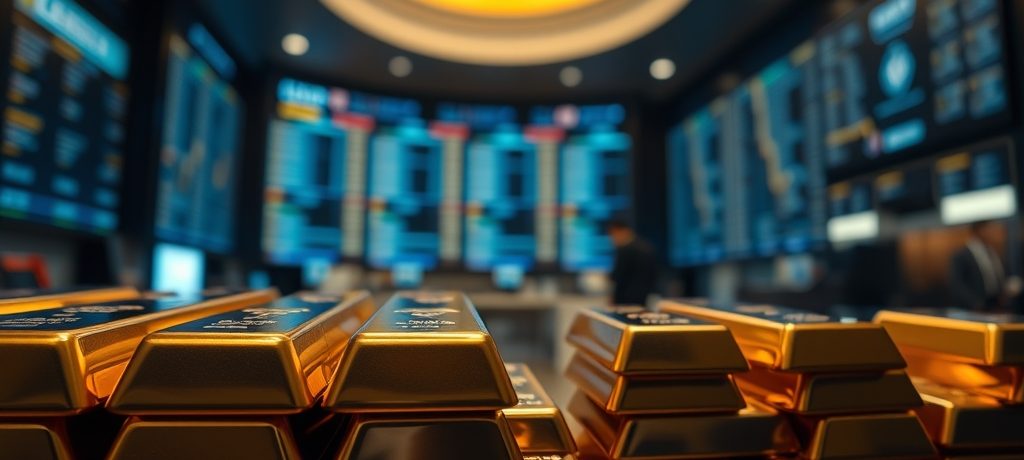
The price of gold, having surged from $1,585 per ounce in 2020 to over $4,500 per ounce currently, is poised for further record highs, with some analysts forecasting a potential doubling within the next decade. This upward trajectory is fueled by a confluence of factors, including investors’ flight to safety amidst global turbulence and strategic accumulation by central banks, though experts diverge on the magnitude and timeline of future gains.
Drivers Behind Gold’s Ascent
The recent rally in gold prices can be attributed to several key drivers. Frank Schallenberger of Landesbank Baden-Württemberg (LBBW) points to ‘expectations of interest rate cuts and a weaker US dollar, strong purchases by central banks, as well as high demand for coins and bars’ as primary catalysts. Thomas Kulp, a research analyst at DZ BANK, further emphasizes the role of ‘geopolitical uncertainty’ as the ‘main driver of the gold price rally in recent years,’ highlighting gold’s dual appeal as a ‘safe-haven’ and a ‘guarantee of independence.’
In an environment where central bank interest rates remain relatively low, traditional investments offer less promising returns. This scenario compels investors to seek alternative avenues for wealth preservation, with precious metals emerging as a favored option. This increased demand naturally exerts upward pressure on prices.
Central Banks and New Market Dynamics
A significant factor underpinning gold’s strength is the sustained buying activity by central banks globally. Economists at Deutsche Bank, in a study published on April 27, observed that nations like China, Russia, India, and Turkey, alongside central banks in emerging markets, are consistently expanding their gold reserves. Michael Hsueh, a precious metals analyst at Deutsche Bank Research and co-author of the study, identifies these as ‘inelastic’ buyers – stable, less price-sensitive entities that have ‘pushed out more price-sensitive “elastic” customers, including private buyers such as jewelry purchasers.’ This steady demand, Hsueh notes, has been a ‘key factor behind gold’s strength between 2021 and 2025.’
Adding a new dimension to demand is the emergence of cryptocurrencies. Schallenberger observes that these digital asset holders are increasingly diversifying their portfolios by ‘buying gold,’ suggesting that ‘If this continues, it could provide further momentum for gold prices.’
The Enduring Appeal of a ‘Safe Haven’
Gold has long been revered as a reliable store of value, particularly during uncertain times. Thomas Kulp of DZ Bank firmly asserts that ‘Gold is and remains the ultimate safe haven. In uncertain periods or times of crisis, the precious metal is usually in demand.’ However, he cautions that its price can be subject to ‘sometimes significant fluctuations,’ a consideration investors should always bear in mind.
Frank Schallenberger offers a more nuanced perspective, warning that gold’s safe-haven reputation is ‘sometimes exaggerated.’ While he argues against holding ‘large amounts of gold,’ he acknowledges its utility as a hedge, suggesting that ‘A share of five or 10% gold in a portfolio is certainly not a bad idea because it can reduce a portfolio’s volatility.’
Conversely, Michael Hsueh of Deutsche Bank Research advocates for holding gold ‘on a large scale as a store of value.’ He cites ‘diversification, protection against geopolitical risks and a hedge against inflation’ as the primary motivations for reserve managers at central banks to incorporate gold into their portfolios.
Divergent Forecasts for Gold’s Future
Forecasting economic developments inherently involves uncertainty, and expert opinions on gold’s future trajectory are no exception. Deutsche Bank Research’s study projects that gold could reach $8,000 per ounce by 2031, effectively doubling its current price. Hsueh defends this outlook, linking it to the continued accumulation by emerging market central banks as part of what he terms the ‘return of history’ – a period characterized by escalating geopolitical tensions reminiscent of the Cold War era. He posits that these uncertain times could lead central banks to increase gold’s share of their reserves back to the lower end of the pre-1990 range, around 40%. ‘Assuming emerging market foreign exchange reserves decline from $8 trillion to $5 trillion, this could correspond to a nominal gold price of $8,000 per ounce,’ Hsueh explains.
However, not all experts share this aggressive forecast. Frank Schallenberger expresses skepticism, stating, ‘At current price levels, I don’t see sufficiently strong drivers that would allow gold prices to double over the next five years.’ He notes a recent loss of momentum in buying by gold ETFs and central banks, which had previously supported the rally.
Thomas Kulp of DZ Bank adopts a more cautious yet optimistic stance. While acknowledging that such forecasts are ‘not surprising’ given recent developments, he anticipates gold prices will ‘return to the $5,000-per-ounce level’ over the next 12 months. Kulp maintains a ‘positive long-term outlook for gold prices,’ affirming that the ‘fundamental drivers of demand remain intact.’
The debate among financial experts underscores the complex interplay of geopolitical events, monetary policy, and investor behavior in shaping gold’s market value. While the precious metal’s role as a hedge against uncertainty appears solidified, the precise path and pace of its ascent remain subjects of ongoing analysis and differing professional opinions.