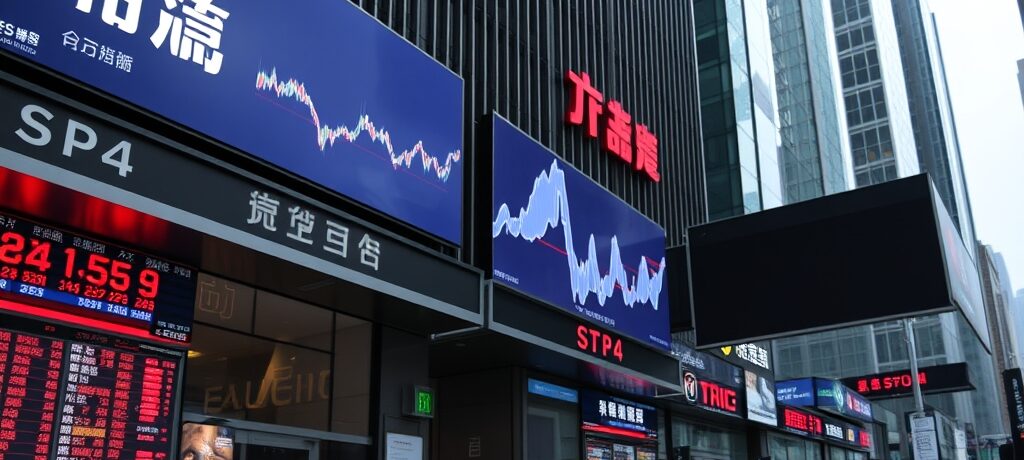
Hong Kong’s Hang Seng Index, which recently demonstrated resilience by finishing higher in two of the last three trading days, now confronts a challenging global outlook that threatens to unwind its recent advances. Following a robust performance on Monday, the index, currently resting just beneath the 26,100-point plateau, is anticipated to be stuck in neutral on Tuesday, according to market forecasts.
The Hang Seng’s recent trajectory saw it recover from a two-day slide where it had slumped almost 300 points, or 1.2 percent. Monday’s trading session marked a significant rebound, with the index rallying 319.35 points, or 1.24 percent, to close at 26,095.88. This upward movement occurred within a trading range of 26,091.86 and 26,326.44 points, driven primarily by strong performances in financial shares, property stocks, and technology companies.
Monday’s Key Performers and Laggards
A detailed look at Monday’s active stocks reveals a mixed but generally positive picture for the Hang Seng. Technology giants and financial institutions were notable contributors to the day’s gains:
- Xiaomi Corporation skyrocketed 6.75 percent.
- Alibaba Group surged 4.52 percent.
- Baidu soared 3.45 percent.
- HSBC spiked 2.28 percent.
- Sun Hung Kai Properties accelerated 1.84 percent.
- Semiconductor Manufacturing jumped 1.76 percent.
- NetEase rallied 1.62 percent.
- Meituan strengthened 1.44 percent.
- Industrial and Commercial Bank of China vaulted 1.23 percent.
- AIA expanded 1.12 percent.
- Tencent Holdings elevated 1.11 percent.
- WuXi AppTec climbed 1.03 percent.
Other significant movers included CITIC, which advanced 0.85 percent, BOC Hong Kong improving 0.76 percent, and China Construction Bank increasing 0.68 percent. Bank of China collected 0.59 percent, while China Life Insurance gained 0.56 percent. Hong Kong Exchange added 0.63 percent, JD.com rose 0.43 percent, Ping An Insurance gathered 0.40 percent, and Zijin Mining was up 0.34 percent. China Petroleum & Chemical perked 0.22 percent.
However, not all stocks participated in the rally. China Merchants Bank eased 0.04 percent, China Mobile sank 0.77 percent, and China Shenhua Energy shed 0.54 percent. Significant declines were observed in CNOOC, which slumped 2.59 percent, and PetroChina, which tumbled 2.74 percent. Nongfu Spring also dropped 0.94 percent.
Global Headwinds Threaten Asian Markets
The positive momentum seen in Hong Kong on Monday is now overshadowed by a negative global forecast for Asian markets. This pessimistic outlook is largely attributed to an escalation of hostilities in the Middle East, which has already sent ripples through Western bourses. Both European and U.S. markets closed lower, setting a precedent that Asian bourses are expected to follow.
Wall Street’s Weak Lead
The lead from Wall Street was notably weak, with major U.S. averages opening mixed on Monday before quickly heading south and finishing solidly in the red. The Dow Jones Industrial Average tumbled 557.37 points, or 1.13 percent, to close at 48,941.90. The NASDAQ Composite Index dropped 46.64 points, or 0.19 percent, ending the day at 25,067.80. Meanwhile, the S&P 500 sank 29.37 points, or 0.41 percent, to finish at 7,200.75.
This weakness on Wall Street emerged amidst a substantial increase in crude oil prices, directly linked to the rising geopolitical tensions in the Middle East. A social media post from the United Arab Emirates’ Defense Ministry reported the detection of four cruise missiles launched from Iran towards various areas across the country. Further exacerbating concerns, a Reuters report indicated that a fire broke out at a major oil industry zone in the U.A.E. following an alleged Iranian drone attack.
Adding to the volatile situation, Iranian state media claimed that the Islamic Revolutionary Guard Corps hit a U.S. warship with two missiles, although U.S. Central Command swiftly denied the report, stating, “No U.S. Navy ships have been struck.”
These developments sent crude oil prices skyrocketing on Monday, with West Texas Intermediate (WTI) crude for June delivery rising $4.00, or 3.92 percent, to settle at $105.94 per barrel. The ongoing diplomatic efforts to end the U.S.-Iran conflict appear to be struggling against the backdrop of a continued Strait of Hormuz blockade, which holds significant oil transit.
The confluence of these geopolitical factors and their immediate impact on global energy markets creates a challenging environment for the Hang Seng Index. The strong gains observed on Monday, fueled by domestic sector strength, now face the risk of being handed back as investors react to the broader negative sentiment emanating from international conflicts and their economic ramifications.