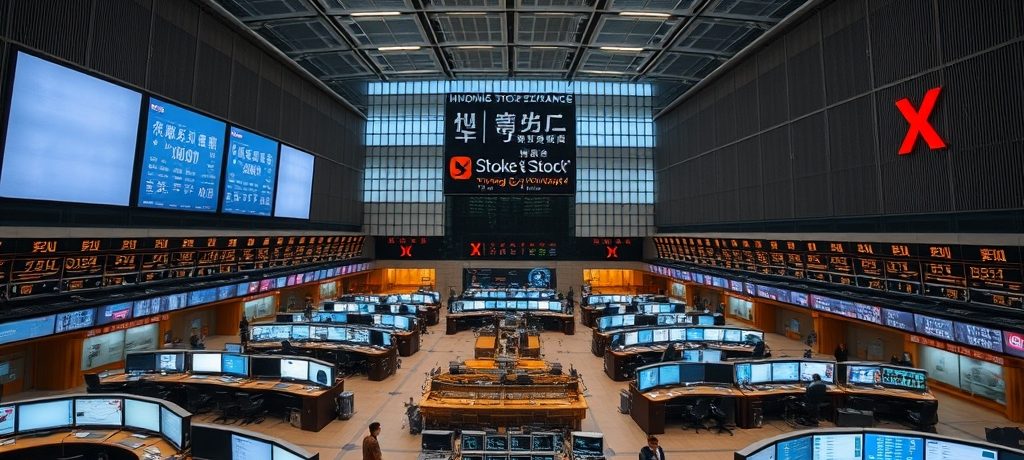
The Hong Kong stock market’s modest two-session winning streak, which saw the Hang Seng Index advance nearly 500 points or 2.5 percent, is poised to conclude on Tuesday amidst a weak global forecast for Asian markets. Following a Monday close just beneath the 20,200-point plateau at 20,197.77, market observers anticipate investors may opt to cash in, influenced by a downturn in European and U.S. bourses and specific sector weaknesses.
Hong Kong Market’s Monday Performance
On Monday, the Hang Seng Index registered a modest gain, improving by 131.58 points or 0.66 percent. The index traded within a range of 20,118.02 and 20,296.94 points throughout the day. This uptick was primarily driven by positive performances from financial shares, property stocks, and technology companies. Among the active constituents, several notable gains were recorded:
- Alibaba Group and ENN Energy Holdings both soared 2.95 percent.
- Galaxy Entertainment surged 3.31 percent.
- Hang Lung Properties skyrocketed 4.37 percent.
- Li Auto accelerated 2.56 percent.
- Haier Smart Home spiked 2.16 percent.
- China Resources Land rallied 1.72 percent.
- Industrial and Commercial Bank of China jumped 1.71 percent.
- CSPC Pharmaceutical strengthened 1.58 percent.
- Hong Kong & China Gas improved 1.35 percent.
- CNOOC climbed 1.19 percent.
- Alibaba Health Info advanced 1.17 percent.
- JD.com added 1.03 percent.
- ANTA Sports gained 0.80 percent.
- Xiaomi Corporation rose 0.68 percent.
- WuXi Biologics increased 1.21 percent.
Smaller gains were seen in China Life Insurance, China Mengniu Dairy, Henderson Land, New World Development, Nongfu Spring, and Lenovo. However, not all stocks participated in the rally; CITIC sank 0.45 percent, Li Ning lost 0.25 percent, Meituan eased 0.20 percent, and Techtronic Industries tumbled 1.42 percent.
Global Headwinds Signal Weakness for Asia
The positive momentum in Hong Kong, however, is overshadowed by a ‘pretty awful’ lead from Wall Street, which experienced substantial losses on Monday. The global forecast specifically points to weakness in oil and technology stocks, sectors expected to lead the Asian markets lower. European and U.S. markets were predominantly lower, setting a challenging precedent for Asian trading sessions.
Wall Street’s Monday Sell-Off
Wall Street’s major averages opened in negative territory on Monday, with only the Dow managing to climb into positive territory by the close. The Dow Jones Industrial Average advanced 289.33 points, or 0.65 percent, to finish at 44,713.58. In stark contrast, the technology-heavy NASDAQ Composite plummeted 612.47 points, or 3.07 percent, closing at 19,341.83. The broader S&P 500 also experienced significant declines, sinking 88.96 points, or 1.46 percent, to end the day at 6,012.28.
Technology Stocks and Interest Rate Concerns Drive Losses
The sell-off on Wall Street was largely attributed to substantial weakness among technology stocks. Nvidia (NVDA), a prominent AI darling and sector leader, notably led the way lower. This plunge in Nvidia’s shares followed news that Chinese startup DeepSeek’s AI Assistant had reportedly overtaken rival ChatGPT to become the top-rated free application available on Apple’s App Store in the United States. Beyond sector-specific concerns, broader anxieties about the outlook for interest rates also weighed heavily on Wall Street. Traders are closely monitoring the Federal Reserve’s monetary policy meeting scheduled for this week. While the Fed is almost universally expected to leave interest rates unchanged, market participants will scrutinize the accompanying statement for any clues regarding the future trajectory of rates. Recent economic data has fueled concerns that the Fed might maintain rates at their current levels for a prolonged period, adding to market uncertainty.
Oil Prices Fall Amid Demand Concerns
Adding to the global headwinds, oil prices experienced a sharp decline on Monday. West Texas Intermediate Crude oil futures for March closed down $1.49, or 2 percent, settling at $73.17 a barrel. This downturn was driven by a confluence of factors, including concerns about potential tariff threats and uncertainty surrounding U.S. trade policy. Furthermore, weak manufacturing data emerging from China raised significant concerns about the outlook for global demand, contributing to the downward pressure on crude prices.
As the Hong Kong market looks towards Tuesday’s trading, the cumulative effect of a weak global forecast, significant tech sector losses on Wall Street, and falling oil prices presents a formidable challenge to maintaining its recent upward momentum. The modest gains achieved over the past two sessions appear increasingly vulnerable, suggesting that the Hang Seng Index may indeed ‘run out of steam’ as anticipated, bringing its brief winning streak to an end.