BASRA, Iraq — Iraq’s vital oil economy has been brought to a near standstill, with exports completely halted and production in its southern hub plummeting by over 70%, just one month after the war in Iran began. The conflict has effectively shut down the Strait of Hormuz, the narrow maritime choke point through which most of Iraq’s crude oil flows, dealing a devastating blow to a nation that relies on oil revenues for approximately 90% of its national budget.
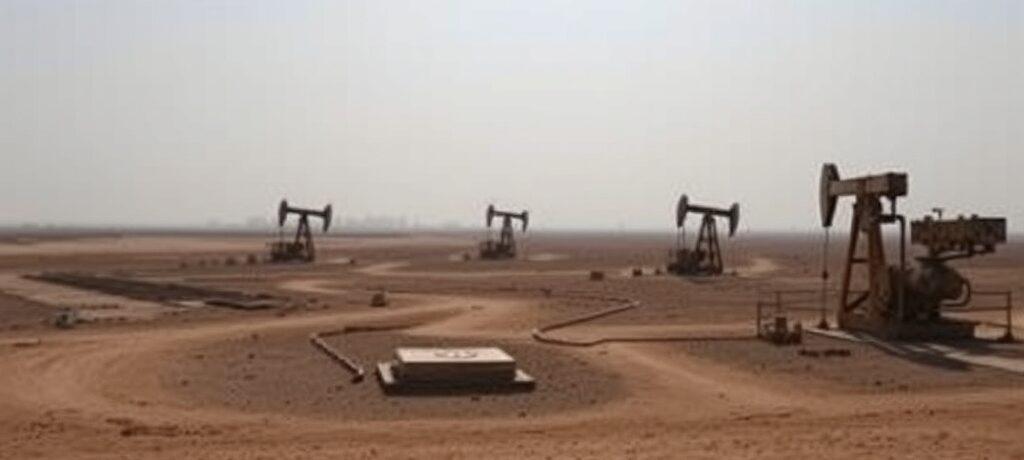
The once-bustling oil fields and ports of Basra province, the heart of Iraq’s crude production, are now largely deserted. Output across Basra province has fallen dramatically from 3.1 million barrels per day (bpd) to roughly 900,000 bpd, according to Bassem Abdul Karim, head of the state-run Basra Oil Company. Individual fields reflect this severe downturn; the Zubair oil field, which previously produced around 400,000 bpd, now sees output at approximately 250,000 bpd. Ammar Hashim, chief engineer at a Zubair degassing station, noted the stark change: ‘It’s quiet now because of the reductions. Of course we are worried.’
Strait of Hormuz Closure Strangles Exports
The primary catalyst for this economic paralysis is Iran’s effective halt of cargo traffic through the Strait of Hormuz. While Iran has offered assurances that Iraqi crude could safely transit the strait, Iraq’s dependence on chartered vessels, rather than its own tanker fleet, has proven to be a critical vulnerability. Tanker owners are largely unwilling to accept the heightened risks of navigating the conflict zone, leading to a complete cessation of Iraqi oil exports. ‘Exports are currently completely halted. At the moment, we are considering alternative loading areas, but none are fully operational,’ Abdul Karim told The Associated Press.
The financial implications for the Iraqi government are dire. Experts predict that without new oil sales, the government possesses sufficient funds only until mid-May. Beyond that, the nation faces a looming fiscal crisis. Ahmed Tabaqchali, an expert in Iraq’s economy, warned, ‘After that, the government would resort to issuing bonds. But not without consequences.’ This scenario underscores the profound economic instability triggered by the conflict.
Security Risks Drive Foreign Exodus
The war, which commenced with U.S.-Israeli strikes, has plunged Iraq into a precarious position, hosting both entrenched Iran-aligned forces and significant U.S. interests. This dual exposure has led to a surge in drone and missile attacks targeting American companies, military bases, and critical energy infrastructure. Iran’s allied Iraqi militias have also struck oil fields. A drone, for instance, crashed in the Majnoon oil field north of Basra without detonating, leading to the suspension of production at the field due to the frequency of such incidents.
The escalating security risks have prompted a mass exodus of international personnel. Hundreds of employees from American, British, Italian, French, and other international oil companies have departed Iraq. This acceleration followed a March 6 drone strike on the Burjisiya complex in Basra, a key logistics hub for the oil industry, which targeted U.S. oil services company KBR’s chemical storage facility. Another drone strike on the British-Petroleum operated Rumaila oil field also caused some foreign workers to leave, though the field continues to operate.
Import Disruptions and Costly Workarounds
Beyond oil exports, Iraq’s import sector has also suffered a severe blow. The volume of imported goods reaching southern Iraq’s ports has been cut in half. Umm Qasr, Iraq’s primary deep-water port, once a cacophony of commerce, now operates well below capacity. Large mother ships, unable to access the port directly due to the Strait of Hormuz closure, are forced to dock in the United Arab Emirates. From there, cargo is transported by trucks and smaller ships to Umm Qasr, a costly and inefficient workaround. Farhan Fartousi, director of the Iraqi Ports Company, stated, ‘Today, our only gateway for goods is the United Arab Emirates.’ The threat to shipping lanes intensified after Iran destroyed two tankers, the Marshall Islands-flagged Safesea Vishnu and the Malta-flagged Zefyros, in Iraqi waters on March 11.
Border trade has also been severely impacted. The Shalamcha border crossing with Iran, a vital artery for familial, commercial, and pilgrim traffic, has experienced routine disruptions. Electricity cuts, following an airstrike on the Iranian side of the crossing, have halted trade, causing trucks to back up for miles. Haidar Abdul-Samad, deputy director of Basra’s Shalamcha border crossing, confirmed that ‘Priority is given to food supplies to prevent price increases,’ while acknowledging that ‘Passenger movement is not at the same level as before; activity has declined due to the war in Iran.’ Iranian trader Atefa Al-Fatlawi, who crosses to buy goods in Basra, expressed widespread fear: ‘We are scared because of the bombings. Shalamcha was targeted. Today, there were no transport vehicles at the garage because of the attack.’
Efforts to reroute Iraq’s oil exports face significant constraints. The country lacks the capacity to substantially boost exports via its northern pipeline, and trucking oil through Jordan and Syria is deemed both costly and inefficient, according to Abdul Karim. As global oil prices rise amidst the regional instability, Iraq’s economy remains deeply vulnerable, caught between the direct impacts of war and the strangulation of its primary export route, with limited viable alternatives on the horizon.