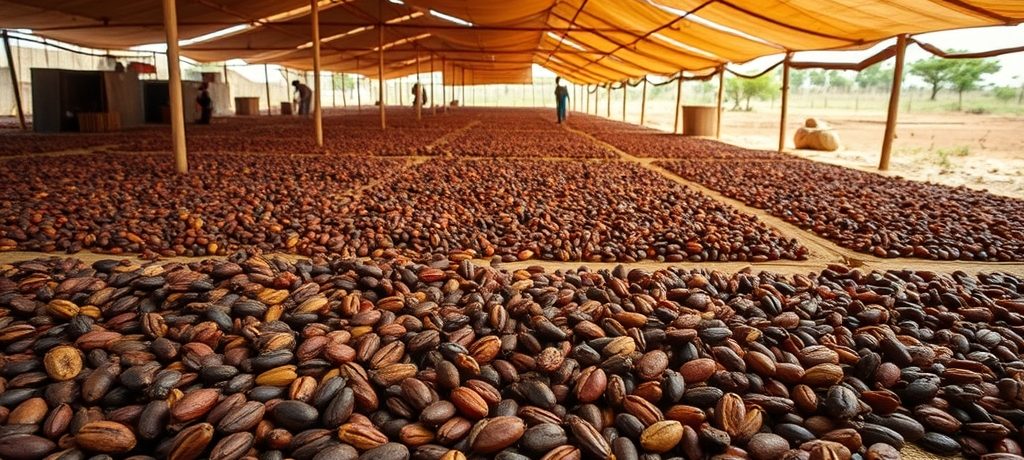
Cocoa prices experienced a significant downturn on Friday, with September ICE NY cocoa (CCU26) closing down -390 points, a -6.04% decline, and September ICE London cocoa #7 (CAU26) falling -306 points, or -6.37%. This sharp reversal was primarily attributed to signs of robust cocoa supplies emerging from the Ivory Coast, prompting widespread profit-taking and long liquidation in cocoa futures.
Cumulative data released on Friday from the Ivory Coast indicated that farmers have shipped 2.07 million metric tons (MMT) of cocoa to ports during the current marketing year, spanning October 1, 2025, through July 5, 2026. This figure represents a substantial 21% increase compared to the same period a year ago. Concurrently, ICE cocoa inventories have risen, reaching a nearly two-year high of 3,151,790 bags on Friday, further underscoring the immediate abundance in supply.
Conflicting Market Signals and Recent Price Dynamics
The recent price drop follows a period of strong upward momentum for cocoa, with NY cocoa hitting a six-month high and London cocoa reaching a 9.25-month high just the day prior. This rally was fueled by a confluence of factors, including adverse weather conditions in key growing regions and signs of recovering demand.
Heavy rains in the Ivory Coast and Ghana have caused widespread flooding, severely impacting farmers’ access to both farms and ports. This excessive moisture also heightens the risk of brown rot and black pod diseases, which can significantly reduce yields and jeopardize the overall harvest. Such threats to global supplies had provided strong bullish support to prices.
Adding to the bullish sentiment, Barry Callebaut AG, the world’s largest cocoa processor, reported on Thursday that its fiscal Q3 sales rose by 5.7%. This marked the first sales increase for the company in over two years, signaling a potential recovery in global cocoa demand.
Long-Term Weather Concerns and Future Crop Outlook
Beyond immediate supply and demand dynamics, cocoa prices also carry underlying medium-term support from future weather concerns. The US Climate Prediction Center stated on Wednesday that the El Niño weather pattern, which emerged across the equatorial Pacific last month, is projected to be one of the strongest in more than 75 years. Historically, an El Niño event typically brings warmer, drier conditions to West Africa, which can reduce soil moisture, stress cocoa trees, and ultimately lower yields for future harvests.
Early surveys of the upcoming 2026/27 Ivory Coast cocoa crop further contribute to this long-term support. These assessments indicate below-average cherelle formation on cocoa trees, suggesting a weak outlook for the main cocoa harvest set to begin in September. Initial crop estimates project an average of 1.8 MMT for the season, an 18% decrease from the approximately 2.2 MMT recorded in 2025/26. Markets are currently awaiting new surveys in July to finalize the size of this crucial crop.
Broader Supply and Demand Pressures
The market has also been under pressure from other supply-side developments. Last month, on June 11, the Ivory Coast revised its estimate of cocoa reaching its ports upward by more than 260,000 MT for the current season. However, the Ivory Coast recently projected its overall cocoa production for 2025/26 to fall by 10.8% year-over-year, from 1.85 MMT in 2024/25 to 1.65 MMT.
Globally, signs of larger cocoa supplies from other regions have also exerted negative pressure. Bloomberg reported on June 25 that Nigerian cocoa exports in May surged by 28% year-over-year to 18,034 MT. Conversely, smaller cocoa supplies from Nigeria, the world’s fifth-largest producer, are projected to be supportive for prices, with Nigeria’s Cocoa Association forecasting a 2025/26 production decline of 11% year-over-year to 305,000 MT, down from 344,000 MT in 2024/25.
Weak global cocoa demand has also been a bearish factor. The National Confectioners Association reported on April 23 that North American Q1 cocoa grindings fell 3.8% year-over-year to 106,087 MT. Similarly, the European Cocoa Association noted a 7.8% year-over-year decline in Q1 European cocoa grindings to 325,895 MT, a larger drop than the anticipated 6% and the lowest for a first quarter in 17 years. In contrast, the Cocoa Association of Asia reported an unexpected 5.2% year-over-year rise in Q1 Asian cocoa grindings to 223,503 MT, surpassing expectations of a 6.7% decline.
Further impacting the market balance, both Ghana and the Ivory Coast, which together produce more than half of the world’s cocoa, have announced significant cuts to the official prices paid to farmers. In February, Ghana reduced farmer pay by nearly 30% for the 2025/26 growing season, while the Ivory Coast announced a 57% cut effective for the mid-crop harvest that began in March.
The outlook for a smaller global cocoa surplus continues to provide underlying support. On April 29, StoneX revised its 2026/27 global cocoa surplus estimate down to 149,000 MT from a January forecast of 267,000 MT, citing risks to the West African cocoa crop from the expected El Niño event. StoneX also reduced its 2025/26 global cocoa surplus forecast to 247,000 MT from an earlier January estimate of 287,000 MT. The interplay of immediate supply surges, long-term weather threats, and fluctuating demand signals continues to create a volatile and complex environment for global cocoa prices.