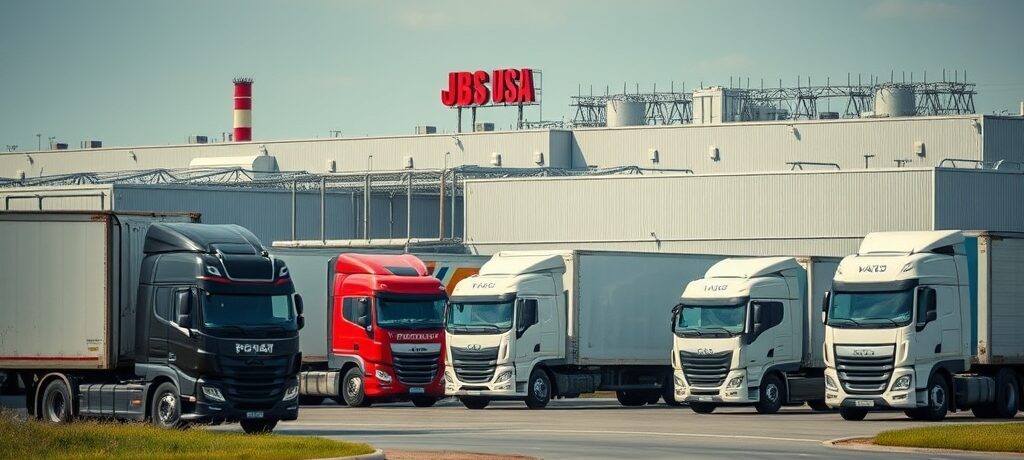
JBS USA announced on April 12, 2026, the finalization of a new collective bargaining agreement with UFCW Local 7, bringing an end to weeks of operational uncertainty at its Greeley beef production facility. This agreement is set to restore ‘normal operations’ at the critical processing plant and provide ‘clarity and stability’ for team members, according to the company. The resolution marks a significant development following a protracted period of intense labor negotiations that had impacted the facility’s output and workforce morale.
The newly ratified agreement is structured to remain in effect through April 2028, offering a defined period of labor peace and predictable operational parameters for the Greeley plant. This two-year term provides a clear horizon for both management and employees. JBS USA stated that the economic framework embedded within this agreement precisely reflects the terms presented in the company’s ‘Last, Best and Final offer.’ Crucially, the company emphasized that this offer remained ‘unchanged economically throughout the bargaining process,’ signaling a consistent and unwavering position from JBS USA regarding its financial commitments to the workforce during the entirety of the negotiations. This steadfastness in its economic proposal was a defining characteristic of the company’s bargaining strategy.
While expressing a measure of relief that an agreement has been reached, JBS USA simultaneously voiced ‘disappointment’ regarding a specific decision made by UFCW Local 7 leadership during the negotiation process. The company highlighted the elimination of a ‘historic pension benefit’ that was an integral component of a broader national agreement. This national agreement had been negotiated in the previous year in partnership with UFCW International, suggesting a precedent for such a benefit across the company’s operations and a unified approach to long-term worker benefits. JBS USA underscored its perspective on the pension’s intrinsic value, stating it was ‘designed to strengthen long-term retirement security for workers.’ In a contrasting move, Local 7 leadership opted to ‘redirect those funds into short-term wage increases,’ a strategic choice that prioritizes immediate financial gains for its members over the long-term retirement planning framework advocated by JBS USA. This divergence in philosophy regarding worker compensation and future security became a central point of contention.
A notable and impactful outcome of the finalized agreement involves the withdrawal of ‘seven alleged unfair labor practice (ULP) charges’ by UFCW Local 7. JBS USA interpreted this action as a clear indication that the core dispute and subsequent strike were fundamentally ‘about the economics of the deal rather than ULPs.’ This interpretation directly challenges earlier ‘union claims to the contrary,’ which had suggested the presence of unfair labor practices as a contributing factor to the industrial action. The company’s emphasis on the economic nature of the strike aims to clarify the underlying causes of the disruption and to solidify its narrative regarding the basis for the eventual resolution, shifting focus away from alleged procedural infringements.
JBS USA further contextualized the Greeley situation by noting that workers at its other beef facilities across the country had already ‘accepted and are benefiting from the pension and other enhancements negotiated nationally.’ This comparison implicitly critiques Local 7’s decision to forgo the pension benefit, suggesting a divergence from a broader, company-wide standard that had been established for its workforce. The company reiterated its firm belief that the strike at the Greeley facility ‘could have been avoided had Local 7 leadership allowed members to vote on the earlier offer.’ This statement points to a perceived procedural misstep on the part of union leadership that, from JBS USA’s perspective, unnecessarily prolonged the dispute and its associated economic impacts.
Throughout the protracted bargaining period, JBS USA consistently maintained its operational activities at the Greeley plant, ensuring continuity amidst the labor unrest to the best of its ability. The company asserted that it continued to meet with the union ‘as scheduled’ and maintained that it ‘bargained in good faith’ throughout the entire process. To further underscore its commitment to constructive dialogue and a fair resolution, JBS USA explicitly stated that it ‘never refused to meet and never conditioned bargaining on the strike ending.’ These assertions aim to present a narrative of consistent engagement and a proactive willingness to resolve the dispute through negotiation, even while operations were impacted by the strike.
With the agreement now formally finalized, JBS USA articulated its forward-looking strategy and commitments for the Greeley facility. The company stated its clear intention to focus on ‘restoring stability, supporting its workforce, and continuing to invest in the Greeley facility for the future.’ This commitment signals a renewed emphasis on long-term operational health, employee well-being, and sustained growth for the plant following the resolution of the labor dispute. The company’s outlook suggests a definitive move beyond the recent period of contention towards a phase of rebuilding and strategic development, aiming to solidify its position in the beef production market.
The resolution of the labor dispute between JBS USA and UFCW Local 7 marks a critical juncture for the Greeley beef production facility, bringing an end to a period of significant uncertainty. While the agreement ensures immediate operational normalcy and economic clarity for workers through April 2028, the divergence over long-term retirement security versus short-term wage increases highlights differing priorities that significantly shaped the negotiation process. The withdrawal of ULP charges further solidifies JBS USA’s position on the economic nature of the strike, setting a clear path for the facility’s future operations and investments, and aiming to restore confidence among all stakeholders in the stability of its labor relations.