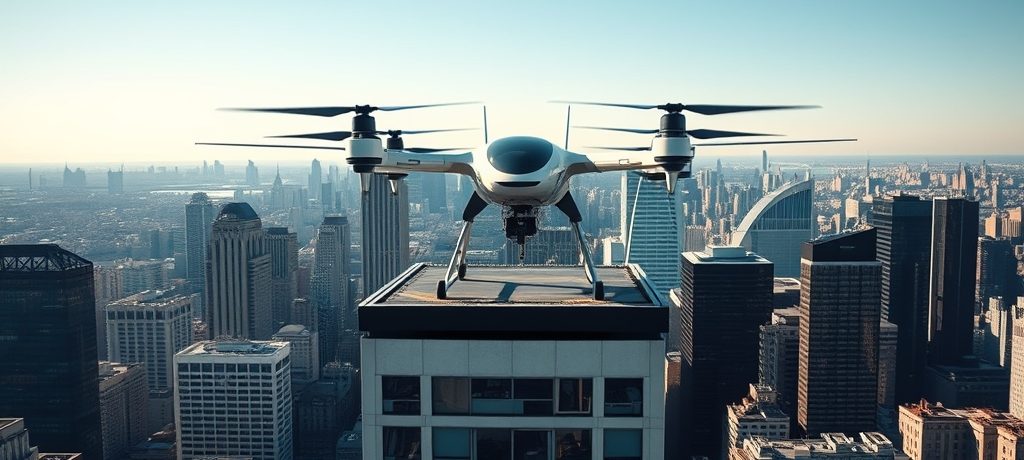
Joby Aviation (NYSE: JOBY) has achieved a significant milestone, executing the first-ever point-to-point electric air taxi flight in Manhattan. This demonstration, which saw an electric vertical takeoff and landing (eVTOL) aircraft travel from JFK Airport to Manhattan in under 10 minutes in late April 2026, marks a pivotal moment for the nascent urban air mobility sector and provides a concrete reason for the company’s anticipated growth over the next five years.
The successful flight is the singular, tangible catalyst cited by analysts for the company’s projected trajectory. It represents a critical shift, moving the concept of air taxis from theoretical discussions into operational reality, thereby offering investors a clear demonstration of functional capability. As Steven Porrello, writing for The Motley Fool, articulated on June 4, 2026, “It’s hard to overstate the significance of this event, not only for Joby but also for the nascent electric vertical takeoff and landing (eVTOL) industry as a whole.” This event, he suggests, allows investors to “point to something concrete and say, ‘Look, this actually works.'”
From Imagination to Operational Reality
For decades, the vision of widespread urban air mobility remained largely confined to the realm of imagination and futuristic concepts. Joby Aviation’s recent flight fundamentally alters this perception, establishing a new benchmark for the industry. By successfully completing a point-to-point journey in one of the world’s most complex and densely populated urban environments, the company has provided irrefutable evidence that the core technology is viable and operational. This achievement, reminiscent of the pioneering spirit of the Wright Brothers, positions Joby Aviation distinctly ahead of competitors such as Archer Aviation (NYSE: ACHR) and other emerging eVTOL startups.
The efficiency demonstrated during the flight—connecting JFK Airport to Manhattan in less than ten minutes—underscores the transformative potential of eVTOLs. This rapid transit capability offers a compelling premium alternative to the often-sluggish ground transportation routes that plague major metropolitan areas. The promise of a “10-to-15-minute urban hop over sluggish traffic” is central to the value proposition that could justify a premium price point for consumers, thereby unlocking significant revenue streams for early movers in this market.
Tapping into a Trillion-Dollar Market
The market opportunity for eVTOLs is not merely substantial; it is, according to some valuations, projected to reach into the trillions of dollars. This vast potential stems from the ability of air taxis to address critical urban challenges, including traffic congestion, environmental concerns, and the demand for expedited travel. Joby Aviation is strategically positioned to capture a significant share of this burgeoning market, provided it can navigate the complex landscape of regulatory approvals and operational scaling.
The company is actively engaged in the rigorous process of securing the necessary FAA certification to commence commercial passenger flights. While no eVTOL company has yet achieved full certification, Joby is reported to be “getting pretty close.” This progress is a key indicator for investors, signaling that the company is moving steadily towards commercialization rather than remaining solely in the development phase. The ability to demonstrate a working product in a real-world scenario like the Manhattan flight significantly bolsters confidence in its certification prospects.
The Path to Commercialization: Ambition Meets Obstacles
The most bullish projections for Joby Aviation envision a transformative period by 2031. In this optimistic scenario, the company is expected to have successfully obtained full FAA certification and established operational commercial routes across key urban centers. Such a trajectory would see Joby generating “hundreds of millions of dollars in revenue, possibly billions,” thereby validating the economic viability and consumer demand for urban air mobility services on a large scale.
However, the path to unlocking these substantial revenues is not without significant execution risks. Joby Aviation faces the formidable challenge of scaling its eVTOL manufacturing capabilities to meet projected demand, a process that requires substantial capital investment and operational expertise. Concurrently, the company must develop and integrate the necessary ground infrastructure, including vertiports and charging stations, into existing urban landscapes. Balancing these manufacturing and infrastructure demands with the stringent and evolving certification requirements from aviation authorities presents a complex operational puzzle.
Beyond the technical and regulatory hurdles, Joby must also focus on cultivating broad consumer demand and, critically, demonstrating that its air taxis are both unequivocally safe and consistently reliable. Public trust and acceptance will be paramount for widespread adoption, necessitating flawless operational records and transparent safety protocols. These factors represent considerable challenges that could introduce “turbulence” for investors.
Engineering Expertise and Future Outlook
Despite these considerable challenges, the engineering prowess and operational achievements demonstrated by Joby Aviation have instilled a notable degree of confidence among financial observers. Steven Porrello of The Motley Fool articulated a strong belief in the company’s trajectory, stating, “At this point, however, Joby has demonstrated such engineering expertise that it would genuinely shock me if it failed to establish itself as a leader in the air taxi market.” This assessment underscores the view that Joby’s technical accomplishments, particularly the groundbreaking Manhattan flight, provide a robust foundation for its future success.
While investors are advised to “expect turbulence” as the company navigates the complexities of commercialization and market penetration, the underlying technology and its proven capability suggest Joby has a “legitimate shot at reaching its destination.” The ultimate size and profitability of the burgeoning air taxi market, and Joby’s eventual share within it, will undoubtedly hinge on its ability to meticulously execute its strategic plans over the coming years, building upon the significant momentum generated by its recent operational triumph.