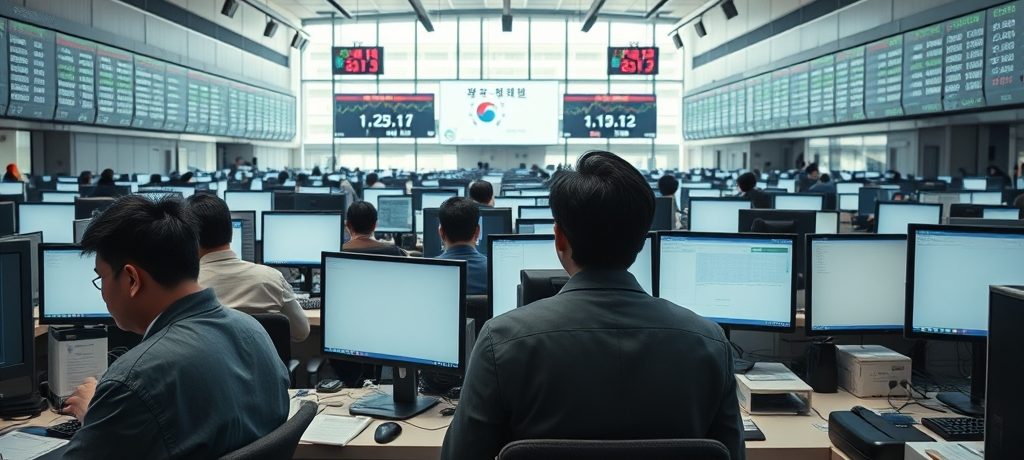
South Korean equities experienced a dramatic downturn, with the Kospi Index plunging more than 8% and triggering a 20-minute trading halt shortly after market open. This sharp decline imperils what has been the world’s biggest rally, as investors rapidly unwound their positions in artificial intelligence (AI) bets that have significantly fueled the global equity bull market.
The sell-off was particularly acute in the semiconductor sector, a cornerstone of South Korea’s economy and a key beneficiary of the AI boom. Memory chip giant Samsung Electronics Co. saw its shares fall as much as 11%, while its peer SK Hynix Inc. slid 10%. The swift and severe market reaction underscored the concentrated risk associated with AI-driven investments, for which Korea has become a prominent ‘posterchild’.
AI Trade Unwinding Fuels Panic Selling
The significant losses in Seoul follow a broader cooling of global tech stocks, driven by growing fears of overheating in the AI trade. This sentiment was exacerbated by US peers tumbling on Friday amid concerns over a possible rate hike. South Korea’s market is particularly susceptible to such unwinding events due to the outsized dominance of its two major memory chipmakers, Samsung and SK Hynix, and the substantial retail money — billions of dollars — tied to chip-linked leveraged exchange-traded funds (ETFs).
Albert Yong, managing partner at hedge fund Petra Capital Management in Seoul, commented on the situation, stating, ‘Given the crowded positioning in semiconductors and the current volatile environment, some degree of panic selling is not surprising.’ The Korea Exchange responded to the volatility by halting trading for 20 minutes and holding an emergency meeting to assess the situation and discuss measures to ensure stable market operations.
Foreign Capital Exodus and Currency Intervention
The market’s woes were compounded by continued foreign investor outflows. Foreign investors continued to sell on Monday, following a net withdrawal of more than $10 billion worth of Kospi shares last week. This exodus of capital has put pressure on the Korean won, which had rebounded from its weakest level against the dollar since March 2009. The rebound followed the government’s announcement on Sunday of a series of targeted measures aimed at bolstering the currency. These actions align with broader efforts by policymakers across Asia to support their respective currencies amidst rising energy costs and a stronger dollar, partly stemming from the Iran war.
Volatility and Mounting Margin Debt
The rapid ascent of the Korean stock market, largely fueled by AI optimism, has been characterized by significant swings. The Kospi 200 Volatility Index has consistently held around 70 over the past several weeks, indicating heightened market uncertainty. Furthermore, margin debt has accumulated to a record 38 trillion won, equivalent to approximately $24.4 billion, as of the end of May. This substantial leverage in the market amplifies the potential for sharp corrections during periods of investor retreat.
Long-Term Outlook Amidst Correction
Despite the immediate downturn, the tech-led sell-off overshadowed what would otherwise have been a positive development for investors: Nvidia Corp. and SK Hynix agreed to partner on designing future generations of memory chips for AI. This collaboration was highlighted by Nvidia CEO Jensen Huang sharing Korean barbecue over the weekend with leaders from SK Group, LG Group, and Naver Corp., signaling strong industry ties.
Many investors, while acknowledging the current turbulence, maintain that the longer-term outlook for tech hardware remains intact, citing the substantial capital expenditure plans of hyperscalers. Jung In Yun, chief executive officer at Fibonacci Asset Management Global, offered a measured perspective: ‘I believe it is still too early to conclude that today’s selloff marks the beginning of a prolonged bear market.’ Yun added, ‘Following a strong rally over recent months, particularly in AI and semiconductor-related names, some degree of correction is both healthy and expected.’ This suggests that while painful, the current market adjustment could be a necessary rebalancing after an intense period of growth.