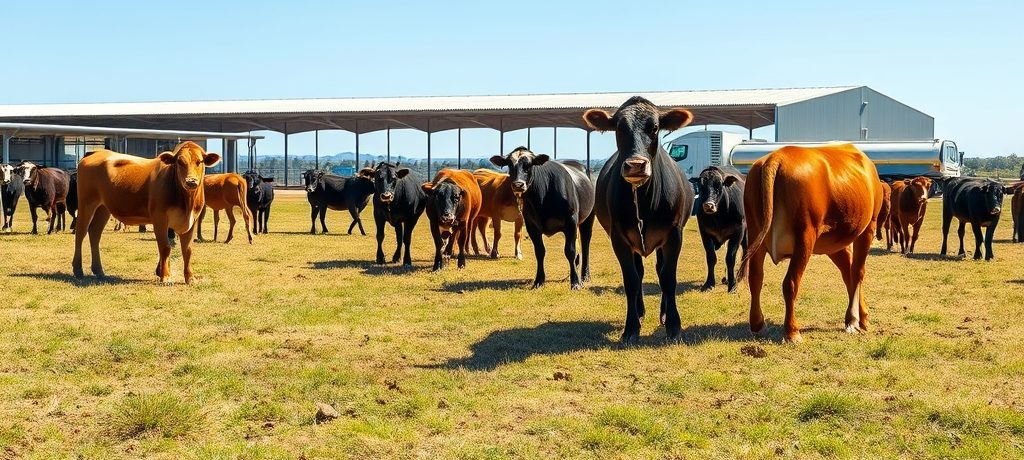
The cattle market demonstrated a robust performance on Thursday, with live cattle futures posting substantial gains across all contracts, signaling a continued rebound. The upward momentum, which saw increases ranging from $1.42 to $3.47, extended to Thursday’s close, according to data from Barchart.
Live Cattle Futures Surge Amidst Mixed Cash Signals
Live cattle futures contracts experienced a broad rally, with the August 2026 Live Cattle contract closing at $231.225, marking an increase of $3.325. The October 2026 contract saw an even larger jump, settling at $227.450, up $3.475, while the December 2026 Live Cattle contract finished at $226.725, a gain of $3.400. This widespread appreciation in futures prices suggests renewed investor confidence or shifting supply-demand dynamics.
However, the cash market presented a more nuanced picture. The USDA reported cash trade on Thursday in the range of $232-233. In contrast, the Thursday Fed Cattle Exchange online auction, which offered 1,054 head, recorded no sales, with only a few bids surfacing at $228. This divergence between the active cash trade reported by the USDA and the lack of transactions on the online exchange indicates potential segmentation or varying price expectations within the physical market.
Feeder Cattle Futures Lead the Charge in Recovery
Feeder cattle futures mirrored the strength seen in their live cattle counterparts, extending a significant bounce that followed Monday’s limit losses. These contracts posted impressive gains ranging from $2.20 to $5.02 by the close. Specifically, the August 2026 Feeder Cattle contract closed at $346.475, up $2.200. The September 2026 contract saw a rise of $3.800, settling at $342.450, and the October 2026 Feeder Cattle contract climbed $4.400 to close at $334.025. This strong recovery in feeder cattle futures underscores a potential shift in sentiment after recent downturns.
Despite the futures rally, the CME Feeder Cattle Index registered a slight dip, declining by 22 cents on July 29 to $347.69. This minor adjustment in the index, juxtaposed with the substantial futures gains, highlights the complex interplay between spot market valuations and forward-looking contract pricing.
Export Sales Reach 5-Week High, Wholesale Prices Decline
Further insights into the beef market’s underlying health came from USDA’s Export Sales data. Beef sales for 2026 reached 15,109 metric tons (MT) for the week ending July 23, marking a five-week high. This robust export performance suggests strong international demand for U.S. beef, providing a supportive factor for the broader cattle complex. However, shipments for the same period were tallied at 12,381 MT, which represented a decrease from the previous week’s figures.
Conversely, wholesale boxed beef prices showed a downward trend in the Thursday afternoon report. Choice boxes were reported down $2.93, settling at $360.50. Select boxes also experienced a decline, falling $1.08 to $341.33. This softening in wholesale prices, despite strong export sales and rising futures, introduces a layer of complexity, indicating potential pressures on processor margins or a recalibration of domestic demand.
Slaughter Rates Continue to Contract
Adding to the market’s fundamental picture, USDA’s Federally Inspected cattle slaughter data revealed continued contraction. The slaughter for Thursday stood at 102,000 head, contributing to a weekly total of 407,000 head. This weekly total represents a decrease of 4,000 head from the previous week and is notably 36,144 head below the slaughter volume recorded during the same week last year. The consistent reduction in slaughter rates could imply tighter cattle supplies in the pipeline, a factor that typically lends support to futures prices over the longer term, even as short-term market dynamics present varied signals.
The overall market activity on Thursday painted a picture of strong futures-led recovery, particularly in live and feeder cattle contracts, bolstered by a significant uptick in beef export sales. However, the mixed signals from the cash market, declining wholesale boxed beef prices, and continued contraction in slaughter rates suggest a market navigating multiple, sometimes contradictory, forces. The resilience shown in futures, especially the bounce out of previous losses, will be a key indicator for market participants as they assess the trajectory of cattle prices in the coming weeks.