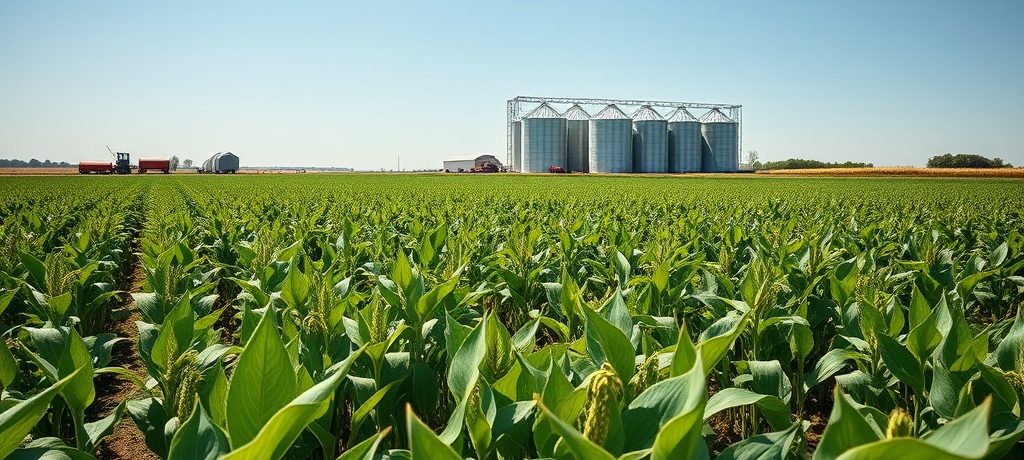
Soybean markets concluded Thursday’s trading session with significant advances, reflecting underlying strength across its derivative products. Futures contracts for soybeans registered gains ranging from 9 ¼ to 15 ¼ cents at the close, signaling a positive sentiment among traders. This upward movement was mirrored in the broader cash market, where the cmdtyView national average Cash Bean price climbed by 9 ¼ cents, settling at $11.34.
The impetus for these gains largely stemmed from the robust performance of soybean’s processed components. Soymeal futures experienced an increase between $1.10 and $3.80, while Soy Oil futures saw even more substantial appreciation, rising by 86 to 147 points. This synchronized ascent across the soybean complex underscores a healthy demand outlook for both the raw commodity and its value-added products, which include feed for livestock and ingredients for various food and industrial applications.
Futures Market Performance and Cash Prices
A closer examination of specific futures contracts reveals a consistent upward trend. The July 2026 Soybeans contract closed at $11.94 ½, up 9 ¼ cents from its previous close. Similarly, the August 2026 Soybeans contract advanced by 11 ¼ cents, reaching $11.96. The November 2026 Soybeans contract, representing new crop delivery, also posted a strong showing, gaining 12 ½ cents to settle at $11.94.
Beyond the futures arena, cash prices also reflected the market’s bullish tone. The Nearby Cash price saw an increase of 10 cents, closing at $11.34 0/1. For new crop deliveries, the New Crop Cash price moved up by 12 ¾ cents, settling at $11.30 ½. These movements across both spot and forward markets indicate a broad-based strengthening in soybean valuations, influenced by current market dynamics and future expectations.
Anticipated Export Sales Data and Market Projections
Looking ahead, market participants are keenly focused on the release of the latest Export Sales data, which is scheduled for Friday due to a preceding Monday holiday. This report is a critical indicator of international demand for U.S. soybeans and their derivatives.
Analysts and traders have formulated their projections for the upcoming data, providing a snapshot of market expectations. For old crop bean sales in the week ending May 21, estimates range between 150,000 and 400,000 metric tons (MT). New crop sales are anticipated to fall within a range of 0 to 300,000 MT. The outlook for soybean meal sales is notably robust, with projections spanning from 250,000 to 800,000 MT. In contrast, bean oil sales are expected to show net reductions of 5,000 MT to net sales of 16,000 MT, suggesting a more tempered demand profile for this particular product in the immediate term.
These export figures are crucial for assessing the supply-demand balance and often dictate short-term price movements. A stronger-than-expected report could provide further momentum to the current rally, while weaker figures might temper enthusiasm.
Agricultural Fundamentals: Weather and Global Harvests
Beyond market-specific data, agricultural fundamentals continue to play a pivotal role in shaping soybean prices. The latest weather forecast for the upcoming week indicates a drier pattern developing east of the Mississippi River and north of the Ohio River. This region encompasses the Eastern Corn Belt (ECB) and the central Corn Belt, areas that have reportedly lagged behind the normal planting pace for the season.
A drier pattern in these key agricultural zones could be a mixed blessing. While it might allow for accelerated planting in areas that have been too wet, prolonged dryness could also raise concerns about early crop development and moisture availability. The market will closely monitor how this weather pattern evolves and its potential impact on overall U.S. soybean production prospects.
Internationally, the soybean harvest in Argentina, a major global producer, is estimated to be 84.6% complete, according to data from the Buenos Aires Grains Exchange. The progress of the Argentine harvest is a significant factor in global supply, and its near completion suggests that a substantial portion of the South American crop is now accounted for, reducing some of the uncertainty related to global supply volumes.
The confluence of strong product demand, anticipation of key export data, and evolving agricultural conditions both domestically and internationally will continue to shape the trajectory of soybean markets. The current upward momentum, as observed in Thursday’s trading, highlights the market’s responsiveness to these multifaceted drivers, with participants closely monitoring upcoming reports and weather developments for further direction.