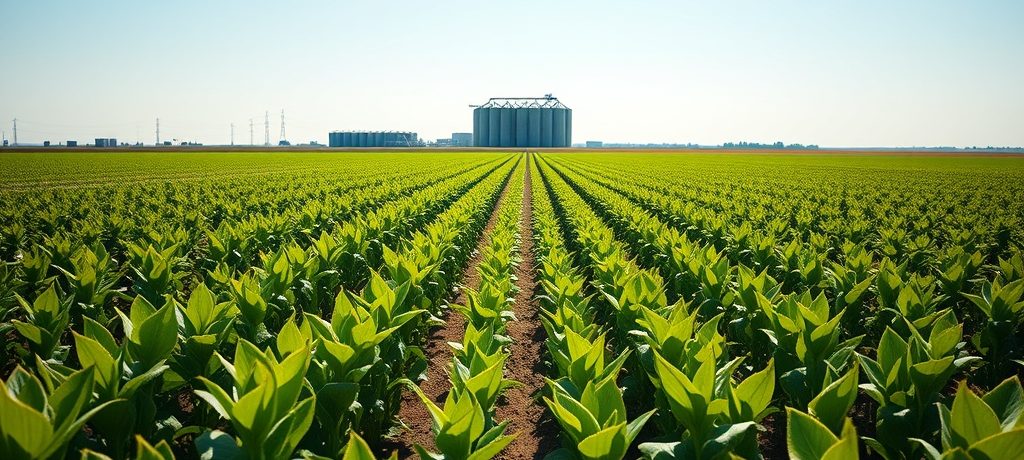
Soybean futures registered losses on Tuesday, with contracts settling fractionally to 4 ¾ cents lower. This downward movement occurred despite a slight uptick in the cmdtyView national average Cash Bean price, which rose by 1/4 cent to $10.58.
Soymeal Futures Drag Down Soybean Market
The primary driver behind the pressure on soybean prices appeared to be a notable decline in soymeal futures. Soymeal futures were down between $1.60 and $2.70 on the day, indicating weak sentiment in the processed soybean product market. In contrast, soy oil futures presented a mixed picture, fluctuating from 35 points higher to 34 points lower, suggesting a more nuanced market dynamic for the oil component.
Crop Progress Report Shows Strong Planting Pace, Mixed Conditions
Recent data from the weekly Crop Progress report released by the National Agricultural Statistics Service (NASS) provided context for the market. By June 7th, 92% of the U.S. soybean crop was planted, which is 4% ahead of the normal pace. Furthermore, 79% of the crop had emerged, exceeding the normal rate by 8 percentage points. This indicates a robust start to the planting season.
However, condition ratings for the crop showed a slight deterioration. The overall percentage of soybeans rated good to excellent (gd/ex) fell by 1% to 65%. The Brugler500 index, a broader measure of crop condition, declined by 2 points to 367. Specific areas noted for weaker conditions included Indiana, which dropped 9 points, Missouri down 4 points, South Dakota down 3 points, and North Dakota down 2 points. Weaker conditions were also observed in other fringe southern states.
Conversely, some regions reported improvements in crop conditions. Minnesota saw a gain of 6 points, Nebraska improved by 3 points, Illinois added 3 points, and Ohio saw a 5-point increase in its condition ratings.
Weather Forecast and WASDE Data on the Horizon
Looking ahead, the weather forecast suggests significant precipitation totals for much of eastern Kansas, extending through Iowa, Michigan, Illinois, Indiana, and Wisconsin, with amounts ranging from 1 to 3 inches. Ohio is expected to receive spottier totals, while Nebraska and the Dakotas are projected to see very light rainfall.
Market participants are also anticipating the upcoming World Agricultural Supply and Demand Estimates (WASDE) report, scheduled for release on Thursday. Traders surveyed by Bloomberg are expecting a steady report. The average trade estimate for old crop bean carryout is 339 million bushels (mbu), a slight decrease from the 340 mbu reported in May. For the new crop, the estimate stands at 310 mbu, unchanged from previous expectations if realized.
International Trade Data Offers Mixed Signals
International trade data provided further insights into the global soybean market. In May, China’s soybean imports totaled 11.79 million metric tons (MMT), representing a 15.3% decline compared to the same month last year. This suggests a potential slowdown in demand from a key importing nation.
On the export front, ANEC estimates Brazil’s soybean exports for June at 14.38 MMT. This figure is an increase from the 12.36 MMT estimate made last month, indicating robust export activity from the South American producer.
Futures Contract Performance
Specific futures contract performance on Tuesday included:
- July ’26 Soybeans closed at $11.13 3/4, down 2 cents.
- Nearby Cash was $10.58 1/1, up 1/4 cent.
- August ’26 Soybeans closed at $11.18 3/4, down 2 1/2 cents.
- November ’26 Soybeans closed at $11.32, down 3 1/2 cents.
- New Crop Cash was $10.66 1/4, down 3 cents.
The downward trend in soybean futures on Tuesday, largely influenced by the weakness in soymeal, highlights the interconnectedness of the soybean complex. While planting progress remains strong, slight deteriorations in crop conditions and mixed international trade signals are factors market participants will continue to monitor closely as key reports and weather patterns unfold.