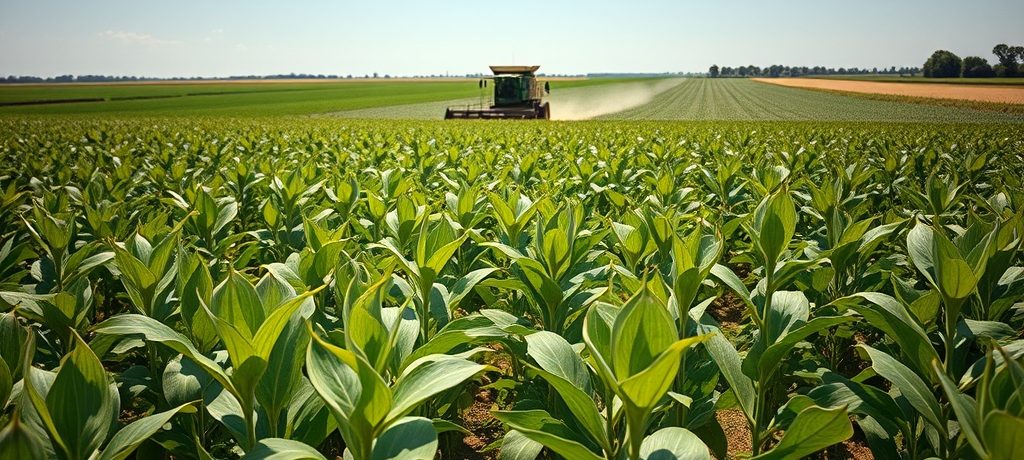
Soybeans experienced a notable late-day rally on Thursday, with contracts closing near their session highs, driven by persistent rumors of robust Chinese demand. Front-month contracts posted gains ranging from 1 to 5 ¾ cents, signaling a renewed bullish sentiment in the market. The cmdtyView national average Cash Bean price also reflected this upward trend, climbing 3 cents to settle at $11.32. This late surge underscores the market’s sensitivity to signals from the world’s largest soybean importer.
Market Dynamics and Price Movements
The firming trend saw soybean contracts recover significantly, closing 6 to 9 cents off their daily lows. Beyond the front-month gains, the broader complex also showed mixed but generally positive movement. Soymeal futures exhibited stronger performance, rising between 20 cents and $1.40 by Thursday’s close. In contrast, Soy Oil futures saw a more varied session, finishing anywhere from 5 points lower to 27 points higher.
Specific contract performances highlighted the upward momentum. August 2026 soybeans closed at $11.57 ¼, marking a gain of 5 ¾ cents. The nearby cash price mirrored this, increasing 3 cents to $11.32 1/1. September 2026 soybeans advanced 3 ½ cents to $11.60, while November 2026 soybeans climbed 3 cents to $11.77 ¾. The new crop cash price also saw an increase of 3 ¼ cents, reaching $11.18 ½. These figures, reported by Austin Schroeder for Barchart on August 6, 2026, illustrate a broad-based strengthening across the soybean complex.
Chinese Demand as a Primary Catalyst
The primary impetus behind Thursday’s price surge appears to be a flurry of activity and speculation surrounding Chinese purchasing. A private export sale of 122,000 metric tons (MT) of soybeans to China for the 2026/27 marketing year was officially reported. Further bolstering market sentiment, wire reports circulated throughout the day suggesting that Chinese buyers had acquired an additional 10 cargoes of U.S. soybeans on Thursday.
This reported activity aligns with data from the latest USDA weekly Export Sales report for the week ending July 30. While overall new crop business was tallied at 903,920 MT—a four-week low for 2026/27 sales—China accounted for a significant portion of these purchases, specifically 330,000 MT. The report also noted that ‘unknown buyers’ constituted the bulk of the new crop purchases, at 497,500 MT, leaving open the possibility of further undisclosed Chinese involvement.
Broader Export Sales Landscape
The USDA’s weekly Export Sales report provided a comprehensive, albeit mixed, picture of the broader soybean export market. For the old crop (2025/26 marketing year), total sales amounted to 32,157 MT for the week ending July 30. This figure represented a marketing year low, indicating a slowdown as the industry approaches the final month of the 2025/26 period.
Conversely, new crop business for 2026/27, while registering a four-week low at 903,920 MT, still demonstrated substantial forward commitments. The significant contribution from China, alongside the large allocation to ‘unknown buyers,’ suggests underlying demand, even if the weekly headline number was subdued. This dynamic highlights the ongoing transition between marketing years and the pivotal role of key importers in shaping future market expectations.
Performance of Related Commodities
The USDA report also shed light on the performance of soybean meal and soy oil in the export market. Soybean meal sales for the week were tallied at 248,090 MT, falling squarely within the expected range of 200,000 to 500,000 MT. This total comprised 101,411 MT for the current marketing year and 146,679 MT for the upcoming 2026/27 period, indicating consistent demand for the protein-rich byproduct.
Bean oil bookings, however, presented a more modest picture, with net sales of 3,926 MT. This figure positioned sales within the broader estimate range, which had anticipated anything from net cancellations of 10,000 MT to sales of 10,000 MT, suggesting a relatively balanced but not particularly strong week for soy oil exports.
Global Supply Dynamics: Brazilian Exports
Adding a global perspective to the market, recent trade ministry data from Brazil provided insights into South American supply. Brazilian soybean exports in July totaled 13.4 million metric tons (MMT). This represented a 9.33% increase compared to the previous year but was simultaneously down 7.58% from a year ago, indicating some variability in year-over-year performance.
Looking ahead, the National Association of Grain Exporters (ANEC) projected August exports from Brazil to reach 9.74 MMT. This forecast suggests a potential increase of 1.63 MMT from the same period last year, indicating a robust export pace from the South American giant, which could influence global supply balances in the coming months.
The late-day rally in soybeans on Thursday, primarily fueled by specific reports and rumors of Chinese purchasing, underscores the critical influence of demand-side factors on commodity markets. While the USDA’s latest export sales report presented a mixed picture with some marketing year lows, the targeted Chinese buying, both reported and rumored, provided the immediate catalyst for price appreciation. As the market transitions into a new marketing year, the interplay between global supply, particularly from South America, and sustained demand from major importers like China will remain central to price formation.