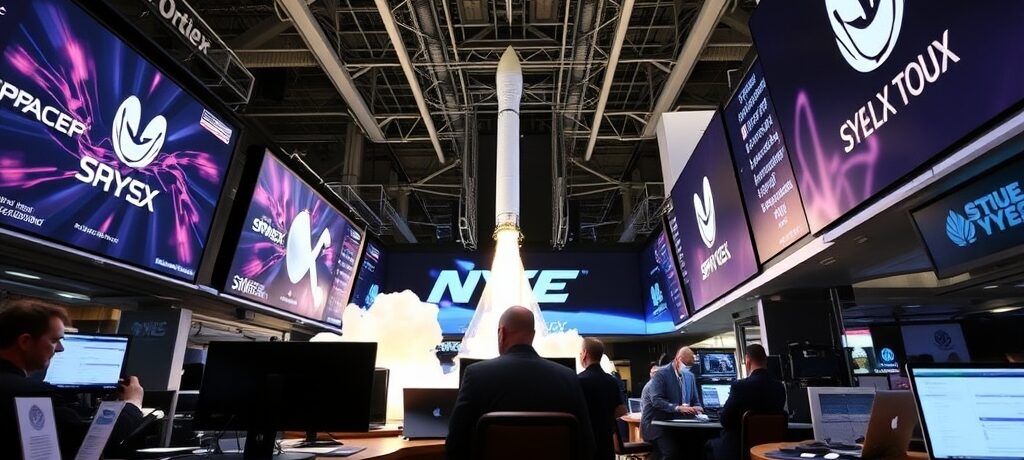
The anticipated initial public offering (IPO) of Elon Musk’s SpaceX has sent ripples through the space industry, sparking a notable rally among related stocks. While direct investment in SpaceX remains unavailable to the public, the impending listing, potentially valuing the company at an estimated $1.75 trillion, has redirected investor attention to other players in the burgeoning space economy. Among these, Intuitive Machines (NASDAQ: LUNR) has emerged as a prominent beneficiary, with its stock price climbing 32.4% over the past month.
Intuitive Machines: A Key Player in Space Infrastructure
Founded in 2013, Intuitive Machines positions itself as a critical space infrastructure company, focusing primarily on satellites and lunar landers. The company boasts a significant operational track record, having launched over 300 spacecraft to date. Currently, it maintains 100 satellites in orbit and has accumulated 177 hours of lunar surface operations, demonstrating its practical experience in extraterrestrial environments.
A cornerstone of Intuitive Machines’ strategy is its deep engagement with NASA. The company secured a substantial $180.4 million contract under NASA’s Commercial Lunar Payload Services (CLPS) initiative. This contract is integral to the Artemis program, NASA’s ambitious endeavor to establish a permanent human presence on the moon. Intuitive Machines’ large cargo class lunar lander, the Nova-D, appears to be NASA’s preferred choice for early missions within the Artemis framework, tasked with delivering essential materials to the lunar surface. Furthermore, the company is actively developing the RACER, or Reusable Autonomous Crewed Exploration Rover, for future lunar exploration.
Navigating Financial Realities as a Young Enterprise
Despite its operational achievements and strategic partnerships, Intuitive Machines, as a relatively young company, presents a profile suited for speculative investment. Its financial performance, while showing signs of improvement, underscores its reliance on external investment and grants, particularly from organizations like NASA.
Recent financial data reveals a mixed picture. The company generated $207.13 million in revenue in 2025, marking a 9.15% decrease from its 2024 revenue of $228 million. However, the 2024 figure itself represented a significant surge, nearly tripling the $79.5 million reported in 2023. This volatility highlights the project-based nature of its revenue streams.
Profitability remains a challenge for Intuitive Machines. The company reported a net margin of -51.58% in 2025, though this represents a substantial improvement from the -152.16% net margin recorded in 2024. Concurrently, its net losses narrowed considerably, decreasing from $346.9 million in 2024 to $106.8 million in 2025. This trend suggests a move towards greater financial efficiency.
Strengthening Cash Position Amidst Growth
A key positive indicator for Intuitive Machines is its robust cash position. The company reported $582.6 million in cash and cash equivalents, more than double the $207.6 million held at the end of 2024. This strong cash reserve significantly outweighs its total liabilities of $553.4 million, providing a solid foundation to fund its ongoing growth initiatives and mitigate some of the risks associated with its unprofitability.
Analysts suggest that while Intuitive Machines’ financials are still developing, its expertise in space cargo delivery, coupled with significant contracts from NASA, positions it as an intriguing, albeit speculative, investment opportunity within the space sector. The company’s financial standing is noted to be stronger than many of its peers in the nascent space industry, making it a compelling consideration for investors seeking exposure to this high-growth, high-risk market segment.
The broader market sentiment, buoyed by the impending SpaceX IPO, continues to draw attention to companies like Intuitive Machines. While the Motley Fool Stock Advisor analyst team did not include Intuitive Machines in their recent list of 10 top stock picks, the company’s specific niche, established operational capabilities, and improving financial metrics make it a notable player for those willing to undertake a calculated, speculative bet on the future of space exploration and infrastructure.