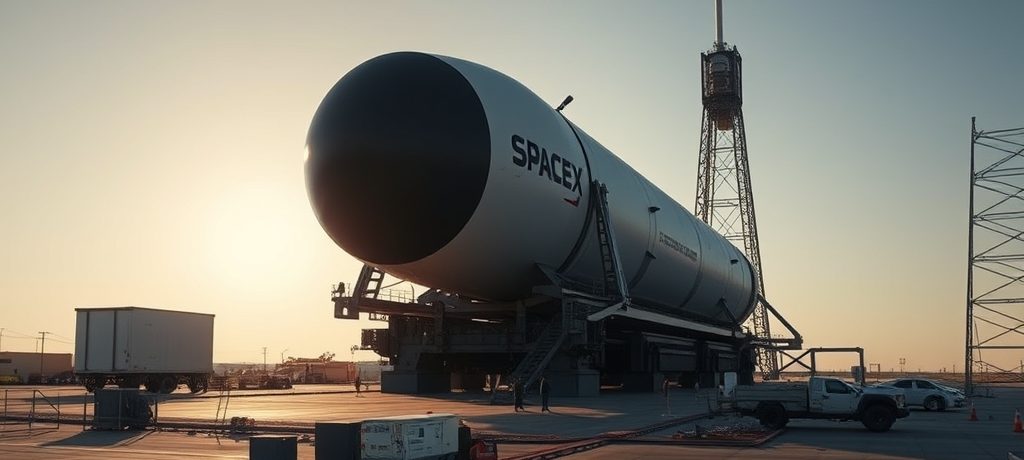
Elon Musk’s SpaceX is on the cusp of a monumental shift, preparing for an initial public offering (IPO) that could redefine the company, the broader stock market, and Musk’s personal fortune. The impending public sale of shares, scheduled to begin trading on June 12, represents a significant gamble, with the company seeking a staggering valuation of $1.75 trillion.
A Staggering Valuation on Ambitious Bets
This valuation places SpaceX among the top 10 most valuable companies globally, a remarkable feat for an entity that reported a net loss of nearly $5 billion (£3.7 billion) last year. The prospectus for the IPO, which aims to make life multiplanetary and extend consciousness to the stars, reveals that the company is not solely focused on its renowned rocketry. Instead, a substantial portion of its future success hinges on artificial intelligence (AI).
SpaceX is bundling its AI venture, xAI, into the public offering. The company’s vision extends to establishing data centers in space, leveraging solar power and the vacuum for immense computing capabilities, alongside ambitious plans for human bases on the Moon and Mars. The total addressable market identified by SpaceX for its services is $28.5 trillion, with an overwhelming $26.5 trillion attributed to AI.
The AI Conundrum
This aggressive pivot towards AI raises questions about the company’s core identity. While SpaceX’s launch capabilities are unparalleled, dwarfing those of any other nation or company, and its Starlink satellite network has demonstrated critical geopolitical utility, these established businesses are estimated to be worth around $300 billion. This figure represents less than 20% of the company’s target valuation.
Economist Sinead O’Sullivan, who has previously worked with NASA, expressed skepticism, stating, “If we look at the business itself, it’s really unclear as to what business or industry SpaceX is even in.” She further noted that while the brand is built on rocketry, significant capital expenditure is directed towards data centers and an AI company that appears more focused on social media than space exploration. O’Sullivan characterizes the venture as “an Elon Musk ego project” and suggests investors are buying into the “Elon Musk brand more than any kind of space industry.”
Investor Enthusiasm and Control Concerns
Despite these uncertainties, there is palpable excitement surrounding the IPO. Several UK stockbrokers have reported a surge in interest from retail investors eager to participate. Hargreaves Lansdown’s Chief Client Officer, Simon Belsham, anticipates the IPO could be a gateway into investing for a new generation. It is estimated that UK retail investors could be allocated approximately £1.5 billion worth of shares.
However, the structure of the offering raises concerns about investor control. Elon Musk, as founder, CEO, chief technical officer, and chairman, wields significant power. Despite owning 42% of the company, his shares carry super-voting rights, granting him effective control over 85%. Financial journalist Robert Armstrong questions the nature of ownership in such a scenario, suggesting investors should receive a discount for forfeiting control.
One institutional investor anonymously told the BBC that the “cult of Elon Musk requires disciples to pay a premium for the questionable privilege of having no real say in how the company they own is run. But people seem happy to do that.” Musk’s controversial use of his power and wealth, including substantial political donations and involvement in international affairs, adds another layer of complexity for potential investors.
Musk’s Proven Track Record
Nevertheless, history suggests that betting against Elon Musk is a precarious strategy. His success with Tesla, which within two decades of its founding surpassed the combined market capitalization of established automotive giants like Toyota, Ford, General Motors, and Volkswagen, underscores his ability to challenge industry norms and defy expectations. With a personal fortune already exceeding $700 billion and projected to reach over $1 trillion, Musk’s track record of turning ambitious visions into market-dominating realities is undeniable.
The SpaceX IPO is more than just a financial event; it is a referendum on the unchecked optimism surrounding AI and a test of how far investors are willing to go to back a visionary, even with significant unanswered questions about the company’s long-term strategy and governance. The success or failure of this offering will undoubtedly shape the future of space exploration, AI development, and the very definition of corporate value in the 21st century.