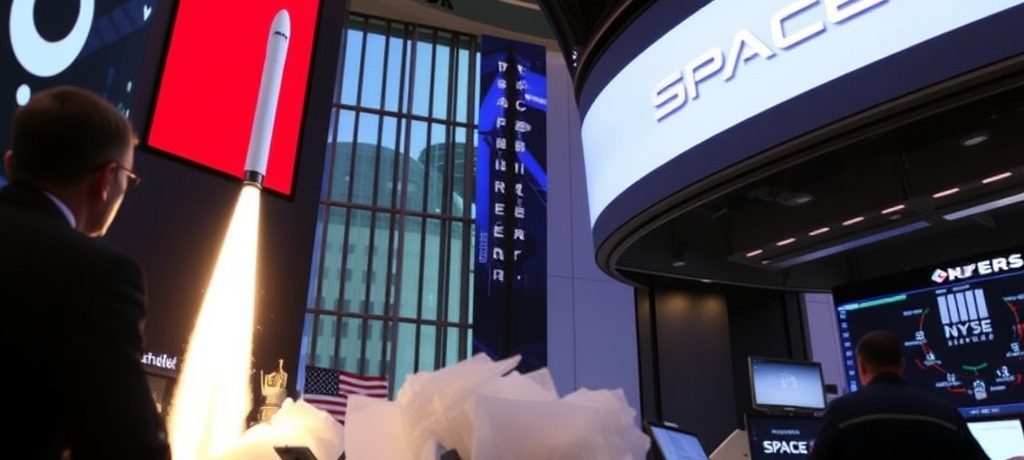
Millions of investors are poised to become indirect owners of Space Exploration Technologies (NASDAQ: SPCX) stock, whether by design or default, following the company’s swift inclusion in two major market indexes. Just weeks after completing the largest initial public offering (IPO) in history on June 12, SpaceX has been fast-tracked into the Russell 1000 and the Nasdaq-100, triggering billions in mandatory purchases by index-tracking funds.
nn
Rapid Index Inclusion Mandates Fund Purchases
n
The rocket and satellite company’s journey from IPO to index component has been remarkably quick. On Friday, June 27, 2026, SpaceX was officially added to the Russell 1000. This move was facilitated by a new rule implemented by FTSE Russell, which oversees the Russell indexes, allowing the largest new listings to enter the index after just five trading days, bypassing the traditional waiting period for scheduled reconstitutions.
n
The momentum continues as SpaceX is also slated for inclusion in the Nasdaq-100. This addition is expected to occur before the market opens on July 7, driven by Nasdaq’s own fast-entry route adopted this year, which permits significant new listings after 15 trading days. These rapid inclusions mean that any fund designed to track either the Russell 1000 or the Nasdaq-100 must now acquire SpaceX shares, irrespective of individual investment theses.
nn
Billions in Capital Inflows Expected
n
The implications for capital flows are substantial. According to various estimates, the Russell 1000 inclusion alone could force over $4 billion in buying. The Nasdaq-100 addition is anticipated to drive approximately another $4 billion in purchases. When accounting for other funds tracking related benchmarks, the total sum of mandated buying is expected to climb even higher.
n
This forced buying comes at a time when SpaceX shares have experienced a cooling period. The stock, trading at about $153 as of this writing, has declined approximately a third from its post-IPO high of about $226, reached on June 16. It is crucial to note that these index-driven purchases do not reflect a fundamental view on SpaceX’s investment merit. Index funds operate under strict rules, buying stocks because they are mandated to, not based on growth prospects, profitability, or valuation analysis.
nn
S&P 500 Holds Firm on Profitability Screen
n
A notable exception to this widespread inclusion is the S&P 500, the benchmark tracked by the majority of retirement dollars. S&P Global’s S&P Dow Jones Indices has declined to relax its stringent standards for SpaceX, maintaining its profitability screen. To qualify for the S&P 500, a company must demonstrate four consecutive quarters of positive earnings under generally accepted accounting principles (GAAP).
n
SpaceX currently does not meet this criterion. The company reported a loss of approximately $4.9 billion in 2025 and posted another loss in the first quarter of 2026. This distinction highlights a fundamental difference in index methodologies: while some indexes prioritize market capitalization and liquidity, the S&P 500 maintains a focus on demonstrated financial performance, specifically profitability.
nn
SpaceX’s Financial Landscape and Valuation
n
SpaceX’s financial profile reveals a company with significant revenue but also substantial expenditures. In 2025, the company generated approximately $18.7 billion in total revenue. Its Starlink satellite-internet service emerged as the primary profit driver, contributing about $11.4 billion in revenue, or roughly 61% of the company’s total, and growing close to 50% from the previous year. The launch business, by comparison, was smaller and experienced about 8% growth.
n
Despite strong revenue from Starlink, SpaceX incurred overall losses, primarily weighed down by considerable spending on its ambitious Starship rocket program and the absorption of Elon Musk’s AI start-up, xAI, earlier this year. The market’s optimism is clearly reflected in its valuation; with a market capitalization of about $2 trillion, SpaceX trades at more than 100 times its annual revenue. The absence of profitability means there is no price-to-earnings ratio to provide a traditional anchor for its valuation.
nn
For millions of investors holding Russell 1000 or Nasdaq-100 index funds, indirect ownership of SpaceX is now a reality. However, this inclusion, driven by rule changes rather than fundamental analysis, underscores a critical distinction. Being added to an index does not inherently equate to being a sound investment. The long-term value of SpaceX will ultimately depend on the continued growth of Starlink and the company’s ability to achieve sustained profitability, rather than its recent index memberships.