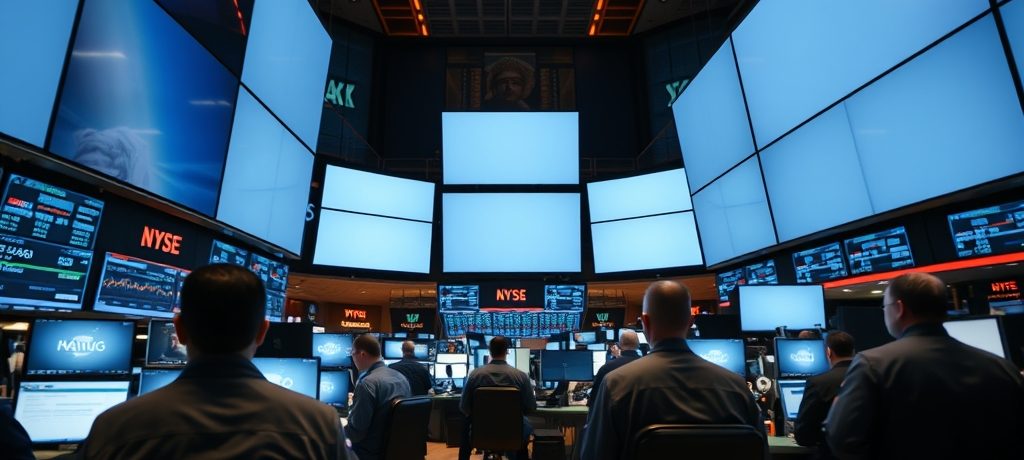
NEW YORK — While the daily headlines surrounding Elon Musk, SpaceX, and the latest initial public offerings (IPOs) might seem like distant noise, the reality for millions of American savers is that their 401(k) accounts are increasingly intertwined with these market-moving events. The recent stock market debut of SpaceX, now valued at a staggering $2.1 trillion, serves as a stark illustration of how even the most hands-off investors are being drawn into the orbit of these colossal new entrants.
SpaceX’s stock launched 19.2% higher in its Wall Street debut, propelling its market capitalization beyond the combined values of Exxon Mobil, Bank of America, and Coca-Cola. This immense valuation means that, regardless of individual investor sentiment, SpaceX is on a trajectory to join high-profile stock indexes, fundamentally altering the composition of funds that underpin countless retirement portfolios.
The Unavoidable Pull of Index Funds
The growing influence of companies like SpaceX on retirement savings stems directly from the pervasive shift towards index funds. These funds, designed to simply mimic the performance of specific market indexes, have become the investment vehicle of choice for a vast number of Americans. According to Morningstar’s data through 2025, only 21% of actively managed U.S. stock funds managed to survive and beat their average index peer over the last decade. This disparity in performance, coupled with lower costs, led to more money being invested in U.S. index funds than actively managed ones starting in 2024, a gap that has only widened since.
Index funds operate on a straightforward principle: if a stock is large enough to meet the qualifications for inclusion in an index, the fund will buy it. The S&P 500, arguably the most famous and influential index, tracks 500 of the biggest U.S. stocks, with trillions of dollars directly mimicking or benchmarking against it. Other significant indexes include the Nasdaq 100, which tracks the 100 largest non-financial companies on the Nasdaq, and the Dow Jones Industrial Average, though the latter tracks only 30 stocks and receives less attention from Wall Street.
Mega IPOs Challenge Index Entry Rules
The emergence of companies like SpaceX, Anthropic, and OpenAI, which swell to tremendous sizes through private investment before their public debuts, is forcing a reconsideration of traditional index entry rules. Nasdaq, for instance, has already adapted, changing its rules to allow some huge companies to join its Nasdaq 100 index after just 15 trading days. This is a significant departure from past practices, which typically involved an annual reconstitution in December to ensure the index included the 100 largest non-financial companies.
This rule change means that popular funds tracking the Nasdaq 100, such as Invesco’s QQQ exchange-traded fund, which holds approximately $477 billion in total investments, could soon acquire shares of SpaceX without their individual holders taking any direct action. Anthropic and OpenAI, two other massive AI-related companies, are also looking to sell their stocks soon, with potential valuations approaching $1 trillion each.
However, not all index providers are moving at the same pace. The company behind the S&P 500 maintains stricter criteria. For a stock to join the S&P 500, it must trade on an eligible exchange for at least 12 months. Furthermore, S&P Dow Jones Indices requires companies to have made a profit in their most recent quarter and over the sum of their last four quarters. SpaceX currently does not meet this profitability requirement, having reported a $4.9 billion loss last year and another $4.3 billion through the first three months of 2026, and acknowledges it “may not achieve profitability in the future.”
Governance Concerns Amid Passive Ownership
The automatic inclusion of mega-cap stocks into index funds also raises questions about corporate governance. Officials from major pension funds, including the California Public Employees’ Retirement System and the New York state and city comptrollers, recently sent a letter to SpaceX decrying its corporate governance. Their concern centers on Elon Musk’s substantial control over the company through a special class of stock with enhanced voting power, which they argue would make him “essentially unfireable without his own consent.”
These pension fund officials highlighted that they could become owners of SpaceX stock simply by holding index funds. This scenario underscores a critical aspect of passive investing: index funds track indexes, and if a stock is in an index, the fund will buy it, even if investors or their representatives have reservations about the company’s valuation or governance practices. Tesla, for example, has remained in the S&P 500 despite years of critics calling it overvalued, growing to become one of Wall Street’s 10 biggest companies. While some specialized indexes, like the S&P 500 ESG index, do apply additional criteria and famously kicked Tesla out in 2022, investors must actively seek out such funds if they wish to apply specific ethical or governance filters.
The rapid ascent of privately funded giants before their public market debuts is fundamentally reshaping the investment landscape. For the millions relying on index funds for their retirement savings, the once-ignorable hubbub around companies like SpaceX is now an undeniable force directly influencing their financial future, demanding a closer look at the mechanisms that govern their passive investments.