President Donald Trump recently visited Milford, Michigan, to champion his tariff policies, asserting that they have led to unprecedented prosperity for car companies and a thriving Michigan economy. However, this optimistic portrayal clashes with economic realities on the ground, where rising costs and inflation are causing concern even among some of his most loyal supporters.
nn
Trump’s Economic Claims Versus Reality
n
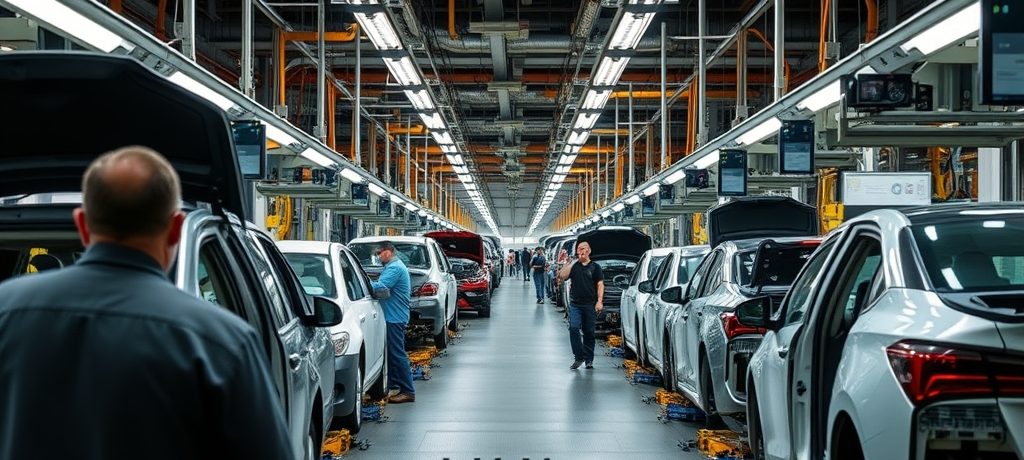
During a rally at General Motors and a tour of new vehicles, President Trump declared that “car companies are doing better than they’ve ever done” and that “it’s amazing what tariffs will do for General Motors,” attributing this success entirely to his administration. He further stated that “Michigan is thriving.” This narrative, however, is not fully supported by economic metrics.
n
Tariffs have imposed a significant financial burden, costing businesses in Michigan and nationwide billions of dollars. Concurrently, these policies have contributed to persistent inflation, which has continued to run “hot,” contrary to the president’s previous assurances that his business acumen would mitigate such issues. Many Americans perceive tariffs as a direct cause of higher prices, a sentiment compounded by increased gasoline prices due to the war in Iran, collectively eroding consumer confidence and keeping the president’s approval ratings low.
nn
Michigan’s Economic Contradictions and Voter Sentiment
n
The divergence between presidential rhetoric and economic reality is particularly acute in Michigan, a critical battleground state ahead of upcoming midterm elections. Despite the adoring crowd at his Milford rally, some ardent Trump supporters voiced concerns about the economic strain. Lisa Scherer, a 64-year-old former landscaping company owner, bus driver, and union steward, acknowledged that high gas prices are “hurting a lot” and that affording necessities is “very rough.” Yet, she maintained, “I’m just hoping, if we hang in there,” expressing continued belief in the president’s overall performance.
n
Michigan’s economy is deeply intertwined with Canada through heavily integrated supply chains, a result of decades of policies aimed at reducing bilateral trade barriers, including the United States-Mexico-Canada Agreement (USMCA) from Trump’s first term. The administration’s decision not to renew USMCA, coupled with new import taxes and plans to impose 50% tariffs on many Canadian imports by invoking the Tariff Act of 1930, introduces significant uncertainty and potential disruption. General Motors, while “honored to spend time showcasing our vehicles and facilities” for Trump, has consistently stated that tariffs increase production costs, leading the president to extend a reprieve from auto-part tariffs until 2030.
n
The impact on the state’s job market is also evident. Michigan has seen a loss of 8,300 manufacturing jobs since Trump announced his “Liberation Day” tariffs in April of last year, according to the Bureau of Labor Statistics. Auto parts manufacturing jobs specifically declined by approximately 4,000 statewide through June compared to the same month last year, with only modest increases in overall auto sector job creation during Trump’s second term.
nn
Supporters Divided on Short-Term Pain, Long-Term Gain
n
While some supporters express immediate concerns, others view the tariffs as a necessary, albeit painful, long-term strategy. Joe Miskovich, a 57-year-old aerospace business owner from Fenton, Michigan, urged the “American public needs to look at the bigger picture,” suggesting that while “there might be a little higher increase in price,” the “long-term effect is going to be absolutely positive to the nation.” Similarly, Roy Parks, a 49-year-old self-employed handyman, described the situation as a “short-term pinch, short-term pain, but long-term good,” likening it to “ripping off the Band-Aid.”
n
However, veteran Michigan pollster Bernie Porn offered a starkly different perspective, questioning the president’s economic pronouncements: “When I was listening to him, I said, ‘What planet are you on?’” Porn noted that tariffs are “helping intensify voters’ concerns about inflation and affordability,” and that Trump “is like an anchor around Republicans” nationally, potentially impacting voter turnout in November.
nn
Future Investments and Political Stakes
n
Despite the current economic headwinds, some auto companies have pledged future investments in U.S. production. General Motors announced in June 2025 plans to invest $4 billion to shift some vehicle production from Mexico to the U.S. starting next year. Ford and Stellantis have similar timelines for expanding domestic operations, and Toyota committed $3.6 billion to relocate Tacoma pickup production from Mexico to Texas over approximately four years. However, these benefits “aren’t being felt yet.”
n
Politically, the president has actively used endorsements to bolster candidates aligned with his agenda, such as Congressman John James in Michigan’s Republican gubernatorial primary. Former Rep. Mike Rogers, running for Senate, echoed this sentiment at the rally, advocating for a senator who promotes Trump’s agenda. Yet, the economic anxieties persist, with Lisa Scherer expressing concern that the president “forgot about the people on a fixed income,” like herself, who relies on $1,100 per month in Social Security benefits. Michigan House Speaker Matt Hall, while praising tariffs at the rally, also highlighted a new fighter jet mission that secured the future of the state’s Selfridge Air National Guard Base as an example of “putting Michigan first.”
n
The ongoing debate over tariffs and their economic consequences in Michigan underscores a broader national challenge: reconciling presidential assurances of prosperity with the tangible financial pressures faced by everyday Americans. As the midterm elections approach, the ability of voters to reconcile these competing narratives will be a crucial factor in the state’s political landscape.