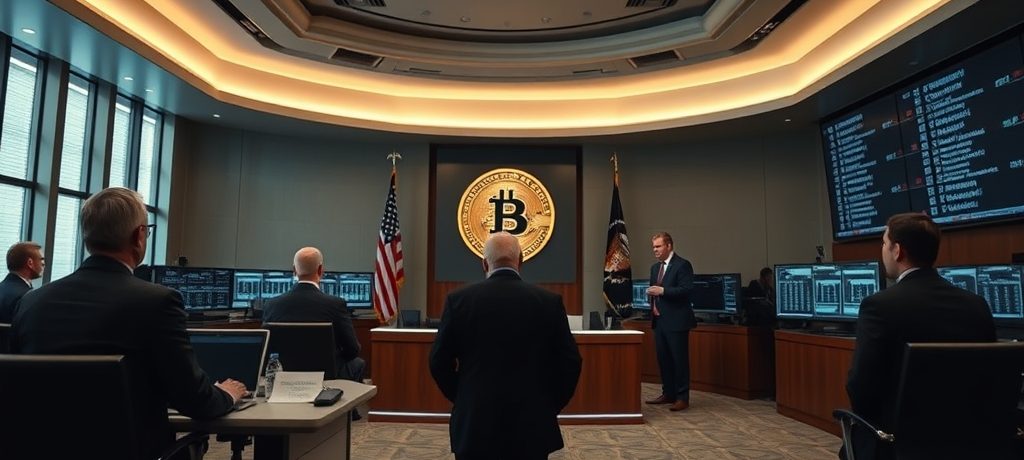
The Trump administration is renewing its efforts to establish a Strategic Bitcoin Reserve, a development that, if realized, could serve as a profound and lasting catalyst for the cryptocurrency market. This renewed push comes sixteen months after President Donald Trump initially issued an executive order to create such a reserve, an initiative that has largely remained “on paper” until now.
nn
The initial executive order established the reserve by utilizing Bitcoins seized during legal proceedings. However, it notably failed to allocate capital for purchasing additional Bitcoin or secure the necessary congressional legislation to formalize its structure and operations. This procedural gap has left the ambitious plan in a state of limbo, prompting the current renewed drive to overcome these obstacles.
nn
Current U.S. Bitcoin Holdings and Management Challenges
nn
The U.S. government is already a significant holder of Bitcoin, with an estimated 323,693 Bitcoins in its possession, valued at approximately $21.2 billion. This substantial holding represents about 1.5% of Bitcoin’s total possible supply. However, these assets are not centrally managed; they are “spread across many federal agencies,” which, according to the source, “makes them difficult to manage and to determine how many there are.” This decentralized custody underscores the need for a more unified and strategic approach, which a formal reserve aims to provide.
nn
Patrick Witt, the White House crypto advisor, has explicitly stated that for the reserve to function effectively, “Congress must formally back the reserve.” Without a bill mandating its creation having passed, Witt believes “the reserve will probably remain unimplemented for now.” Furthermore, attempts to establish the reserve through “non-legislative approaches have been stymied by certain existing regulations and laws,” highlighting the deep-seated procedural complexities involved.
nn
Legislative Hurdles and Political Realities
nn
The legislative path for a Strategic Bitcoin Reserve faces considerable challenges. Senator Cynthia Lummis’s proposed Bitcoin Act, for instance, aims to direct the Treasury Department to acquire 1 million Bitcoins over a five-year period and hold them for a minimum of two decades. Despite its potential impact, this bill “has been stalled in committee since last spring” and may not garner sufficient attention to secure a spot on the Congressional calendar before the year’s end.
nn
The political landscape further complicates matters. The source notes that “given the balance of power in Congress, after the midterm elections, there may not be any window of opportunity whatsoever to advance a bill mandating the creation of the reserve anyway.” This assessment suggests that investors should temper expectations, as the immediate future of a U.S. strategic Bitcoin reserve remains uncertain. Consequently, the article advises against basing an “investment thesis for buying Bitcoin on its inclusion in the U.S. reserve in the near future.”
nn
Potential Upside: A Supply Shock and Global Re-rating
nn
Despite the current hurdles, the potential implications of a successful Strategic Bitcoin Reserve are substantial. If such a reserve were to be established, or if the Bitcoin Act or similar legislation were enacted, it “would be a huge and enduring catalyst for Bitcoin.” With most of Bitcoin’s total supply already mined, a sovereign entity like the U.S. “locking away close to 5% of its supply for a minimum of two decades” would create a “slow-motion supply shock.”
nn
This action, combined with existing holdings by Bitcoin exchange-traded funds (ETFs) and corporate treasuries, would significantly reduce the available circulating supply. The source posits that if “the U.S. ever truly treats Bitcoin as a strategic asset like gold, other governments would need to decide whether to jump on the bandwagon.” Such a scenario would likely lead to the coin’s price permanently re-rating upward, reflecting its newfound status as a globally recognized strategic asset. However, the article cautions investors not to “hold your breath for that to happen.”
nn
Ultimately, while the prospect of a U.S. Strategic Bitcoin Reserve holds immense potential for the cryptocurrency’s valuation, its realization is fraught with political and procedural difficulties. Regardless of governmental action, Bitcoin’s inherent supply dynamics—guaranteeing it will be “harder to produce and in shorter supply in the future than it is today”—continue to make it a compelling asset. Should the government decide to sequester more of it, that would simply be “the icing on the cake” for existing supply-side fundamentals.