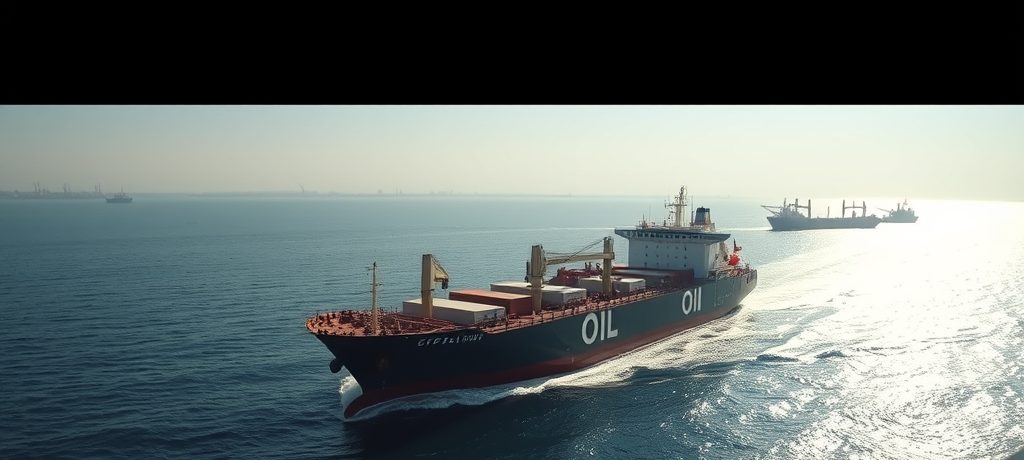
Crude oil prices experienced a significant downturn on Monday, with West Texas Intermediate (WTI) futures plummeting over 5%, following the announcement that the United States and Iran have reached a preliminary agreement to resolve their protracted conflict. The deal, slated for signing on Friday, is set to immediately restore the free flow of oil and energy trade through the strategically vital Strait of Hormuz, alleviating market concerns over supply disruptions that have persisted for months.
WTI Crude Oil for July delivery was last observed trading down by $4.31, representing a substantial 5.08% decline, to settle at $80.57 per barrel. This sharp drop comes after two consecutive sessions of losses last Friday, signaling a decisive market reaction to the de-escalation of tensions between the two nations.
Geopolitical Breakthrough and Market Repercussions
The breakthrough marks an end to a conflict that commenced on February 28 and has spanned more than 100 days. U.S. President Donald Trump had previously indicated last week that a preliminary deal with Iran was imminent. On Sunday, President Trump confirmed via Truth Social that negotiations on an agreement with Iran were complete and that a signing ceremony would take place on Friday. This sentiment was echoed by Iran’s Deputy Foreign Minister Kazem Gharibabadi, who reaffirmed that a deal had indeed been reached.
The Memorandum of Understanding (MoU) is expected to be unveiled after a signing ceremony in Switzerland, an event which will be hosted by Pakistan. Both Pakistan and Qatar played crucial intermediary roles in facilitating the agreement. A key immediate outcome of the deal is President Trump’s authorization for the toll-free opening of the Strait of Hormuz, alongside the lifting of a naval blockade previously imposed on vessels traveling to and from Iranian ports. President Trump further stated that once sea mines, reportedly laid by Iran during the conflict, are removed, traffic would flow freely across the strait. He lauded the agreement as an accomplishment that his predecessors had been unable to achieve.
Confirming the swift operationalization of the agreement, President Trump messaged on Monday that ships were already beginning to move, with many reportedly loaded with oil, indicating a smooth and rapid reopening of the critical waterway. This immediate resumption of trade is the primary driver behind the sudden easing of supply-disruption concerns that have kept crude prices elevated.
Details of the Accord and Future Challenges
While the full text of the MoU remains undisclosed, preliminary reports suggest its immediate focus is on ensuring the quick reopening of the Strait of Hormuz. Other more complex and crucial issues have been deferred for discussion during an extended 60-day ceasefire period. These critical sticking points include the unfreezing of Iran’s assets held in foreign countries, the lifting of U.S. sanctions on Iranian exports, the ongoing Israel-Lebanon conflict, Iran’s nuclear ambitions, and the removal of weapons-grade uranium from Iran.
U.S. Vice President JD Vance, in an interview with CNBC, acknowledged that numerous details have been pushed to future talks but expressed optimism, asserting that the U.S. holds a strong negotiating position. Vance also indicated that the Strait of Hormuz would remain toll-free in the long term. Concurrently, Iran’s Foreign Ministry spokesperson Esmail Baghaei confirmed that Iran would not seek to collect tolls on ships transiting the strait, reinforcing the commitment to unimpeded maritime trade.
Despite the immediate positive impact, President Trump had previously issued a cautionary note in an interview with the New York Times, stating that if Iran failed to reach an accord with the U.S., he would restart attacks on Iran and position the U.S. as a guardian of the Middle East, demanding 20% of the region’s revenues in return. This underscores the delicate balance and potential for future volatility should the broader negotiations falter.
Broader Economic Implications
The market’s reaction extended beyond crude oil. Globally, stock markets responded positively to the announcement, reflecting a broader sense of relief. With oil-linked inflationary pressures showing symptoms of easing, the U.S. dollar index also registered a slight decline, last seen trading at 99.58, down by 0.16 points, or 0.16%, today. This suggests that the de-escalation of geopolitical tensions and the prospect of stable energy supplies are contributing to a more favorable global economic outlook, at least in the short term, as the market digests the implications of this significant preliminary agreement.