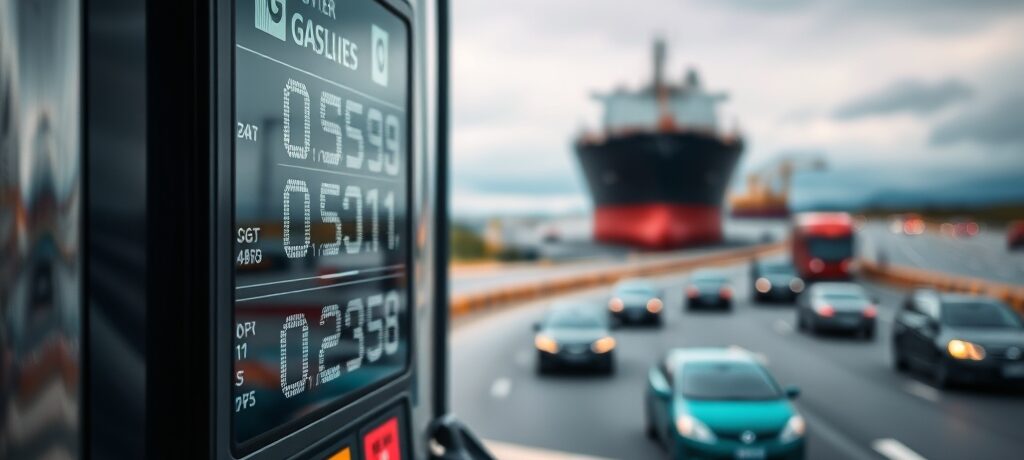
U.S. drivers are currently grappling with the highest fuel costs seen since 2022, as the national average for a gallon of gas surpassed $4 on Tuesday, April 2, 2026, according to AAA. This rapid ascent in pump prices, often changing daily or even between nearby stations, is largely a consequence of a volatile global oil and gas market, with factors far removed from the control of local gas station operators.
Geopolitical Tensions and Crude Oil Dynamics
The primary catalyst for the current price surge is the ongoing Iran war, which is significantly shaking global oil markets. This geopolitical instability has directly contributed to a jump in crude oil prices, compounded by shipping disruptions in critical waterways like the Strait of Hormuz. According to the U.S. Energy Information Administration, roughly half of the price consumers pay at the pump is attributed to the cost of crude oil, the fundamental ingredient in gasoline. An additional 20% of the price covers the costs incurred by refiners who process crude into usable gasoline.
As these upstream costs escalate, gas retailers are compelled to adjust their pump prices to reflect the higher price they pay for their subsequent fuel shipments. Garrett Golding, assistant vice president for energy programs at the Federal Reserve Bank of Dallas, highlights that most profits within the oil and gas supply chain are generated by companies involved in extracting and refining crude oil. While these entities may experience a period of increased profitability, Golding notes a cautious outlook, as a significant spike in prices could ultimately dampen demand.
The Tight Margins of Local Retailers
Despite the perception that local gas stations profit handsomely from rising prices, industry experts and operators paint a different picture. Lonnie McQuirter, director of operations at 36 Lyn Refuel Station in south Minneapolis, articulated the challenges, stating his margins have become “much tighter.” On Wednesday, his station posted regular gas at $3.399 a gallon, approximately 18 cents below the metro average, according to AAA. McQuirter explained, “We price based on what we’re able to buy fuel at, and how well we can operate.” He attributed the higher prices compared to a month prior primarily to fluctuating wholesale fuel prices, which can shift multiple times daily, alongside increased credit card fees and rising pump maintenance costs.
The financial breakdown of a gallon of gas underscores the limited share for retailers. After crude oil and refining costs, taxes—federal, state, and local—account for nearly 20% of the price. This leaves approximately 10% for retailers, out of which they must cover transportation, labor, and other operational expenses. Data from the convenience store trade group NACS, citing research firm OPIS, indicates that retailers’ markup has averaged about 38 cents per gallon over the past five years. After accounting for all expenses, stations may retain roughly 15 cents per gallon, as noted by Jeff Lenard, a vice president at NACS. “Some make more, some make less,” Lenard added.
Local Variations and Competitive Strategies
While the national average has surpassed $4, the price drivers encounter can vary significantly by state, city, and even individual station. A major contributor to these disparities is taxation; for instance, California’s gas taxes and fees totaled about 71 cents per gallon last year, starkly contrasting with roughly 9 cents in Alaska. Beyond taxes, factors such as distance from refineries, the type of retailer, the volume of fuel sold, and the presence of nearby competitors also influence local pricing.
Neal Walters, a partner focused on energy at the global management consulting firm Kearney, highlighted a common competitive strategy: gas stations often price gasoline aggressively on large outdoor signs to attract drivers, hoping to entice them inside to purchase higher-margin convenience store items. This dynamic illustrates that even local pricing decisions are often driven by competitive pressures rather than an ability to dictate market rates.
Retailers as Price Takers, Not Makers
Patrick De Haan, head of petroleum analysis at GasBuddy, succinctly summarized the retailer’s position, comparing it to a homeowner selling a house: “Whatever the price of oil and gasoline are, they are a price taker, not maker.” When oil prices rise, retailers’ margins frequently shrink because they struggle to pass along increases as quickly as they themselves incur them. Conversely, when oil prices begin to fall, retailers may recover some of those losses, particularly if there’s uncertainty about future supply costs. Golding described this phenomenon as prices tending to “rocket up but tend to drift down like a falling feather.”
Furthermore, higher gas prices can negatively impact a station’s overall profitability by reducing in-store sales, as cash-strapped customers cut back on discretionary spending. This further complicates the financial landscape for small operators like Lonnie McQuirter, who noted that in times of consumer distress, small operators act “more on emotion than greed.” He emphasized the personal toll of seeing customers “having to cut back on certain things in order to afford to live.”
The current landscape of high U.S. fuel prices is a complex interplay of global geopolitical events, volatile commodity markets, and intricate supply chain economics. Far from being a source of windfall profits for local gas stations, these rising costs present significant operational challenges and tighter margins for retailers, who primarily serve as conduits for prices determined by forces largely beyond their control.