Cocoa prices have surged to six-month highs, extending a sharp three-week rally, as severe weather conditions in West Africa, particularly the Ivory Coast and Ghana, threaten global supplies. On Tuesday, September ICE NY cocoa (CCU26) closed up +65 points, marking a +1.14% increase, while September ICE London cocoa #7 (CAU26) rose +43 points, or +1.02%. This upward momentum is primarily driven by immediate disruptions from heavy rainfall and the looming specter of an El Niño weather pattern.
Immediate Supply Disruptions from Heavy Rains
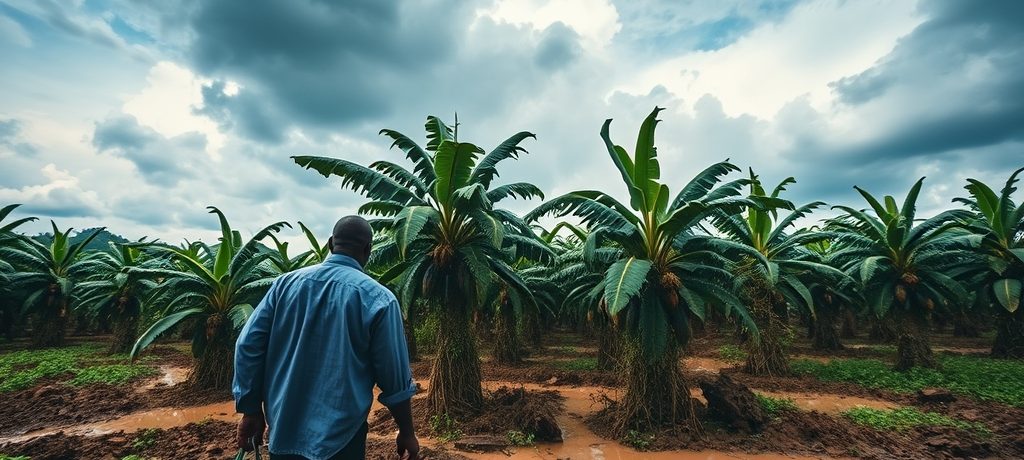
The recent rally in cocoa prices is directly linked to excessive rainfall across key West African growing regions. Heavy rains in the Ivory Coast and Ghana, which together account for more than half of the world’s cocoa production, have led to widespread flooding. This has severely impacted infrastructure, cutting off farmers’ access to their farms and, crucially, to ports for shipping. The logistical bottlenecks created by these conditions are already jeopardizing the timely delivery of current harvests and raising concerns about global supply chains.
Beyond transportation issues, the excessive moisture poses a significant agricultural threat. It increases the risk of prevalent cocoa tree diseases such as brown rot and black pod disease. These diseases are known to reduce yields substantially, further jeopardizing the overall harvest quality and quantity from these vital regions.
El Niño Forecast Adds Medium-Term Pressure
Adding a layer of medium-term support to cocoa prices are future weather concerns centered around the confirmed El Niño weather pattern. On June 10, Japan’s Meteorological Agency officially confirmed the formation of an El Niño across the equatorial Pacific. Historically, an El Niño event typically ushers in warmer, drier conditions across West Africa. Such conditions are detrimental to cocoa cultivation, as they reduce soil moisture, stress cocoa trees, and ultimately lead to lower yields.
The severity of this upcoming weather event is a particular concern for the market. The US National Oceanic and Atmospheric Administration (NOAA) estimates a 67% chance of a “Super El Niño” this year, potentially one of the strongest ever recorded. This forecast amplifies fears of significant yield reductions in the upcoming growing seasons, further tightening an already sensitive market.
Weak Outlook for the 2026/27 Ivory Coast Crop
Market sentiment is also being shaped by early assessments of the 2026/27 Ivory Coast cocoa crop. Initial surveys indicate below-average cherelle formation on cocoa trees, a critical early indicator that signals a weak outlook for the main cocoa harvest, which is slated to begin in September. These early crop assessments project a poor pod development, with an average estimate of 1.8 million metric tons (MMT) for the season starting in September. This figure represents a significant -18% decline from the approximately 2.2 MMT recorded in the 2025/26 season. The markets are now keenly awaiting new surveys scheduled for July to gain a clearer picture of the final crop size.
Further compounding supply concerns, Nigeria, the world’s fifth-largest cocoa producer, also faces a projected decline. Nigeria’s Cocoa Association forecasts that Nigerian cocoa production in 2025/26 will fall by -11% year-over-year to 305,000 MT, down from a projected 344,000 MT for the 2024/25 crop year.
Conflicting Signals: Rising Inventories and Mixed Demand
Despite the prevailing bullish sentiment driven by weather risks, cocoa prices have also contended with countervailing pressures from rising inventories and mixed global demand signals. ICE cocoa inventories recently climbed to a nearly two-year high of 3,082,154 bags on Tuesday, indicating a substantial volume of available stock.
Last month, signs of abundant supply exerted downward pressure on prices. On June 11, the Ivory Coast revised its estimate of cocoa reaching its ports upwards by more than 260,000 MT for the current season. Cumulative data from the Ivory Coast reveal that farmers shipped 2.04 MMT of cocoa to ports between October 1, 2025, and June 28, 2026, marking a +20% increase from the same period a year ago. However, the Ivory Coast also recently stated that its cocoa production in 2025/26 would fall -10.8% year-over-year to 1.65 MMT from 1.85 MMT in 2024/25, presenting a complex picture of supply dynamics. Additionally, Bloomberg reported on June 25 that Nigerian cocoa exports in May rose +28% year-over-year to 18,034 MT, further indicating some pockets of increased supply.
Global demand figures present a varied landscape. The National Confectioners Association reported on April 23 that North American Q1 cocoa grindings declined -3.8% year-over-year to 106,087 MT. Similarly, the European Cocoa Association noted a -7.8% year-over-year fall in Q1 European cocoa grindings to 325,895 MT, a steeper decline than the anticipated -6% and the lowest for a first quarter in 17 years. Conversely, the Cocoa Association of Asia reported an unexpected increase in Q1 Asian cocoa grindings, rising +5.2% year-over-year to 223,503 MT, surpassing expectations of a decline of -6.7%.
Farmer Pay Cuts and Revised Surplus Forecasts
Further market dynamics include recent policy changes regarding farmer compensation in major producing nations. In February, Ghana reduced the official price it pays its cocoa farmers by nearly 30% for supplies destined for the 2025/26 growing season. Following suit, the Ivory Coast announced in March a 57% cut in cocoa farmers’ pay, effective for the mid-crop harvest that commenced in March. These significant reductions in farmer income could influence future planting and cultivation efforts, potentially impacting long-term supply.
Analysts are also adjusting their global surplus forecasts in light of these developments. On April 29, StoneX revised its 2026/27 global cocoa surplus estimate downwards to 149,000 MT from a January forecast of 267,000 MT. This revision explicitly cited risks to the West African cocoa crop stemming from the expected El Niño weather event. StoneX also cut its 2025/26 global cocoa surplus forecast to 247,000 MT from an earlier January estimate of 287,000 MT, signaling a tightening market outlook.
The confluence of immediate weather-induced supply disruptions, the long-term threat of a “Super El Niño,” and a projected weaker Ivory Coast crop has firmly placed West African weather risks at the forefront of cocoa market concerns. While rising inventories and mixed demand provide some counterpoints, the dominant narrative remains one of tightening supply, suggesting continued volatility and upward pressure on cocoa prices as the market navigates these complex climatic and agricultural challenges.