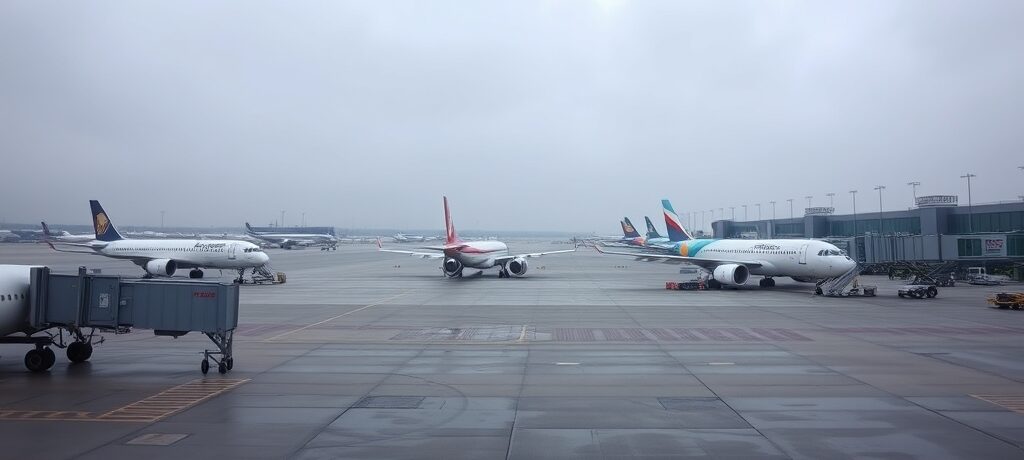
The Lufthansa Group, the German aviation conglomerate overseeing Lufthansa Airlines and several other European carriers, has announced a significant reduction in its flight schedule, cutting 20,000 short-haul flights through October. This drastic measure comes as the ongoing Iran war intensifies pressure on global oil prices and raises profound concerns over the availability and cost of jet fuel, a critical operational expense for airlines worldwide.
The decision, revealed on Tuesday, targets less profitable routes, primarily impacting the company’s key hub airports in the German cities of Frankfurt and Munich. These cancellations are projected to yield substantial savings, equivalent to approximately 40,000 metric tons of jet fuel, underscoring the severe economic pressures driving the group’s strategic adjustments. The Lufthansa Group’s operational consolidation extends beyond its flagship carrier, encompassing Lufthansa Airlines, Austrian Airlines, Brussels Airlines, SWISS, and ITA Airways, with network adjustments also affecting hubs in Brussels, Rome, Vienna, and Zurich. This follows a prior cost-cutting initiative last week, which saw the shutdown of its regional subsidiary, CityLine.
Escalating Fuel Costs and Supply Worries
The aviation industry’s vulnerability to fuel price volatility has been starkly exposed since late February, coinciding with the commencement of the Iran war following U.S. and Israeli strikes. Jet fuel prices have more than doubled in some markets during this period, transforming what is typically one of an airline’s largest operating expenses into an unprecedented financial burden. Data indicates that the global price of jet fuel surged from approximately $99 per barrel at the end of February to as high as $209 a barrel by early April, illustrating the rapid and dramatic escalation.
Geopolitical tensions, particularly fighting around the Strait of Hormuz, have played a pivotal role in disrupting global fuel prices and supplies. This critical waterway off Iran’s coast is a conduit for roughly a fifth of the world’s oil, making any instability in the region a direct threat to energy markets. The head of the International Energy Agency (IEA) issued a stark warning on April 16, estimating that Europe possessed only about six weeks’ worth of jet fuel remaining and cautioning that airlines would be compelled to cut routes without an increase in supply.
Impact on Travelers and Industry-Wide Adjustments
For travelers, the ripple effects of these market dynamics are already manifesting as fewer flight options on certain routes and an increase in associated costs. Airlines across the board are responding to the heightened operational expenses by raising checked bag fees or implementing new fuel surcharges, particularly as the peak summer travel season approaches. This translates into higher fares and reduced flexibility for consumers planning their journeys.
The Lufthansa Group is not an isolated case in scaling back its operations. The broader aviation sector is grappling with similar challenges. According to aviation analytics firm Cirium, all but one of the world’s 20 largest airlines have canceled scheduled May flights, affecting every major global region. This extensive list of carriers includes prominent names such as Delta Air Lines, United Airlines, American Airlines, Air Canada, Emirates, Qatar Airways, Air China, British Airways, and Air France-KLM, highlighting the systemic nature of the current crisis.
Specific Carrier Responses
- Edelweiss Air: The Switzerland-based carrier announced it is discontinuing service to Denver and Seattle for the summer season and reducing flights to Las Vegas through the early autumn.
- Air New Zealand: This carrier is consolidating approximately 4% of its schedule across May and June. Air New Zealand explicitly stated, “Like airlines globally, we’re experiencing jet fuel prices that are more than double what they would usually be,” underscoring the universal impact of the fuel price shock.
In response to the escalating crisis, Lufthansa stated it has secured enough jet fuel “for the coming weeks” and is “pursuing a range of measures” to maintain a stable fuel supply for the summer period. These measures include the “physical procurement of jet fuel,” indicating a proactive approach to mitigate potential shortages. However, the widespread flight cancellations and operational adjustments across major global airlines signal a challenging period ahead for the aviation industry, as companies navigate volatile energy markets and geopolitical uncertainties that continue to reshape their operational strategies and financial outlooks.