The International Monetary Fund (IMF) on Wednesday significantly adjusted its economic outlook for the world economy this year, projecting a sluggish 3% expansion. This modest downgrade from earlier forecasts is primarily attributed to the energy shock stemming from the ongoing Iran war, though booming investment in artificial intelligence (AI) and other advanced technologies is providing a crucial counterweight.
The new forecast for 2026 represents a notable dip from the 3.5% growth recorded in 2025 and is also lower than the 3.1% the IMF had anticipated for this year back in April. Despite the current headwinds, the 191-nation lending organization, which works to promote economic growth and financial stability, expects a rebound to 3.4% growth globally next year.
The War’s Economic Ripple Effect
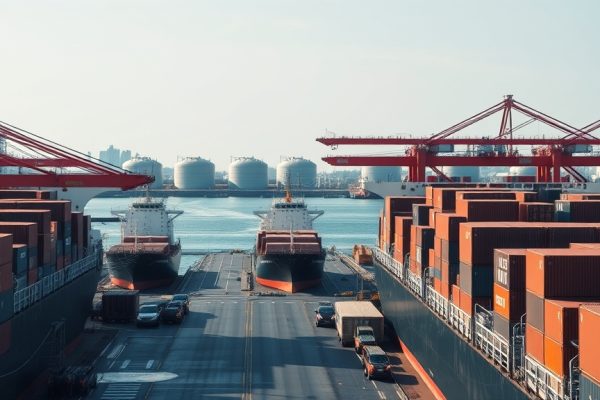
The primary driver behind the revised outlook is the geopolitical instability in the Middle East. On February 28, Iran responded to U.S. and Israeli attacks by shutting down the Strait of Hormuz, a critical maritime choke point through which a fifth of the world’s crude oil and natural gas passes. This action immediately triggered a sharp increase in energy prices, subsequently squeezing businesses and consumers worldwide.
According to the IMF’s latest projections, oil prices are now expected to climb by nearly 32% over the course of 2026. This surge in energy costs is feeding into broader inflationary pressures, with global consumer prices overall forecast to increase by 4.7% this year. This figure marks an acceleration from the 4.1% rise observed in 2025, effectively stalling two years of hard-won progress against inflation.
The IMF’s forecasts are predicated on a critical assumption: that the Strait of Hormuz will reopen later this month, with commercial traffic returning to normal by March 2027. This assumption holds even as U.S. strikes on Iran have resumed and President Donald Trump declared on Wednesday that a ceasefire with Iran was over, underscoring the precariousness of the global economic environment.
AI and Resilience Offer Partial Offset
Despite the severe energy shock, the global economy has demonstrated a degree of resilience. Petya Koeva Brooks, deputy director of the IMF’s research department, noted on Wednesday that “The world economy has weathered the shock from the war better than feared.” This unexpected fortitude is partly due to countries drawing on existing oil stockpiles to mitigate immediate supply disruptions. Furthermore, oil-exporting nations outside the Persian Gulf have stepped up their production, helping to stabilize the market to some extent.
Crucially, booming investment in artificial intelligence and other advanced technologies is playing a significant role in offsetting the economic damage from the conflict. Countries that are both energy producers and beneficiaries of robust AI investment are proving to be more insulated from the war’s adverse economic impacts.
Divergent Regional Performance
The economic impact of these global forces is not uniform, leading to varied growth prospects across major economies:
- United States: The world’s largest economy is expected to exhibit solid growth, with the IMF forecasting a 2.3% expansion this year. This is an increase from 2.1% in 2025 and remains unchanged from the April forecast. The U.S. economy benefits from its status as an energy producer and a hub for AI investment. Additional tailwinds include President Donald Trump’s 2025 tax cuts, significant gains in productivity, and a strong stock market.
- Eurozone: The 21 European countries that share the euro currency are collectively forecast to grow by a mere 0.9% in 2026, a downgrade from 1.4% in 2025. These nations, heavily reliant on energy imports, have been particularly hard hit by the higher energy prices resulting from the conflict.
- China: The world’s second-largest economy is projected to expand by 4.6% this year. While this is a slowdown from 5% in 2025, it is slightly faster than the IMF’s April expectation. China faces challenges from elevated energy prices and an ongoing property market collapse. However, these are being partially offset by substantial public works spending, a surge in high-tech manufacturing, and booming exports.
- India: Once again, India is anticipated to be the world’s fastest-growing major economy, with a projected growth rate of 6.4%. Although this marks a moderation from a sizzling 7.7% last year, it is driven by robust consumer spending.
The complex interplay of geopolitical conflict, inflationary pressures, and technological advancements defines the current global economic landscape. While the Iran war presents a substantial drag, the mitigating factors, particularly the surge in AI investment and strategic energy responses, have prevented a more severe downturn, setting the stage for a potential recovery in the coming year, provided geopolitical stability improves.