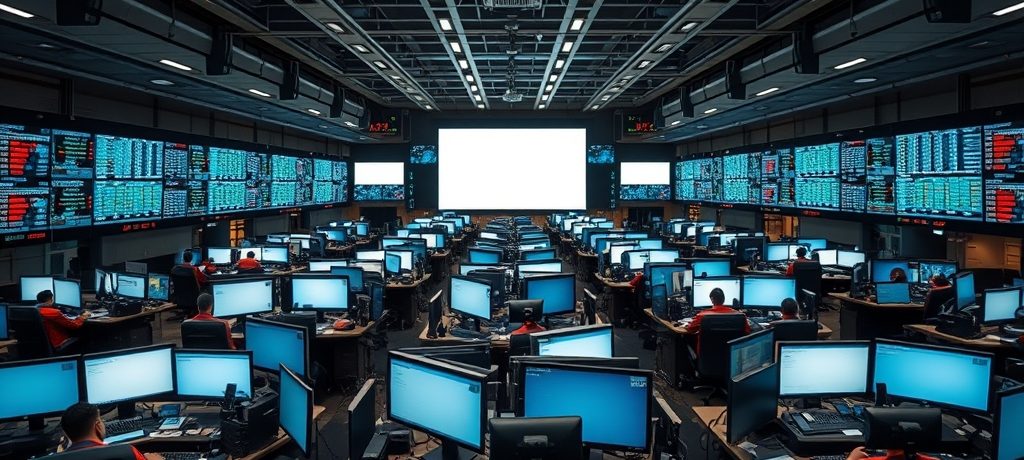
Federal Reserve Chairman Kevin Warsh’s recent press conference, devoid of any forward guidance on interest rate policy, has plunged already-stressed S&P traders into a new realm of uncertainty, triggering immediate and wild market swings. This ‘silent treatment’ from the central bank comes at a time when investors are already grappling with a relentless run of challenges, from geopolitical conflicts and tariff disputes to persistent inflation.
Guidance Vacuum Fuels Market Anxiety
The issue reached a critical point this week when Chairman Warsh concluded his press conference without offering any indication of whether or when the Federal Reserve plans to raise interest rates to combat stubbornly rising prices. This decision proved particularly perplexing given that three of the 12 members on the Federal Reserve Open Market Committee (FOMC) voted for immediate rate hikes – a notable divergence from the committee’s typical near-unanimous consensus. Wall Street professionals, accustomed to the Fed’s forward guidance as a tool to reduce market volatility, were quick to express their dismay.
Immediate Market Aftershocks
The lack of clarity immediately spooked traders, culminating in a wild final hour of trading on Wednesday. The S&P 500 Index experienced its worst selloff on a Fed decision day since December 2024. Concurrently, the yield on 10-year Treasury bonds leaped to its highest level since January 2025, signaling investor demand for higher returns in a more uncertain environment. Further underscoring the heightened fear, the Cboe Volatility Index, or VIX, vaulted above 20, a level widely interpreted as indicative of increased market apprehension.
Wall Street’s Sharp Rebuke
‘I was really shocked at how poorly I thought that press conference went,’ stated Marta Norton, chief investment strategist at Empower, reflecting a sentiment echoed across financial circles. Experts argue that the absence of a clear ‘anchoring thesis’ from the Fed forces the market to factor in a confluence of complex variables without a guiding hand. Karl Schamotta, chief market strategist at Corpay, noted that investors now demand a ‘higher uncertainty premium’ to compensate for the risk that the central bank might delay action on inflation. He provocatively added, ‘Some might call this a ‘moron risk premium,’ but I could not possibly comment,’ in a note to clients. Joe Gilbert, portfolio manager at Integrity Asset Management, articulated the challenge: ‘The market is being forced to factor in a confluence of factors without an anchoring thesis, which has been the Fed’s forward guidance.’
Warsh’s ‘Play the Ball’ Strategy Under Fire
Chairman Warsh, in contrast, appears to be adopting an alternative philosophy, seeking for markets to help guide the central bank rather than the other way around. He described this approach as investors ‘learning to play the ball, not the referee.’ However, investors contend that Warsh’s sports analogy falls short in the current economic climate. The macro forces influencing stock prices are increasingly erratic, making it exceedingly difficult to simply ‘play the ball.’ For instance, President Donald Trump’s efforts to rebuild his tariff wall coincide with the war in Iran causing wild fluctuations in oil prices and inflation expectations. Given the Fed’s pivotal role in setting short-term interest rates in response to such multifaceted factors, the decision to offer no guidance is widely perceived as exacerbating risks in an already volatile market. As Norton succinctly put it, ‘You’re also a player on the court, you’re not just a referee.’
End-of-Week Swings Confirm Volatility
The market’s heightened sensitivity and erratic behavior were starkly evident through the end of the week. After its Wednesday afternoon tumble, the S&P 500 rallied on Thursday and early Friday, only to reverse direction and fall into the red before staging another reversal to end up. This whipsaw action was largely propelled by chip stocks, which have been a significant market driver throughout the year. The Philadelphia Stock Exchange Semiconductor Index (SOX) mirrored this volatility: it sank 5.3% on Wednesday, then soared 8.2% on Thursday, marking its best day since April 2025. On Friday, the SOX jumped another 5% at the start of trading, only to give up its entire gain and turn negative in less than an hour, eventually closing barely in the green.
The Federal Reserve’s deliberate silence, juxtaposed against a backdrop of complex global economic pressures and dissenting internal views, has undeniably introduced a new layer of unpredictability for S&P traders. As markets struggle to find their footing without the traditional anchor of central bank guidance, the expectation for continued wild swings appears to be the new normal.