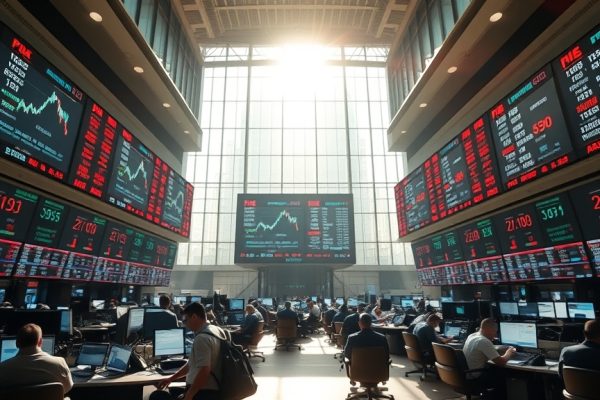
The S&P 500 Index saw a marginal decline of -0.08% on Friday, while the Nasdaq 100 Index experienced a more significant drop of -1.27%, primarily driven by a sharp sell-off in semiconductor stocks. The iShares Semiconductor ETF (SOXX) plummeted by over -4%, as investors grappled with escalating concerns regarding the long-term sustainability of artificial intelligence (AI) demand. This sector-specific downturn overshadowed a positive day for the Dow Jones Industrial Average, which managed a gain of +0.39%, highlighting a fragmented market sentiment.
Semiconductor Sector Under Pressure
The semiconductor industry, a bellwether for technological advancement, faced considerable headwinds despite some positive individual company news. Intel (INTC), for instance, projected a substantial short-term increase in its Q3 sales, forecasting revenue between $15.8 billion and $16.8 billion, well above the analyst consensus of $15.1 billion. This outlook included an anticipated +59% quarter-over-quarter surge in data center sales. However, the market reacted negatively, pushing Intel’s stock down by more than -7%. Broader concerns about potential ‘overspending on data centers and an AI bubble’ fueled the sell-off. Other major chip companies also saw significant declines, with Arm Holdings (ARM), Marvell Technologies (MRVL), Micron Technology (MU), and GlobalFoundries (GFS) all closing more than -5% lower.
Geopolitical Tensions and Trade Tariffs Weigh In
Beyond the tech sector, broader market sentiment was dampened by a confluence of geopolitical developments and new trade policies. President Trump announced a new tariff regime, imposing duties ranging from 10% to 12.5% on 60 nations. These tariffs, based on Section 301 of the Trade Act of 1974 and tied to claims of forced labor in supply chains, replaced a 10% global import tax that expired on Friday. Key exclusions from these new tariffs include fuel, foods, fertilizer, products covered by the North American trade agreement, automobiles, metals, and drugs. Furthermore, the President threatened new tariffs on the European Union in retaliation for the EU’s $1 billion fine against Alphabet.
Geopolitical risks also contributed to market unease. President Trump indicated he is considering a ‘massive attack’ on Iran, stating he holds the nation responsible for recent Houthi missile and drone attacks on two Saudi Arabian oil tankers in the Red Sea. This threat of expanded military action in the Middle East added a layer of uncertainty, particularly after the Houthi vow to blockade shipping linked to Saudi Arabia, which could further disrupt global oil shipments.
Counterbalancing Factors and Economic Data
Despite the bearish pressures, several factors provided some market support. WTI crude oil prices fell by -3% on Friday, reversing about half of Thursday’s +6.17% rally. This decline occurred as oil shipments continued through the Red Sea despite Houthi threats, with some tankers reportedly turning off their location transponders. Additionally, the 10-year T-note yield fell by -1.4 basis points to 4.679%, offering some relief to equity markets.
The ongoing Q2 earnings season emerged as a significant bullish factor. Forecasts compiled by Bloomberg Intelligence suggest Q2 earnings may increase by +23%, following a robust +30% in Q1, which more than doubled analysts’ expectations. AI spending is projected to be a primary driver, with AI infrastructure stocks expected to contribute nearly 60% of the S&P 500’s earnings-per-share growth in Q2. So far, 89% of S&P 500 companies reporting Q2 earnings have beaten estimates, according to Bloomberg data.
Economic indicators presented a mixed picture. The S&P July manufacturing PMI slightly fell by -0.1 point to 53.8, missing expectations. However, the S&P July services PMI rose by +2.4 points to 53.6, exceeding forecasts. In the housing market, US June new home sales increased by +1.6% month-over-month to 628,000, surpassing expectations, though June building permits simultaneously fell by -2.6% to 1.374 million.
Monetary Policy and Individual Stock Performance
Central bank policy remained a focal point. Markets are currently discounting a 38% chance of a +25 basis point rate hike at the upcoming FOMC meeting on July 28-29. In Europe, the ECB maintained its key deposit rate at 2.25% but President Christine Lagarde noted, ‘Risks to the inflation outlook are to the upside,’ with markets pricing in a 90% chance of a +25 bp ECB rate hike at its September 10 meeting.
Individual stock movements reflected the day’s varied sentiment. The ‘Magnificent 7’ group closed mixed, stabilizing after Thursday’s sharp sell-off. Alphabet (GOOGL) rose +0.65%, and Apple (AAPL) gained +3.53%, while Tesla (TSLA) continued its decline, falling -2%. Software stocks demonstrated strength, with Atlassian (TEAM) closing up more than +8%, ServiceNow (NOW) up more than +7%, and Adobe (ADBE) up more than +6%. Workday (WDAY) and Intuit (INTU) also saw gains exceeding +5%. Conversely, Oracle (ORCL) fell by more than -4% despite announcing a 10-year contract with the US Department of Defense, valued at over $3 billion for the first five years, due to market concerns about its heavy capital spending and data center exposure. Charter Communications (CHTR) declined -1.47% after an earnings miss, and Newmont Corp (NEM) fell -1.62% despite favorable Q2 earnings.
The market’s performance on Friday underscored a complex interplay of sector-specific anxieties, particularly within the high-growth technology segment, alongside broader macroeconomic and geopolitical influences. While strong corporate earnings and easing oil prices offered some stability, the shadow of AI demand concerns and evolving trade policies continues to shape investor outlook.