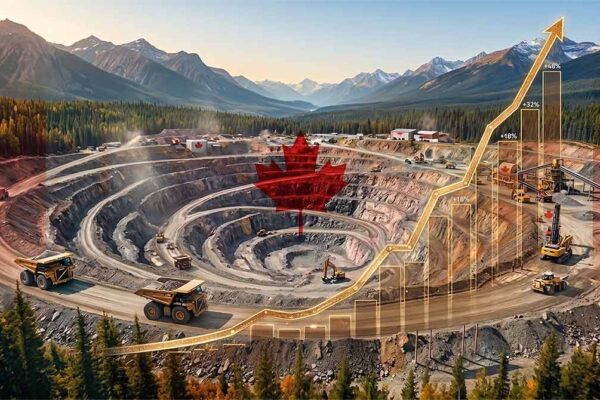
As of April 2026, the commodities market remains unusually supportive for both gold and copper. Gold has held near historic highs — trading around $4,800 per troy ounce in early April after finishing 2025 comfortably above $4,000 — while copper briefly exceeded $14,500 per tonne intraday in January 2026. For investors, that combination matters: precious metals remain supported by macro uncertainty and official-sector buying, while base metals are being repriced by electrification, grid build-out, and the rise of AI infrastructure. (Kitco)
Gold Prices Remain Elevated
Gold’s strength is no longer just a short-term fear trade. World Gold Council data show central banks bought a net 863 tonnes in 2025, including 230 tonnes in Q4 alone, while January 2026 ETF inflows added 120 tonnes and pushed global holdings to a record US$669 billion. The WGC expects 2026 to remain supported by geopolitical tensions, ETF demand and elevated central-bank buying, while a February Reuters poll put the median 2026 average gold forecast at $4,746.50 per ounce. (World Gold Council)
For junior gold companies, that backdrop is materially better than it was a year ago. High bullion prices improve project economics, and listed junior miners have started to participate more meaningfully: VanEck’s GDXJ showed YTD returns of 15.40% as of April 14, 2026. Strategic interest has also strengthened. S&P Global says 2025 gold deal value reached $21.2 billion, the highest since 2010, with development assets in stable jurisdictions remaining attractive to buyers seeking future production. Bloomberg-reported January M&A, including Zijin’s agreement to acquire Allied Gold for C$5.5 billion, reinforces the message that quality ounces in the ground are once again commanding scarcity value. (VanEck)
That does not mean every junior gold name will rerate automatically. Investors are still selective, and the market is rewarding credible development timelines, disciplined capital allocation and jurisdictional quality more than pure exploration narratives. In other words, a rising gold price is helping, but execution still matters more than excitement.
Copper Demand Broadens Beyond Electric Vehicles
Copper’s story in 2026 is stronger — and more complex — than the EV-led narrative of last year. The IEA says copper’s surge to record highs has been driven by mine disruptions, U.S. tariff uncertainty, and structural demand from electrification and AI. Global electricity demand is forecast to rise by 3.6% annually from 2026 through 2030, with U.S. demand growing by nearly 2% a year and about half of that increase tied to data-center expansion. EVs remain a key pillar of demand, but S&P Global notes they use roughly 2.9 times as much copper as conventional vehicles, while total copper demand is projected to rise from 28 million metric tons in 2025 to 42 million by 2040. (IEA)
The supply side remains the real investment thesis. The IEA warns that, based on the current project pipeline, copper could face a 30% supply deficit by 2035. That shortfall is being shaped by declining ore grades, higher capital intensity, slower discovery rates and long development timelines — around 17 years from discovery to production. Even downstream processing is under strain: the 2026 annual TC/RC benchmark fell to zero, highlighting just how tight the concentrate market has become. For investors, this is a reminder that copper is not simply cyclical at the moment; it is becoming increasingly strategic.
Opportunities and Challenges for Junior Copper Mining Companies
This is where junior copper companies become especially relevant. S&P Global reports that 2025 copper-focused M&A reached $30.81 billion, and noted that many buyers are being pushed toward earlier-stage assets because most tier-one copper deposits are already in major hands. That helps explain why advanced exploration and development-stage juniors are attracting more attention again. It also aligns with what major producers are telling the market directly: BHP said in its half-year FY26 results that copper accounted for 51% of underlying EBITDA, a milestone that underscores how decisively big miners are pivoting toward the metal. (S&P Global)
Still, the challenges are substantial. Permitting, infrastructure, metallurgy, financing and political risk can all delay or derail otherwise attractive copper stories. Policy momentum is improving in some regions — the U.S. added copper to its final 2025 critical minerals list, and Argentina has moved to ease glacier-related restrictions in an effort to unlock more than $26 billion of copper investment — but these tailwinds do not eliminate legal, environmental or community hurdles. For junior miners, the winners are likely to be the projects that combine scale with realistic development pathways. (U.S. Department of the Interior)
Strategic Considerations for Junior Miners
- Favor financeable assets. In both gold and copper, the market is becoming more discerning, so ounces and tonnes with a plausible path to permits, studies, offtake and construction deserve more attention than story stocks.
- Watch the jurisdiction premium. Policy support for critical minerals is growing, but so is the market’s preference for projects in jurisdictions where regulatory timelines and community engagement are clearer.
- Expect more consolidation. High metal prices and long lead times make acquisitions an attractive shortcut for larger producers trying to replenish pipelines.
- Separate metal-price leverage from execution risk. Strong commodity prices can hide dilution, capex inflation and permitting slippage, so management quality remains a key differentiator.
Conclusion
The gold and copper mining backdrop in April 2026 is more constructive than it was a year ago, but it is also more selective. Gold remains supported by central-bank buying, ETF inflows and macro uncertainty, while copper has evolved from a green-transition theme into a broader electrification and AI infrastructure story with genuine supply constraints. For junior miners, that means real opportunity — but not a free pass. The companies most likely to create value for investors will be those that can turn favorable metal prices into funded, buildable and strategically relevant projects.
Sources:
World Gold Council, IEA, Reuters, S&P Global, Bloomberg, U.S. Department of the Interior, The Wall Street Journal.