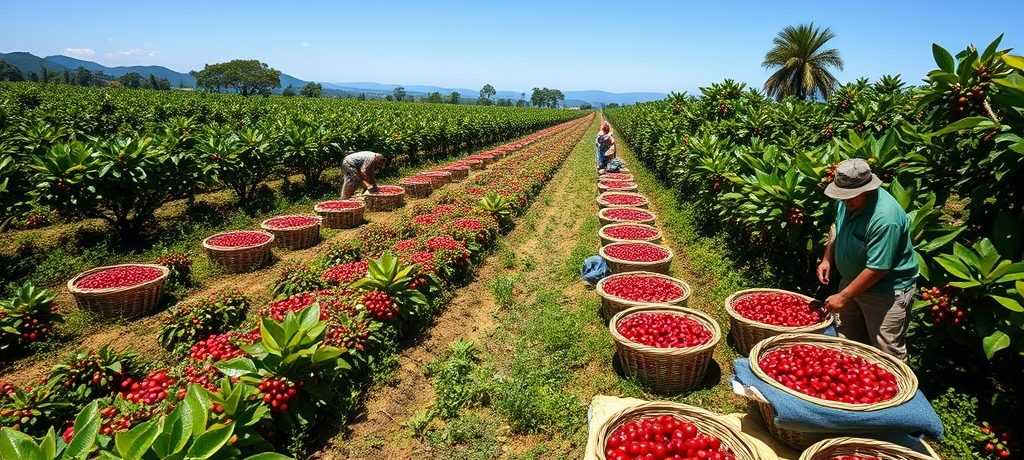
Coffee futures experienced a sharp decline on Friday, with July arabica coffee (KCN26) closing down -8.65 points, a -3.15% drop, and July ICE robusta coffee (RMN26) falling -78 points, or -2.19%. This downturn pushed arabica prices to a one-week low, primarily driven by updated weather forecasts indicating dry conditions in Brazil’s key coffee-growing regions for the upcoming week, enabling the resumption of the harvest that had been delayed by heavy rains.
Brazil’s Harvest Resumes, Market Reacts to Supply Prospects
The immediate catalyst for Friday’s market retreat was the improved weather outlook in Brazil, the world’s largest coffee producer. After a period of heavy rainfall had stalled harvesting activities, the prospect of dry conditions next week signaled an acceleration of bean collection. This development reinforced a broader bearish sentiment that has seen coffee prices, particularly arabica, ratcheting lower over the past month, with arabica futures reaching a 1.5-year nearest-futures low just last Tuesday.
Analysts have been consistently revising up their projections for Brazil’s upcoming coffee crops, contributing significantly to the improved global supply outlook. The Coffee Trading Academy, for instance, projected Brazil’s 2026/27 coffee harvest to increase by 12% year-over-year, reaching 71.4 million bags. Even more bullish, Marex Group Plc forecasted a record 2026/27 Brazilian coffee crop of 75.9 million bags in March, surpassing Sucafina’s estimate of 75.4 million bags, which itself represented a 15.5% year-over-year increase. StoneX also raised its Brazil 2026/27 coffee production estimate to a record 75.3 million bags, up from a November estimate of 70.7 million bags.
Global Surplus Expectations Weigh Heavily
The anticipated surge in Brazilian production is a major factor in the expanding global coffee surplus. StoneX projected that the 2026 global coffee surplus would expand significantly to 10 million bags, a substantial increase from 1.8 million bags in 2025, marking the biggest surplus in six years. This robust supply outlook is a dominant force shaping current market dynamics.
Beyond Brazil, Vietnam, the world’s largest robusta producer, has also contributed to the bearish pressure on robusta prices through soaring exports. According to Vietnam’s National Statistics Office, coffee exports from January to April 2026 rose by 15.8% year-over-year to 810,000 metric tons. This follows a strong performance in 2025, when Vietnam’s coffee exports jumped by 17.5% year-over-year to 1.58 million metric tons. Furthermore, Vietnam’s 2025/26 coffee production is projected to climb 6% year-over-year to a four-year high of 1.76 million metric tons, equivalent to 29.4 million bags.
Mixed Signals from Inventories and Weather Risks
Despite the prevailing bearish sentiment, some factors have offered underlying support to coffee prices, though they have been largely outweighed by the supply outlook. ICE coffee inventories have shown a downward trend over the past two months. ICE arabica coffee inventories fell to a 3.5-month low of 435,430 bags on Friday, while ICE robusta inventories reached a two-year low of 3,631 lots on May 15.
Global weather risks also present a potential bullish counterpoint. Excessive dryness in Vietnam’s Central Highlands, a primary growing region, has raised concerns about the robusta crop, with forecaster Vaisala noting that recent showers have been spotty and more rain is needed. Similarly, concerns about an El Niño weather pattern potentially impacting Brazil’s 2026/27 coffee crop next year are supportive of prices. Coffee trader Commercial indicated that El Niño could delay rains in Brazil this September and October, a critical period for tree flowering. The US National Oceanic and Atmospheric Administration (NOAA) estimates an 82% probability of El Niño conditions emerging between May and July and persisting through the end of the year, with a 67% chance of a “Super El Niño.”
Additionally, smaller exports from Brazil have provided some support. Cecafe reported on May 12 that Brazil’s April green coffee exports fell 1.3% year-over-year to 2.76 million bags. The ongoing closure of the Strait of Hormuz has also disrupted global coffee supplies, increasing shipping rates, insurance, fertilizer, and fuel costs, which typically translates to higher costs for importers and roasters.
Broader Production and Export Landscape
Looking at the broader picture, the USDA’s Foreign Agriculture Service (FAS) bi-annual report in December projected that world coffee production in 2025/26 would increase by 2.0% year-over-year to a record 178.848 million bags. This global increase is expected despite a forecasted 4.7% decrease in arabica production to 95.515 million bags, offset by a substantial 10.9% increase in robusta production to 83.333 million bags. FAS specifically forecasted that Brazil’s 2025/26 coffee production would decline by 3.1% year-over-year to 63 million bags, while Vietnam’s 2025/26 coffee output would rise by 6.2% year-over-year to a four-year high of 30.8 million bags. FAS also projected that 2025/26 ending stocks would fall by 5.4% to 20.148 million bags from 21.307 million bags in 2024/25. In contrast, the International Coffee Organization (ICO) reported in November that global coffee exports for the current marketing year (October-September) fell 0.3% year-over-year to 138.658 million bags.
Ultimately, the immediate impact of Brazil’s harvest resumption, coupled with robust projections for future crops and strong exports from Vietnam, has created a powerful bearish momentum in the coffee market, overshadowing concerns about current inventory levels and potential future weather disruptions.