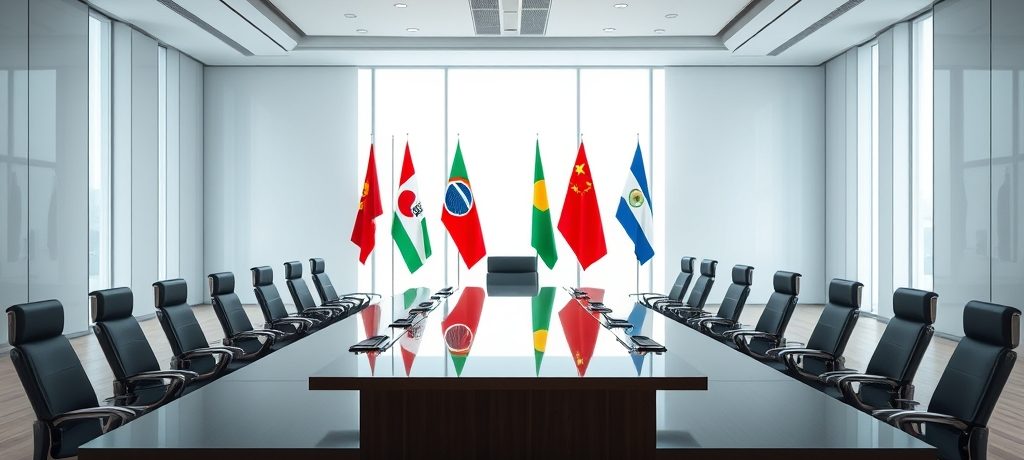
NEW DELHI – A two-day meeting of BRICS foreign ministers concluded in New Delhi on Friday, May 15, 2026, without the customary joint statement, underscoring significant internal divisions within the expanding economic bloc. Host nation India confirmed the failure to reach a consensus, citing “differing views among some members” regarding the ongoing situation in the Middle East.
The absence of a unified declaration highlights the inherent challenge for BRICS – comprising Brazil, Russia, India, China, South Africa, Ethiopia, Egypt, Iran, the United Arab Emirates, and Indonesia – as it endeavors to amplify its global influence. India’s official statement indicated that members articulated “their respective national positions and shared a range of perspectives” on critical issues, including sovereignty, maritime security, and the protection of civilian infrastructure and lives in the Middle East.
Further details from the host’s statement revealed a specific point of contention: a footnote explicitly noted that “a member had reservations” concerning parts of sections dealing with Gaza and security dynamics in the Red Sea and Bab al-Mandeb Strait. This explicit mention points to deep-seated geopolitical disagreements among the member states, particularly concerning sensitive regional conflicts and vital shipping lanes.
Divisions within the bloc have become particularly pronounced during what the source refers to as the “Iran war,” with visible rifts emerging between Iran and the UAE. During the New Delhi proceedings, Iranian Foreign Minister Abbas Araghchi reportedly urged BRICS nations to unequivocally condemn the U.S. and Israel for what he characterized as their “unlawful aggression.” Araghchi also called upon member states to actively resist what he termed the “politicization of international institutions,” reflecting a broader geopolitical stance that clashes with the positions of other members.
The inability to present a united front on a major global conflict such as the Middle East poses a considerable hurdle for BRICS. As the bloc seeks to integrate new members and project a cohesive voice on the world stage, these internal divergences threaten to dilute its collective power and strategic objectives. The failure to issue a joint statement on an issue of such global magnitude could impact the bloc’s credibility and its aspirations to reshape the world order, potentially affecting its economic and political leverage in future international dialogues and trade negotiations.
This outcome underscores the complex geopolitical landscape that BRICS navigates. While the bloc aims to foster economic cooperation and present an alternative to Western-dominated institutions, its internal heterogeneity, particularly on sensitive security matters, remains a significant impediment to achieving full strategic alignment and consolidated global influence.