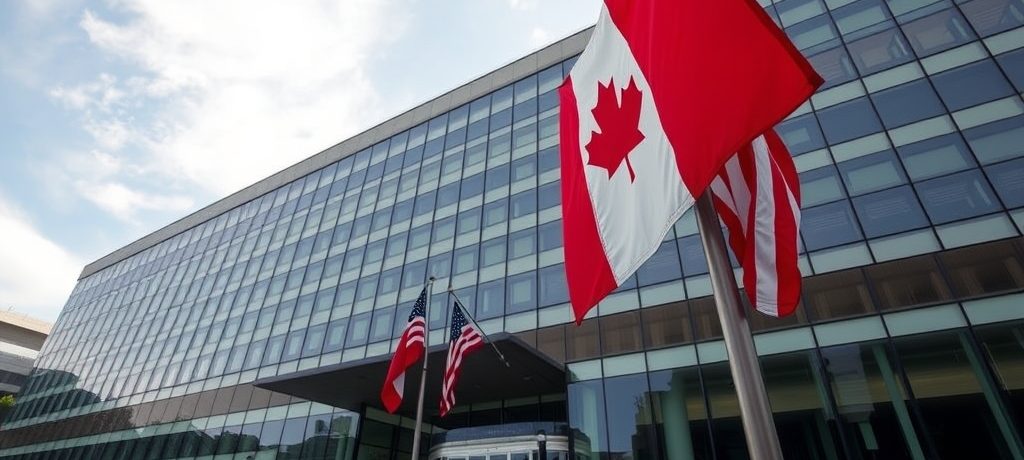
Canada has formally urged the United States and Mexico to extend the crucial North American free trade agreement for an additional 16 years, a move that comes amidst renewed provocations from U.S. President Donald Trump regarding the prospect of Canada becoming the 51st American state. This dual pressure highlights the complex and often contentious economic and political ties binding the three nations.
Trade Renewal Efforts Intensify
Dominic LeBlanc, Canada’s minister for U.S. trade, dispatched a letter on Tuesday to U.S. Trade Representative Jamieson Greer and Mexico’s Economy Secretary Marcelo Ebrard, formally recommending the 16-year renewal of the United States-Mexico-Canada Agreement (USMCA). LeBlanc underscored the pact’s significance, stating, ‘The Agreement is highly beneficial to each of our countries and to the integrated North American economy.’
Mexico has echoed Canada’s call, with Economy Secretary Ebrard confirming on Tuesday that Mexico also seeks a 16-year extension. These communications precede the USMCA’s scheduled July review, where the parties must decide between ongoing annual reviews or a comprehensive 16-year renewal. Should no consensus be reached for the longer extension, the agreement is set to remain in place for 10 more years, subject to annual reviews.
LeBlanc, who met with Greer in Washington on Tuesday alongside Canada’s Chief Trade Negotiator Janice Charette, also presented a series of proposals addressing long-standing U.S. concerns. He has previously indicated his belief that the U.S. might prefer annual reviews, suggesting the Trump administration could seek to cause uncertainty about the trade pact’s permanence.
Sovereignty Under Scrutiny
The push for trade stability is unfolding against a backdrop of heightened political tension, largely fueled by President Trump’s persistent rhetoric about Canada’s potential annexation. On Monday, Trump posted ’51st State!’ on social media, linking to a news article detailing Canada’s slide into a technical recession. This post was subsequently amplified by U.S. Ambassador to Canada, Pete Hoekstra.
The suggestion has consistently drawn sharp rebukes from Canadian officials. Ontario Premier Doug Ford issued a pointed response on Tuesday, declaring, ‘I can’t believe I have to say this again, but Canada will never be the 51st state. Canada is not for sale.’
Canadian Prime Minister Mark Carney, when questioned about Ambassador Hoekstra’s conduct, maintained a pragmatic stance. ‘It’s an administration that we have to work with. It’s our biggest trading relationship. It’s our biggest security relationship … we take the administration as it is,’ Carney stated, adding that his government would not ‘respond to, react to, everything that he posts.’ Carney earlier acknowledged some weakness in the country’s economy as he walked into a Cabinet meeting on Tuesday.
Economic Interdependencies and Frictions
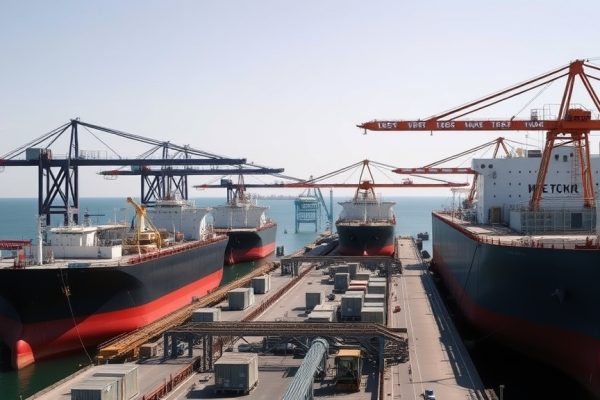
The USMCA, the latest iteration of a North American free trade pact that has intertwined the economies of the United States, Mexico, and Canada since the early 1990s, has largely shielded Canada and Mexico from many of Trump’s protectionist measures. However, the integrated North American economy continues to face challenges from specific tariffs, such as those on aluminum, which are causing damage.
Prime Minister Carney noted that the U.S. currently has approximately 30 different trade irritants with Canada, a figure significantly lower than the nearly 60 irritants it holds with Mexico. The potential for the U.S. to withdraw from the agreement with just six months’ notice adds a layer of uncertainty. The ’51st state’ rhetoric has also had tangible effects, with reports indicating a significant number of Canadians are canceling trips to the U.S.
Political Commentary from the South
The U.S. political sphere has also weighed in on the strained relationship. Illinois Governor JB Pritzker, a prominent Democratic presidential prospect, criticized President Trump for attempting to ‘destroy the relationship with America’s northern neighbor with chaotic tariffs and mindless cruelty.’ Pritzker made these comments during a Tuesday zoom call with Democrats Abroad, highlighting the bipartisan concern over the stability of North American economic and political alliances.
As the July review of the USMCA approaches, Canada finds itself navigating a delicate balance: advocating for long-term trade stability crucial for its economy while simultaneously fending off challenges to its national sovereignty. The interplay between economic necessity and political identity underscores the enduring complexities of the North American partnership, demanding careful diplomacy amidst a volatile geopolitical landscape.