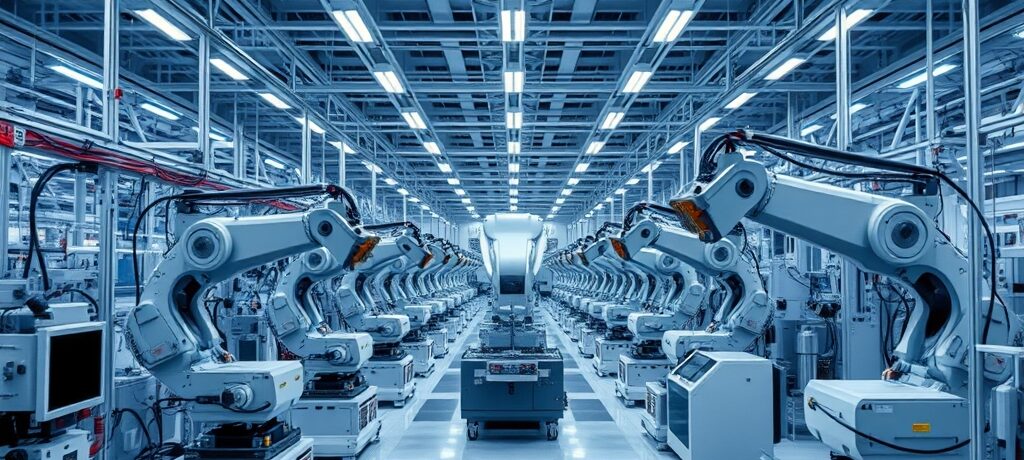
Four years after the United States imposed stringent export curbs on advanced semiconductors, China’s drive for chip self-sufficiency has significantly altered the global technology landscape. The restrictions, aimed at limiting Beijing’s military and financial technological advancements, have instead catalyzed a massive investment in China’s domestic semiconductor ecosystem. While still trailing at the absolute cutting edge, China’s development of capable, cost-effective “good-enough” chips is rapidly becoming a foundational element for a substantial portion of the global economy.
Beijing’s Strategic Pivot to Domestic Production
The “Made in China 2025” plan, which outlined ambitious goals for domestic semiconductor production, gained significant momentum following the US curbs. The Chinese government has since channeled hundreds of billions of dollars into nurturing local chip manufacturers. This strategic push includes substantial subsidies, tax breaks, and other financial incentives designed to foster domestic alternatives to global leaders like NVIDIA, known for its cutting-edge AI chips, and TSMC, Taiwan’s dominant contract chipmaker for advanced semiconductors.
Evidence of this acceleration is visible in the financial performance of key Chinese players. SMIC, a cornerstone of China’s self-reliance strategy, reported record revenues of $9.3 billion (€7.8 billion) last year. HuaHong, the mainland’s second-largest chip foundry, has been operating at an impressive 106% capacity, driven by robust demand, according to its fourth-quarter 2025 earnings report.
Progress and Persistent Gaps
Despite these advancements, experts caution against overstating China’s current capabilities. Ryu Yongwook, an assistant professor at the National University of Singapore’s Lee Kuan Yew School of Public Policy, notes that while Beijing aims for self-sufficiency, the country “is nowhere near it.” Ryu, an expert in US-China tech rivalry, points out that China lags behind the US in research, design, and innovation, and trails Taiwan and South Korea in production capacity.
However, China has achieved notable breakthroughs. The Rhodium Group, a think tank focusing on China, indicates that the country has captured approximately 30% of the global market for legacy chips. These are the essential, albeit not the most advanced, semiconductors that power vehicles, industrial equipment, and consumer electronics. Chinese firms’ ability to produce these chips at scale is raising concerns among global competitors.
“Chinese production expansion will drive down [chip] prices globally and put pressure on non-Chinese vendors,” predicted John Lee, director of research consultancy East-West Futures. He highlights that this trend is already evident in sectors like silicon carbide wafers, a critical material for high-power chips.
Advancements in More Sophisticated Chips
China has also made strides in more advanced chip technology. The successful production of 7-nanometer-class processors, now powering Huawei’s latest smartphones, represents a significant achievement. These chips are comparable to those TSMC produced in 2018 for Western clients. Nevertheless, they still fall short of current 3-nanometer and 5-nanometer chips in terms of speed, power efficiency, and production cost.
Tim Rühlig, senior analyst for Global China at the European Union Institute for Security Studies, described China’s ambitions in cutting-edge chips as encountering a “brick wall” due to technological limitations and US sanctions. “There is only so much that you can do without access to the US’s most advanced chipset,” Rühlig stated, suggesting China might require “a decade or so” to bridge the gap.
Reflecting a potential shift in strategy, China’s latest Five-Year Plan de-emphasizes outright chip dominance. Instead, it highlights artificial intelligence (AI) and outlines a “model-chip-cloud-application” framework, positioning advanced chips as one component within a broader computing ecosystem.
China’s ‘Plan B’: Practical AI and Global Reach
China’s alternative strategy focuses on developing practical, task-oriented AI for industrial applications that demand less computing power, a niche where domestic chips can perform effectively. While these chips and AI systems may not be at the absolute forefront of technological capability, they offer strong performance at a significantly lower cost. This value proposition is driving rapid adoption across the Global South, where governments and companies are increasingly opting for Chinese solutions over Western alternatives.
Market intelligence firm Trendforce reported that Chinese AI platforms, including DeepSeek and Alibaba’s Qwen, had secured roughly 15% of the global AI model market by late 2025. This development poses a long-term challenge to the global dominance of US tech giants like Microsoft and Google, which are projected to invest a record $700 billion this year in AI infrastructure, according to Goldman Sachs.
US Lead Faces New Challenges
The path for Silicon Valley’s AI ambitions is not without its own obstacles. ICIS, a global market intelligence provider, warned in January that US data centers, reliant on high-end chips for AI, could face limitations due to a strained power grid. In contrast, China’s rapidly expanding power sector offers a distinct advantage. With an estimated 400 gigawatts of spare capacity projected by 2030, China is well-positioned to deploy data centers at scale, even if its chips are less efficient.
“Cheap energy is a very important factor, not necessarily for chips but for AI and other advanced technologies,” said Ryu Yongwook. “Cheap energy in China goes some way to make up for its relative chip inefficiency.”
ICIS outlines three potential scenarios for the future of the chip race: the US maintains its lead by addressing its power grid issues; the US continues to lead AI research with advanced chips while China’s AI systems gain traction in the Global South; or escalating geopolitical tensions could lead to the emergence of two distinct AI ecosystems. Regardless of the ultimate outcome, the chip industry is heading towards a future where Chinese competitors are not only underpricing rivals but also rapidly narrowing the gap in product sophistication and reliability, as concluded by John Lee.