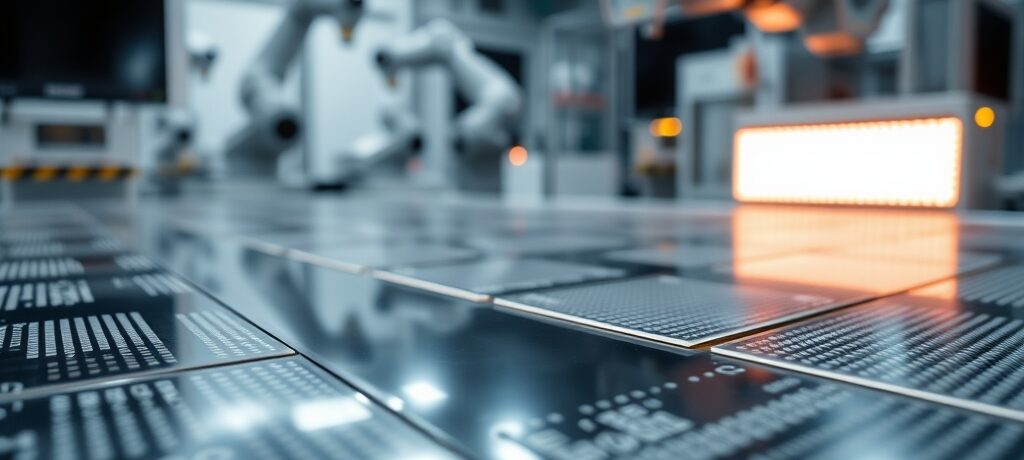
Four years after the United States tightened export curbs on advanced semiconductors, China’s determined push for chip self-reliance is reshaping the global market, driving down prices and challenging established players. These restrictions, aimed at limiting Beijing’s ability to develop technologies crucial for AI, data centers, and national defense, have spurred China to pour hundreds of billions of dollars into building its domestic semiconductor production capabilities, a goal outlined years earlier in its Made in China 2025 plan.
nn
Beijing has strategically deployed massive subsidies, tax breaks, and other cost-saving measures to cultivate local counterparts to global leaders like NVIDIA and Taiwan’s TSMC. This investment is yielding tangible results, with SMIC, a cornerstone of China’s self-reliance strategy, reporting record revenues of $9.3 billion (€7.8 billion) last year. HuaHong, the mainland’s second-largest chip foundry, has also demonstrated robust growth, operating at 106% capacity due to high demand, according to its 2025 fourth-quarter earnings report.
nn
Legacy Chips: China’s Market Dominance and Price Pressure
nn
While some experts, like Ryu Yongwook, an assistant professor at the National University of Singapore’s Lee Kuan Yew School of Public Policy, caution against exaggerating China’s overall chip self-sufficiency, the country has made significant inroads in specific market segments. Ryu, an expert in US-China tech rivalry, told DW that “Beijing wants to achieve chip self-sufficiency, but the current level is nowhere near it,” noting that China lags the US in research, design, and innovation, and is behind Taiwan and South Korea in production.
nn
Nevertheless, China has achieved meaningful breakthroughs in recent years, particularly in legacy chips. According to the Rhodium Group, a think tank focused on China, the country has captured approximately 30% of the global market share for these “workhorses of the modern economy.” These semiconductors, while not the fastest or most advanced, are indispensable for vehicles, industrial equipment, and consumer electronics. Chinese firms are now producing them on a massive scale, raising concerns among global competitors.
nn
John Lee, the Berlin-based director of research consultancy East-West Futures, predicted that “Chinese production expansion will drive down [chip] prices globally and put pressure on non-Chinese vendors.” He added that this trend “is already happening in some sectors, such as silicon carbide wafers,” a critical material for high-power chips.
nn
Advanced Chips: Progress Amid “Brick Wall” Limits
nn
China has also demonstrated progress in more advanced chip manufacturing. The country has successfully produced 7-nanometer-class processors that power Huawei’s latest smartphones. These chips are comparable to those released by TSMC in 2018 for Western customers, marking a significant domestic achievement. However, they still lag behind the current cutting-edge 3-nanometer and 5-nanometer chips in terms of speed, power efficiency, and production cost.
nn
Tim Rühlig, senior analyst for Global China at the European Union Institute for Security Studies, described China’s advanced chip ambitions as facing a “brick wall” of technological limits and US sanctions. Rühlig told DW that “there is only so much that you can do without access to the US’s most advanced chipset,” estimating that China may require “a decade or so” to truly catch up in this high-end segment.
nn
A Strategic Shift Towards “Good-Enough” AI
nn
Reflecting these technological realities, Beijing’s priorities appear to be shifting. The Communist Party’s new Five-Year Plan, a 141-page document, now emphasizes AI more than 50 times, outlining a “model-chip-cloud-application” framework that positions advanced chips as one component within a broader computing ecosystem. This indicates a strategic pivot towards practical, task-oriented AI for industry, which typically requires less computing power—a demand that domestic chips can readily meet.
nn
China’s chips and AI systems, while not always at the absolute cutting edge, offer strong performance at significantly lower costs. This cost-effectiveness is driving rapid adoption across the Global South, where governments and companies are increasingly opting for Chinese solutions over Western alternatives. Taipei-based market intelligence firm Trendforce recently noted that Chinese AI platforms, including DeepSeek and Alibaba’s Qwen, had captured approximately 15% of the global AI model market by late 2025. This poses a long-term competitive threat to the global dominance of US tech giants like Microsoft and Google, which are projected to spend a record $700 billion this year on AI infrastructure, according to investment bank Goldman Sachs.
nn
Energy Advantage Fuels China’s Data Center Expansion
nn
Beyond chip technology, China holds another significant advantage: a rapidly expanding power sector. Global market intelligence provider ICIS warned in January that US data centers, which rely heavily on high-end chips to power AI, could soon face limitations due to the country’s strained power grid. In contrast, ICIS projects China to have an estimated 400 gigawatts of spare capacity by 2030, enabling it to roll out data centers at scale, even if its chips are less efficient than their US counterparts.
nn
“Cheap energy is a very important factor, not necessarily for chips but for AI and other advanced technologies,” stated Ryu Yongwook. He added that “cheap energy in China goes some way to make up for its relative chip inefficiency,” providing a crucial compensatory factor in the broader technological race.
nn
ICIS outlines three potential outcomes in the evolving chip race: the US maintains its lead by resolving power grid issues, the US continues to lead AI research with advanced chips while China’s AI systems proliferate in the Global South, or, in the event of escalating trade and geopolitical tensions, two distinct AI ecosystems emerge. Regardless of the ultimate trajectory, the chip industry faces a future where “Chinese competitors are both underpricing them and rapidly closing the gap in sophistication and reliability of products,” concluded John Lee, signaling an intensifying competitive landscape for global players.