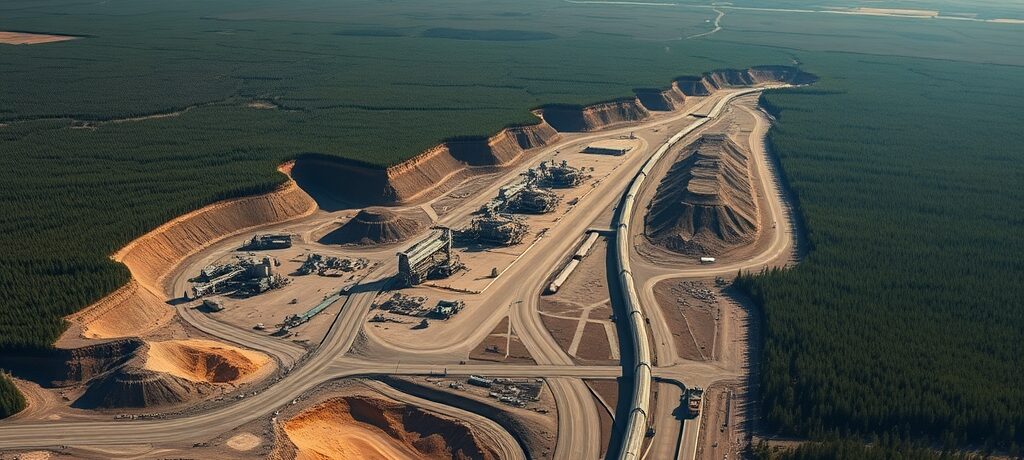
Calgary, AB — Canadian Natural Resources Ltd. (CNRL) president Scott Stauth has emphatically stated that a new oil pipeline to the West Coast, alongside more competitive investment policies, is indispensable for Canada to achieve another significant phase of oilsands growth. Speaking during the company’s first-quarter earnings call on Thursday, Stauth underscored the substantial, untapped potential within the oilsands sector.
“There’s significant upside for volume development in the oilsands,” Stauth remarked, articulating a clear vision for the industry’s future. He added, “We need a regulatory framework and a fiscal framework that will allow us to grow those volumes, and for a decade or so in Canada, we have not had the environment, regulatory-wise, to be able to do so.” This sentiment reflects a broader industry frustration with the current policy landscape.
Regulatory Hurdles and Policy Standoffs
Stauth’s comments align with a growing chorus of industry executives who, during the current earnings season, have urged Ottawa to alleviate regulatory burdens. These calls specifically target planned increases to the industrial carbon tax, which industry leaders argue deter capital investment in the sector. The ongoing debate unfolds at a critical juncture in negotiations between the federal government and Alberta over a comprehensive deal aimed at boosting energy production, potentially including federal backing for a new bitumen pipeline to the West Coast.
A primary sticking point in these negotiations is the pace at which industrial carbon pricing should escalate to a minimum effective credit price of $130 per tonne. Ottawa views this policy as fundamental to achieving Canada’s emissions-reduction targets, while the industry contends it stifles growth and competitiveness. Concurrently, the industry is advocating for Ottawa to refocus on the previous government’s ambition to position Canada as an “energy superpower” and double non-U.S. exports over the next decade. Economists and industry advocates suggest this ambitious target necessitates a significant increase in pipeline capacity.
While acknowledging the utility of expansions to Enbridge’s Mainline system and the Trans Mountain pipeline, as well as the potential revival of Keystone XL, Stauth emphasized the critical need for new infrastructure. He specifically called for a new one-million-barrel-a-day pipeline to the West Coast, deeming it “very important” for long-term growth. This demand is not new for CNRL, which has previously announced a delay in its major $8.25-billion expansion of the Jackpine oilsands mine, pending greater clarity on federal regulations. Stauth reiterated, “We need that pipeline to be able to grow oilsands in a significant way.”
Market Dynamics and CNRL’s Performance
The oilpatch’s push for policy changes comes as producers have experienced a boost in their first-quarter earnings, primarily driven by higher energy prices exacerbated by geopolitical tensions in the Middle East. CNRL reported an adjusted profit of $2.4 billion in the first three months of the year, a figure that remained roughly flat compared to the same period a year earlier.
A notable highlight from CNRL’s report was the strong performance of its upgraded bitumen, known as synthetic crude oil (SCO). The company pointed out that SCO is currently selling for US$5.70 more per barrel than the U.S. Benchmark West Texas Intermediate (WTI). This premium is particularly significant given that synthetic crude typically trades at a discount to WTI. Refiners are actively seeking SCO, considering it an ideal feedstock for the production of jet fuel and diesel. Based on current forward pricing, CNRL projects that SCO could continue to trade above WTI for the remainder of 2026.
Stauth attributed this market dynamic to global demand, stating, “With everything that’s going on worldwide, there’s simply just a greater demand out there for that light crude to create that diesel production.” In the first quarter, CNRL’s production averaged 1,643,000 barrels of oil equivalent per day, marking a four percent increase from the previous year. Despite robust market demand and strong operational performance, the company’s leadership remains steadfast that sustained, significant growth hinges on a supportive policy environment and crucial infrastructure development.