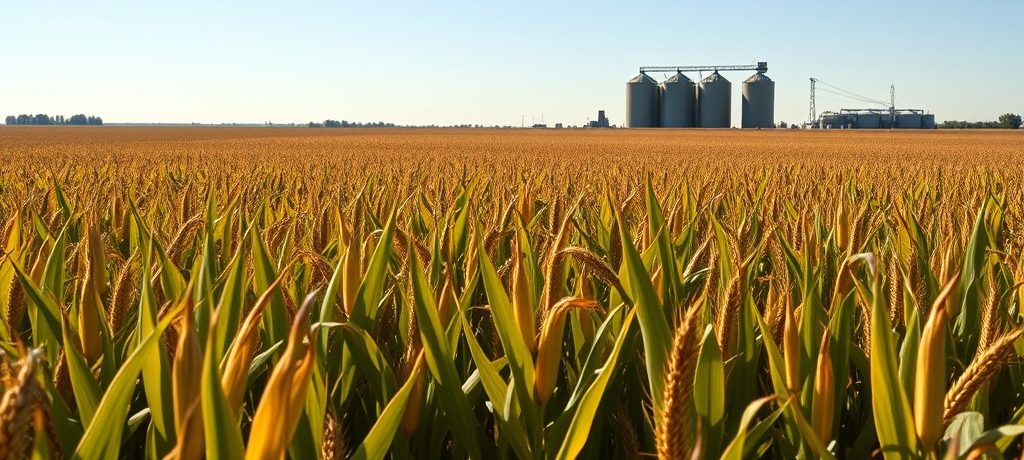
Corn futures extended their recent pattern of weakness at the Wednesday close, with most contracts registering declines ranging from a penny to 5 ¾ cents. This persistent downward pressure was particularly acute in the front months of the futures curve, which bore the brunt of the day’s losses. The market’s performance on August 05, 2026, as detailed by Austin Schroeder for Barchart, signals a continued bearish sentiment among traders and investors.
Mirroring the futures market, the CmdtyView national average Cash Corn price also saw a notable reduction, falling by 5 ½ cents to settle at $4.07. This synchronized movement across both futures and cash markets suggests a broad-based re-evaluation of corn’s immediate value, influenced by a confluence of supply and demand factors.
Export Activity and Anticipated Data Releases
In terms of international demand, the USDA announced a private export sale of 120,000 metric tons (MT) of corn to Mexico. This specific transaction included 30,000 MT earmarked for the 2026/27 marketing year and a larger volume of 90,000 MT designated for the 2027/28 period. While such sales are a positive indicator of ongoing global trade, this particular announcement did not provide enough impetus to reverse the day’s prevailing downward trend in futures prices.
The market’s attention is now firmly fixed on the forthcoming Export Sales data from the USDA, which is slated for release on Thursday. This report is highly anticipated by traders, who are currently forecasting old crop corn sales for the week ending July 30 to range between 200,000 and 600,000 MT. For the upcoming 2026/27 marketing year, new crop sales are expected to be significantly higher, with projections falling between 0.7 and 1.2 million metric tons (MMT). These figures will be instrumental in providing a clearer picture of global demand strength and could serve as a significant catalyst for price movements in the immediate term.
Ethanol Sector Dynamics: Production, Stocks, and Exports
The latest weekly data from the Energy Information Administration (EIA), covering the week of July 31, offered insights into the ethanol industry, a critical component of corn demand. Total ethanol production reached 1.107 million barrels per day (bpd), representing a decrease of 26,000 bpd from the previous week. This dip in production could be interpreted as a response to prevailing market conditions or a temporary adjustment in operational schedules.
Despite the slight reduction in output, ethanol stocks experienced a draw of 202,000 barrels, bringing the total inventory down to 24.524 million barrels. This simultaneous decrease in both production and stocks suggests that the overall demand for ethanol, or its movement out of storage, remained robust. Further supporting this, ethanol exports showed a notable increase, climbing by 63,000 bpd to reach 200,000 bpd during the same week. Refiner stocks also saw a modest reduction, decreasing by 3,000 bpd to 936,000 bpd. These mixed signals from the ethanol sector—lower production but higher exports and declining stocks—indicate a complex interplay of factors influencing corn usage for fuel.
Midwest Weather Outlook: Potential for Relief
Looking at the agricultural landscape, the NOAA 7-day Quantitative Precipitation Forecast (QPF) offers a potentially positive development for crop conditions. The forecast predicts substantial rainfall across a significant portion of the Midwest over the coming week. Regions including Iowa, Missouri, Illinois, Indiana, Wisconsin, Michigan, and Ohio are expected to receive precipitation totals ranging from nearly 1 inch to as much as 4 inches in some localized areas. Such widespread and ample rainfall could prove beneficial for corn crops currently in critical development stages, potentially alleviating any existing moisture stress and supporting yield prospects. While beneficial for long-term supply, the immediate market reaction to this weather outlook remains to be seen, as traders often weigh current supply against future potential.
Detailed Futures and Cash Price Movements
A granular examination of specific contract performances at the Wednesday close underscores the broad nature of the market’s decline:
- The Sep 26 Corn contract concluded the day at $4.36 ¾, marking a decrease of 5 ½ cents.
- Nearby Cash prices were recorded at $4.07 1/1, also down 5 ½ cents.
- The Dec 26 Corn contract settled at $4.60, reflecting a 5 ½-cent reduction.
- Mar 27 Corn closed at $4.75 ¾, experiencing the largest single contract drop of 5 ¾ cents.
- New Crop Cash prices saw a 6-cent decline, ending the day at $4.10 3/8.
The consistent downward movement across various maturities, from immediate cash prices to deferred futures contracts, paints a clear picture of prevailing bearish sentiment. Despite the reported private export sale to Mexico and an uptick in ethanol exports, these positive demand indicators were insufficient to counteract the broader selling pressure. As the market looks forward, the release of Thursday’s USDA Export Sales data and the actualization of the forecasted Midwest rainfall will be key determinants in shaping the next phase of price discovery within the corn complex.